
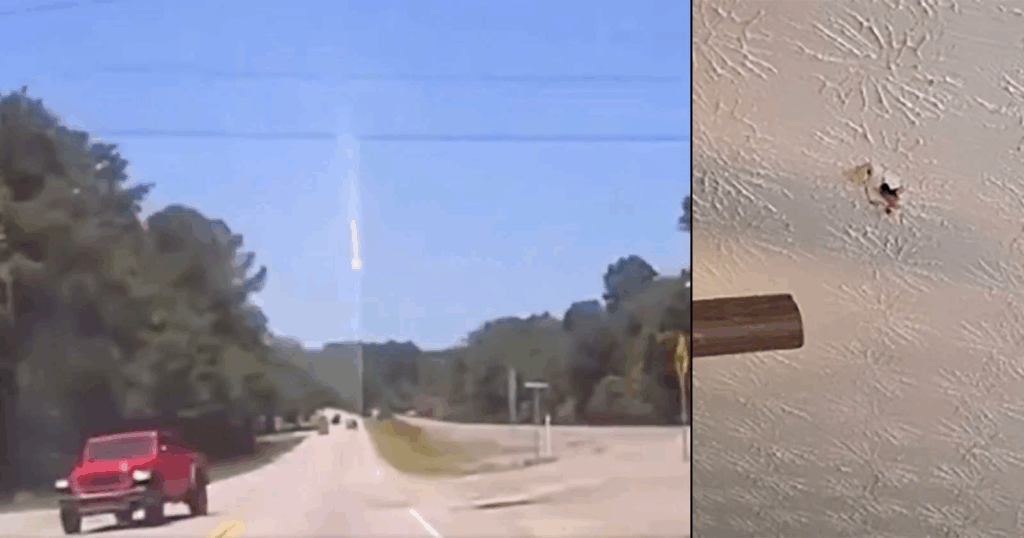
Atlanta, August 9, 2025— A meteorite that crashed through the roof of a home in McDonough, Georgia, has been found to be older than our planet, according to scientists who examined the rare space rock.
University of Georgia planetary geologist Scott Harris determined that the meteorite is around 4.56 billion years old — roughly 20 million years older than Earth itself.
“This meteor has a long and fascinating history before it ever reached the ground in McDonough,” said Harris, a researcher in UGA’s Franklin College of Arts and Sciences. “To fully understand it, we have to analyze what the rock is made of and figure out which group of asteroids it came from.”
From Deep Space to a Georgia Roof
The meteorite, weighing only about 50 grams in total, was part of a fragment the size of a cherry tomato. It pierced a local man’s roof “like a bullet,” left a dent in his floor, and even pulverized part of the impact area into dust. Harris personally studied 23 grams of the recovered fragments.
He identified the rock as a chondrite, a common but scientifically valuable type of stony meteorite that formed during the early solar system. Chondrites are rich in carbon, water, and clay materials — the building blocks of planets and life.
An Ancient Origin
Harris explained that the meteorite belongs to a group of asteroids in the main belt between Mars and Jupiter, linked to the breakup of a much larger asteroid roughly 470 million years ago. Some debris from that event entered Earth-crossing orbits, eventually intersecting with our planet’s path.
“If given enough time, their orbit around the Sun and Earth’s orbit will line up in exactly the same place, at the same moment in time,” Harris said.
Naming the McDonough Meteorite
The University of Georgia, working with Arizona State University, plans to submit the find to the Nomenclature Committee of the Meteoritical Society. The proposed name: the McDonough Meteorite, after the city where it landed.
According to UGA, this is only the 27th meteorite ever recovered in Georgia and just the sixth that was actually witnessed falling.
A Growing Trend in Meteorite Recoveries
“This is something that used to happen once every few decades,” Harris noted. “Now, with modern technology and an observant public, we’re able to recover more and more meteorites.”
Meteorites have long intrigued scientists studying the formation of the solar system. Earth itself formed around 4.54 billion years ago and was bombarded during its early years by meteorites, comets, and other cosmic debris.
A Meteoric Summer
The McDonough fall came just weeks after reports of a daytime fireball over the southeastern U.S., confirmed by NASA during the Bootids meteor shower in late June. Around the same time, the Henry County resident whose home was struck reported hearing three simultaneous sounds: the impact on the roof, a brief sonic boom, and the strike on the floor.
“There was enough energy when it hit that it pulverized part of the material into literal dust,” Harris said.