
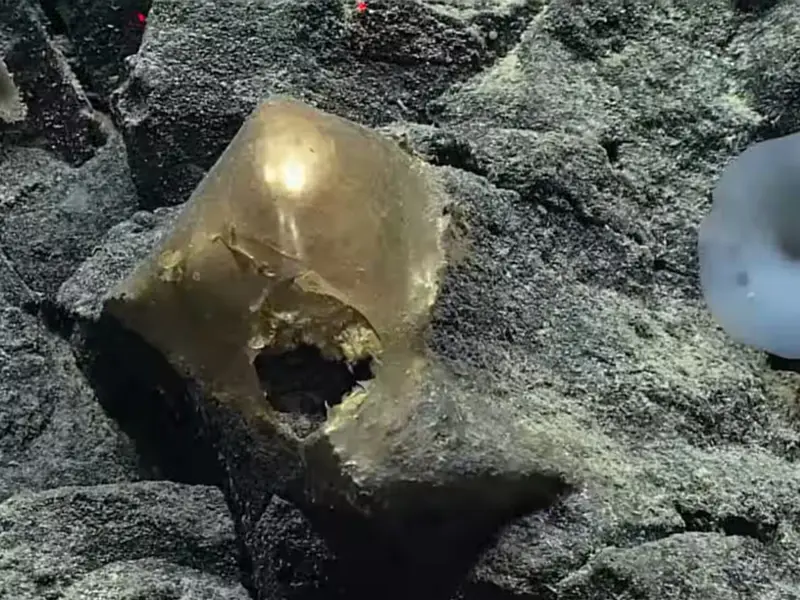
In 2023, a strange golden object discovered deep beneath the waters of the Gulf of Alaska captured global attention. Dubbed a “golden egg” because of its smooth, rounded shape and metallic sheen, the object puzzled scientists and sparked widespread speculation.
Now, after years of analysis, researchers say they’ve finally identified it, and the answer is far more unusual than anyone expected.
What Was the “Golden Egg” Found in the Gulf of Alaska?
The object was discovered by a remotely operated vehicle named Deep Discoverer, deployed by the National Oceanic and Atmospheric Administration (NOAA).
Key characteristics of the object
- Roughly 4 inches wide
- Smooth, golden exterior
- Attached to a rock on the seafloor
- Featured a small hole, revealing its inner structure
At the time, scientists were unsure whether it was
- An egg case
- A previously unknown species
- Or something entirely new
The unusual appearance—and the fact that it didn’t match known marine organisms—made it an instant deep-sea mystery.
Why Did It Take So Long to Identify?
Initial tests didn’t provide clear answers.
Early analysis hit a wall
Scientists conducted the following:
- Physical examinations
- Standard DNA sequencing
- Comparative analysis with known species
But none of these methods produced a match.
As Dr. Allen Collins, a zoologist involved in the research, noted, routine processes were expected to solve the mystery—but they didn’t.
Why was it so difficult
- The sample had contaminated DNA from surrounding microorganisms
- Its structure didn’t clearly resemble known species
- It required specialised expertise across multiple disciplines
Ultimately, researchers had to combine the following:
- Morphological analysis
- Advanced genetics
- Deep-sea biology
- Bioinformatics
What Did Scientists Discover About the Golden Orb?
The breakthrough came when scientists took a closer look at the object’s microscopic structure.
Key findings
- The orb had a fibrous, layered surface
- It contained stinging cells, similar to those in corals and anemones
- These cells were identified as spirocysts, found only in a specific group of marine invertebrates
This narrowed the possibilities significantly.
So, What Is It Really?
The object turned out to be part of a deep-sea organism known as Relicanthus daphneae.
What that means
- It’s not an egg
- It’s a detached structure from a giant, rare sea anemone
- The golden “orb” likely belonged to the lower portion of the organism
Using whole-genome sequencing, scientists confirmed that the DNA was “genetically almost identical” to known samples of this species.
The Bigger Mystery: Where Did the Rest of the Animal Go?
Even with the identification, one question remains unanswered.
What scientists don’t know
- Why was the structure separated from the organism
- What happened to the upper half of the anemone
Possible explanations include the following:
- The animal died and decomposed
- It detached and moved elsewhere
- Environmental factors caused fragmentation
NOAA researchers acknowledge that the full story may never be known.
Why This Discovery Matters
At first glance, identifying a deep-sea organism might seem niche. But discoveries like this play a bigger role in science.
Expanding our understanding of deep-sea life
The deep ocean remains one of the least explored environments on Earth. Each finding helps scientists:
- Map biodiversity in extreme environments
- Understand how life adapts to high pressure and low light
- Identify entirely new biological structures
The role of technology
This discovery highlights how modern tools are changing ocean research:
- Remotely operated vehicles like Deep Discoverer enable exploration at extreme depths
- Whole-genome sequencing helps identify organisms that don’t match existing databases
Why Initial DNA Tests Failed
One of the most interesting aspects of this case is how traditional methods fell short.
The problem with contamination
The orb had picked up DNA from:
- Bacteria
- Microorganisms
- Other marine life
This “noise” made it difficult to isolate the organism’s true genetic signature.
The solution: whole-genome sequencing
Instead of targeting specific DNA fragments, scientists analyzed the entire genetic material.
This allowed them to:
- Filter out contamination
- Identify consistent genetic patterns
- Match it to a known species
What Makes Relicanthus daphneae Unique?
The species at the center of this mystery is itself unusual.
Key traits
- Deep-sea dwelling
- Related to sea anemones but structurally distinct
- Contains specialized stinging cells
Despite being known to science, it’s rarely observed—making this detached structure even more intriguing.
What’s Next for Deep-Sea Exploration?
Scientists believe this won’t be the last mystery of its kind.
Future discoveries will depend on:
- Improved imaging technology
- More advanced genetic analysis
- Continued deep-sea expeditions
As NOAA researchers noted, advancements in technology will continue to reveal organisms and phenomena that challenge current understanding.
TL;DR
- A mysterious “golden egg” found in 2023 puzzled scientists
- Initial tests failed to identify it
- Advanced analysis revealed it’s part of a deep-sea anemone
- The organism is Relicanthus daphneae
- The rest of the animal is still missing
- The discovery highlights how little we know about the deep ocean