

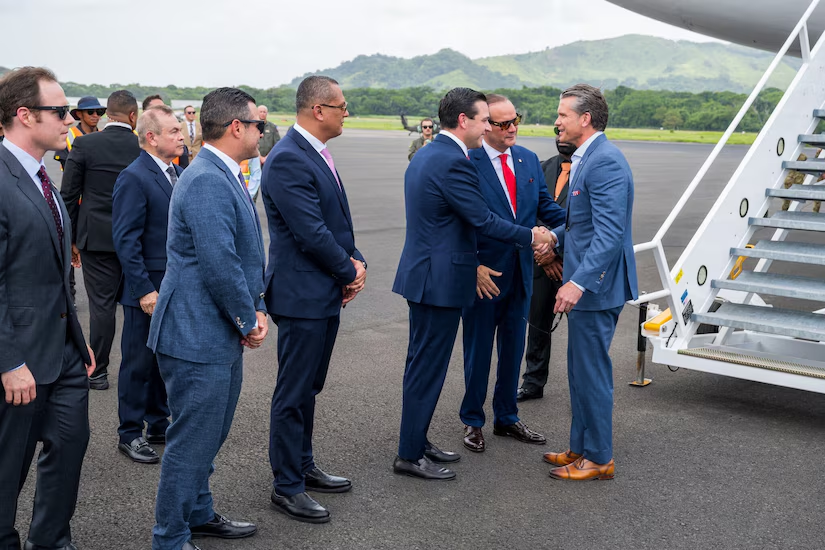
US Secretary of War Pete Hegseth visited Panama’s Jungle Operations Training Center on Thursday as Washington expands a multinational campaign targeting transnational drug cartels across the Western Hemisphere.
The visit came after a two-day meeting involving 19 countries that are part of the Americas Counter Cartel Coalition, also known as the “Shield of the Americas.” The coalition is intended to coordinate efforts against criminal networks involved in drug trafficking and other forms of organised crime.
Hegseth used the jungle training facility to highlight the readiness of US and partner forces operating in difficult environments.
“No environment is too harsh, no terrain too tough,” Hegseth said during the visit, praising what he described as “lethal joint and partner forces”.
The Panama trip comes as the Trump administration increasingly treats transnational cartels as a national-security issue, putting greater emphasis on military cooperation and regional security alongside traditional law-enforcement efforts.
What is the Americas Counter Cartel Coalition?
The Americas Counter Cartel Coalition was launched by President Donald Trump in March as a US-led effort to bring countries across the Western Hemisphere together against transnational criminal organisations.
The coalition, referred to as the A3C and the “Shield of the Americas”, is focused on strengthening cooperation against drug-trafficking networks while also addressing issues involving illegal migration and foreign influence in the region.
The latest meeting in Panama was aimed at moving the coalition from broad political commitments toward specific operational plans.
According to Marine Corps Gen. Francis L. Donovan, commander of US Southern Command, participating countries agreed to:
- Refine priority campaign plans targeting criminal networks
- Assign lead nations for particular regions and missions
- Establish specialized working groups
- Set measurable objectives and milestones
- Develop a formal A3C campaign plan by November
The approach reflects an effort to divide responsibilities among countries rather than having the United States carry the entire burden.
Why did Hegseth visit the Panama jungle training center?
The Jungle Operations Training Center provides a practical setting for forces preparing to operate in tropical environments.
Jungle operations can present challenges that differ significantly from conventional military environments. Dense vegetation, extreme humidity, difficult terrain, limited visibility, and restricted mobility can complicate everything from movement and communication to logistics and medical evacuation.
That makes specialised training particularly important for forces expected to operate in Central and South American terrain.
During his visit, Hegseth met with US service members and observed training activities connected to Panamax exercises. His remarks emphasized the ability of American and partner forces to function in demanding conditions.
The visit did not, however, amount to an announcement of a new military operation being launched from the training centre.
Instead, it provided an operational backdrop to the broader diplomatic and security discussions taking place among coalition members.
How will the 19 countries coordinate against cartels?
The coalition’s strategy appears to rely heavily on assigning different responsibilities to participating nations.
Donovan said countries had already begun volunteering to lead efforts in particular geographic areas and against specific criminal networks. Working groups are expected to develop the details of those campaigns.
That structure could allow countries with specialised intelligence, military, maritime, law-enforcement or border-security capabilities to contribute in different ways.
The goal is to create what Donovan described as “systemic friction” against criminal networks by combining the capabilities of multiple governments.
The coalition’s formal campaign plan is expected to take shape by November.
What did Hegseth say about the cartel campaign?
Hegseth delivered some of his strongest rhetoric during the Panama meeting, warning criminal organisations that Washington and its partners intend to take a more aggressive approach.
“When we say we will dismantle the cartels, we mean it,” he told coalition members, while acknowledging that achieving that objective could require countries to take difficult and risky steps.
He also introduced a blunt new motto for the coalition: “We do bad things to bad people.”
Hegseth said the phrase was meant to capture the administration’s approach toward criminal organisations that Washington accuses of causing extensive harm across the region.
The language underscores a broader shift in how the Trump administration describes the cartel problem. Rather than treating drug trafficking exclusively as a law-enforcement challenge, officials increasingly portray major trafficking organisations as threats to national and regional security.
Why Panama matters to the US strategy
Panama occupies an important position in the Western Hemisphere because of its geographic location and the Panama Canal, a critical international shipping route.
For Washington, closer cooperation with Panama also fits into a broader effort to strengthen security partnerships in the region.
During the trip, Hegseth met with Panamanian President José Raúl Mulino. His discussions in Panama came as the United States seeks deeper coordination with regional governments on security, organized crime and migration.
The emphasis on regional partnerships is also significant because cartels operate across national borders. A criminal network can move money, drugs, weapons and people through several jurisdictions, making unilateral action more difficult.
A multinational framework therefore gives participating governments a mechanism to share responsibilities and coordinate their responses.
What happens next?
The immediate challenge for the coalition will be turning its political commitments into measurable operations.
The countries involved now have to determine which networks and regions should receive priority, which nation should lead individual efforts and what resources each government will contribute.
The planned November campaign document will be an important test of whether the coalition can move beyond statements and create a functioning multinational structure.
For the United States, the strategy also represents a significant expansion of regional security cooperation. Rather than relying exclusively on American forces, Washington is seeking to build a network in which local partners take greater responsibility for operations in their own areas.
Hegseth’s jungle training visit highlighted that philosophy: military readiness is being paired with multinational planning.
The broader campaign remains in its early stages, however. The creation of a coalition does not by itself guarantee that countries will agree on targets, tactics, legal authorities or the level of military involvement required.
The next few months will determine whether the “Shield of the Americas” becomes a durable security partnership or remains primarily a political framework.
Why the jungle training matters
The Panama visit offered a glimpse into one of the less visible elements of the anti-cartel campaign: the physical demands placed on personnel who may eventually operate in the region.
Cartel operations can take place in remote areas where conventional military infrastructure is limited. Forces working in such environments may need to navigate dense jungle, maintain communications and operate for extended periods under difficult weather conditions.
Training in those circumstances is designed to ensure that troops are prepared before they encounter those conditions during real-world missions.
That is why Hegseth’s message about operating in “no environment” being too harsh fits into the coalition’s wider strategy. Washington is not only seeking political alignment among its partners but also attempting to build practical capabilities that can be deployed across challenging terrain.
The coalition’s success will ultimately depend on what happens after the speeches and training exercises: whether 19 governments can coordinate intelligence, resources, law enforcement and military capabilities into a sustained campaign against criminal networks.




