
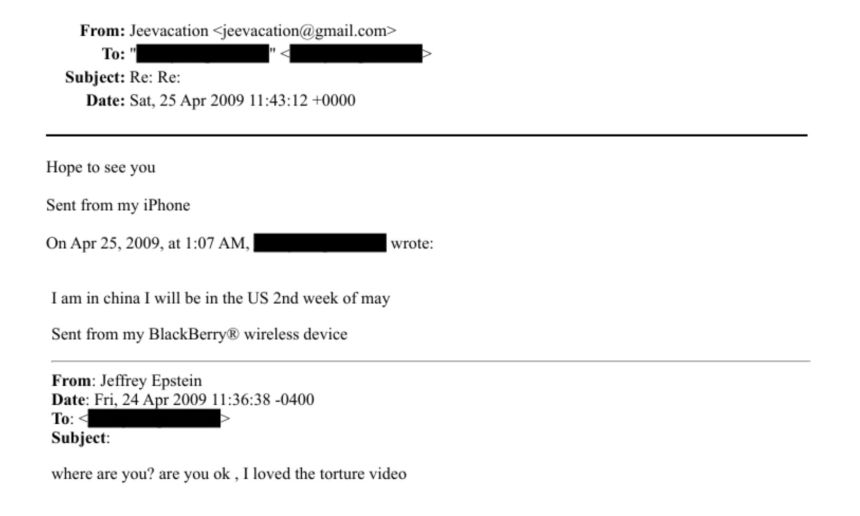
A new release from the long-running Epstein files saga has reignited attention around one of the case’s most disturbing fragments: a 2009 email mentioning a “torture video.” Lawmakers reviewing unredacted records say they have now identified the previously hidden recipient. The revelation adds names to public discussion but does not, by itself, establish criminal wrongdoing.
Below is a clear breakdown of what was disclosed, what remains unknown, and why these documents keep surfacing years after Jeffrey Epstein’s death.
What was revealed in the latest Epstein files disclosure?
Members of the U.S. Congress, including Rep. Ro Khanna and Rep. Thomas Massie, reviewed previously redacted Justice Department materials connected to Jeffrey Epstein. They argued some redactions did not meet congressional disclosure standards and pushed for public identification.
One of the most widely discussed documents is a 2009 email written by Epstein containing the line:
“where are you? are you ok I loved the torture video”
Officials say the recipient named in a related file is Emirati businessman Sultan bin Sulayem. The message itself does not explain what video is being referenced.
Important context
- The email alone does not prove a crime occurred
- The meaning of “torture video” remains unknown
- No charges were announced alongside the disclosure
Because Epstein’s communications often mixed personal, social, and business contacts, investigators historically distinguished between association and participation.
Which additional names were made public?
Lawmakers said several previously hidden names appeared in the unredacted records. Among those listed in the newly discussed batch:
- Salvatore Nuara
- Zurab Mikeladze
- Leonic Leonov
- Nicola Caputo
- Sultan Ahmed bin Sulayem
- Leslie Wexner
Earlier investigative material had also referenced figures such as Lesley Groff and Jean-Luc Brunel in connection with Epstein’s network. Their appearances in documents do not necessarily indicate criminal liability.
Why names appear in investigative files
People may be listed because they:
- had contact information recorded
- communicated with Epstein
- conducted business dealings
- were witnesses or associates
Legal responsibility depends on evidence, not presence in records.
Why the “torture video” email is causing an intense reaction
The phrase itself is shocking and easily detached from context. That combination fuels viral attention.
Three reasons the message resonates
- Ambiguity
The document does not describe the video, leaving interpretation open. - Epstein’s notoriety
His crimes color perceptions of every communication. - Public distrust after earlier secrecy
Redactions create suspicion, even when legally required.
This dynamic often turns incomplete information into speculation online.
Has any investigation been reopened?
No public announcement indicates a new criminal investigation tied to this specific email disclosure.
Authorities previously investigated Epstein and associates across multiple jurisdictions. After his 2019 death, prosecutors continued some related cases, but document releases mainly serve transparency and civil litigation rather than new prosecution.
To reopen a criminal matter, investigators generally need:
- new physical evidence
- corroborated witness testimony
- or proof of previously unknown criminal acts
A single unexplained email typically does not meet that threshold.
Why are documents still being released years later
The Epstein archive is unusually large. It spans:
- criminal cases
- civil lawsuits
- victim compensation proceedings
- congressional reviews
Each process has different disclosure rules. As appeals conclude and privacy protections expire, more material becomes public.
What drives periodic revelations
- court-ordered unsealing
- congressional oversight reviews
- media litigation for transparency
- victim lawsuits
This staggered process explains why “new” information often consists of old records becoming public rather than fresh investigative discoveries.
The difference between allegation, association, and guilt
High-profile cases frequently blur these categories.
| Term | Meaning |
|---|---|
| Mentioned in files | contact or reference exists |
| Alleged involvement | accusation made |
| Charged | prosecutors filed criminal case |
| Convicted | guilt proven in court |
Much public confusion arises when the first category is interpreted as the last.
What remains unanswered
Despite renewed attention, major gaps persist:
- What video did the email reference?
- Whether it is related to illegal activity
- Whether investigators previously examined it
- Why the message existed at all
Until corroborating evidence appears, the disclosure functions mainly as contextual information, not a legal conclusion.
TL;DR
- Lawmakers reviewing unredacted Epstein records identified the recipient of a disturbing 2009 email
- The message references a “torture video” but offers no explanation
- Additional names were disclosed from investigative files
- No new criminal case has been announced
- Being named in documents does not equal wrongdoing
Final perspective
The Epstein case sits at the intersection of crime, power, and secrecy. Every new document release revives public scrutiny because unanswered questions linger. But transparency and proof operate at different speeds.
The latest disclosure expands the map of who appeared in Epstein’s orbit. It does not yet redraw the legal conclusions.