
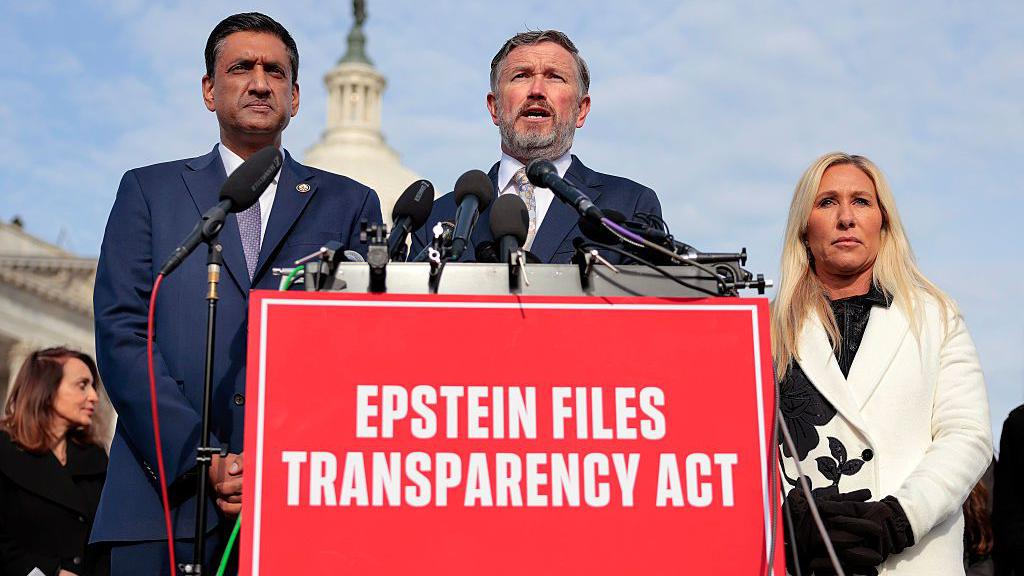
The long-running controversy surrounding the Jeffrey Epstein case has flared up again, this time on Capitol Hill. Reps. Ro Khanna (D-Calif.) and Thomas Massie (R-Ky.) have publicly revealed the names of six men they say were improperly redacted from the latest release of Epstein-related files, accusing the Department of Justice (DOJ) of shielding powerful individuals in violation of the Epstein Files Transparency Act.
While none of the men named have been charged or formally accused of crimes, the disclosure has reignited bipartisan demands for full transparency and raised uncomfortable questions about how much of the Epstein record remains hidden and why.
What did Ro Khanna and Thomas Massie reveal?
Less than 24 hours after personally visiting the DOJ to review less-redacted Epstein materials, Khanna took to the House floor to disclose six names he described as belonging to “wealthy” and “powerful” men.
The six men named are
- Salvatore Nuara
- Zurab Mikeladze
- Leonic Leonov
- Nicola Caputo
- Sultan Ahmed Bin Sulayem, a prominent Emirati business leader
- Leslie Wexner, billionaire retail magnate and longtime Epstein associate
According to Khanna and Massie, the names appear in Epstein records as potential co-conspirators, a designation that lawmakers emphasized does not equate to guilt or criminal liability.
Still, Khanna argued that the DOJ had no legal basis to withhold the names in the first place.
Why are lawmakers accusing the DOJ of improper redactions?
At the heart of the dispute is the Epstein Files Transparency Act, which was passed to ensure public access to records tied to Epstein’s crimes and the network that enabled them.
Lawmakers’ core allegation:
The DOJ unlawfully redacted names of alleged co-conspirators—something the law does not permit.
Speaking on the House floor, Khanna questioned the scope of the redactions.
“If we found six men that they were hiding in two hours,” he said, “imagine how many men they are covering up for in those three million files.”
Massie went further, suggesting the DOJ applied blanket redactions, including to women’s names, rather than narrowly tailoring redactions as required by law.
The implication is serious: that transparency was achieved only after lawmakers forced the issue through direct intervention.
What do the Epstein files actually contain?
Earlier this year, the DOJ released more than three million pages of documents, images, and videos related to Epstein investigations. The department has said this release fulfills its obligations under the transparency law.
But members of Congress, and many victims’ advocates, disagree.
What remains contested:
- Whether all alleged co-conspirators were properly disclosed
- Whether redactions were applied too broadly
- Whether influential figures received special protection
Who are the named individuals, and what is their legal status?
The six men named by Khanna and Massie span multiple countries and industries, from global shipping to fashion retail.
Key point: no charges
- None of the six men has been charged with crimes related to Epstein
- Lawmakers explicitly stated that appearing in Epstein records does not establish wrongdoing
- Inclusion in the files may reflect contact, travel, or mentions, not criminal conduct
This distinction matters legally, but politically and reputationally, the fallout can still be significant.
Leslie Wexner, in particular, has long been linked to Epstein through financial and personal ties, though he has denied knowledge of Epstein’s criminal activities.
Why does this disclosure matter now?
The Epstein case has always been about more than one man. It’s about systems of power, influence, and impunity—and whether the justice system treats elite networks differently.
Why this moment is pivotal:
- The disclosures are bipartisan, cutting across party lines
- They challenge DOJ assurances that no one is being protected
- They reopened scrutiny of how Epstein operated for decades without accountability
The timing also matters. Public trust in institutions, especially the justice system, is fragile. Perceived secrecy only deepens skepticism.
What has the DOJ said in response?
The DOJ has denied protecting any specific individuals and maintains that its redactions complied with the law. Officials have also rejected claims that politically sensitive names—such as that of former President Donald Trump were shielded.
Trump has denied wrongdoing and has not been charged in connection with Epstein.
Still, DOJ explanations have not quelled congressional pressure.
Could more names be released?
That question now dominates the debate.
Khanna and Massie argue that if six names were uncovered in just hours of review, more may be buried in the remaining files. Other lawmakers are calling for:
- Independent audits of DOJ redactions
- Court-supervised unsealing of records
- Additional congressional hearings
Whether those efforts succeed may depend on sustained public attention—and continued bipartisan alignment.
Why transparency, not prosecution, is the immediate focus
It’s important to note that lawmakers are not claiming the six men committed crimes. Their argument is narrower but still explosive: the public has a right to see the full record.
Transparency serves multiple purposes:
- It allows journalists and researchers to scrutinize patterns
- It gives victims confidence that nothing is being hidden
- It restores credibility to institutions damaged by past secrecy
In the Epstein case, secrecy has long been seen as part of the problem.
TL;DR
- Reps. Ro Khanna and Thomas Massie named six men allegedly redacted from the Epstein files
- They accuse the DOJ of violating the Epstein Files Transparency Act
- None of the men has been charged or formally accused
- The disclosure has renewed calls for full, unredacted transparency
- Congress and the DOJ remain at odds over whether more records must be released