
TL;DR
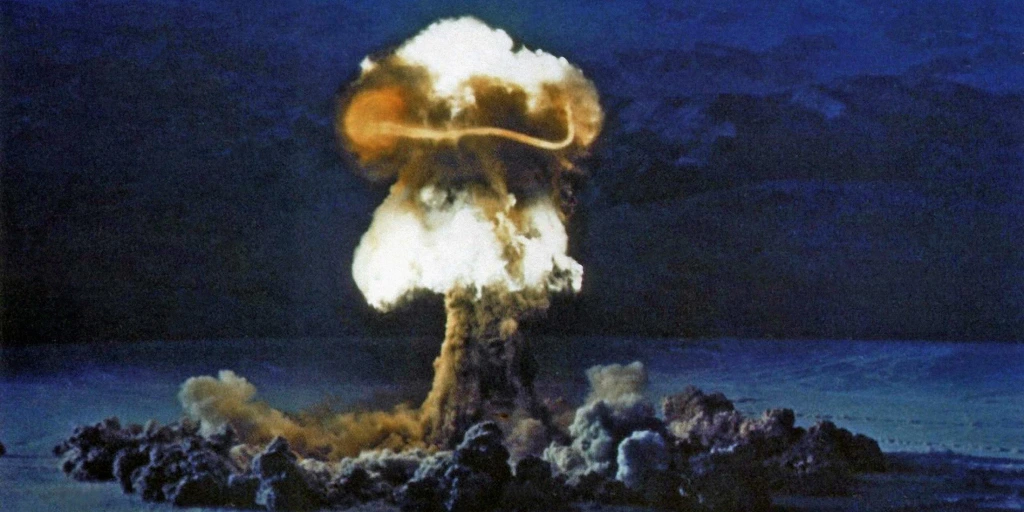
U.S. President Donald Trump has hinted that the country could soon resume nuclear testing, potentially including underground detonations, as part of a renewed arms strategy to counter Russia and China. The move could mark the first U.S. nuclear test in over three decades, raising global security concerns and reigniting debate over the future of nuclear nonproliferation.
What did Donald Trump say about new U.S. nuclear tests?
Speaking aboard Air Force One on Friday, President Donald Trump reiterated his intention to restart nuclear weapons testing, a move that would break with decades of U.S. restraint. When pressed on whether these tests would include traditional underground detonations, Donald Trump offered a characteristically vague but forceful response:
“You’ll find out very soon. But we’re going to do some testing, yeah,” Trump told reporters. “Other countries do it. If they’re going to do it, we’re going to do it.”
Days earlier, Donald Trump announced on social media that he had instructed the Department of War to “start testing our nuclear weapons on an equal basis,” citing Russia and China’s recent advancements in nuclear programs as justification.
He claimed that during his first term, the United States “accomplished a complete update and renovation of existing weapons,” giving the country “more nuclear weapons than any other nation.”
Has the U.S. conducted nuclear tests before?
The United States has not conducted a full-scale underground nuclear test since 1992, when President George H.W. Bush signed a moratorium under the framework that eventually led to the Comprehensive Nuclear-Test-Ban Treaty (CTBT).
While the U.S. signed the CTBT in 1996, it has never ratified it, leaving room for legal ambiguity should Washington decide to resume testing. Previous administrations, including those of George W. Bush, Barack Obama, and Joe Biden, refrained from actual detonations but maintained readiness through subcritical experiments that simulate nuclear reactions without triggering a chain reaction.
If Trump follows through, it would mark the first resumption of nuclear detonations in more than 30 years, an unprecedented reversal in post-Cold War nuclear policy.
Why is Donald Trump pushing for nuclear testing now?
Trump’s comments appear to be motivated by geopolitical competition rather than immediate military necessity.
- Russian advancements: Moscow recently tested two nuclear-powered strategic weapons — the 9M730 Burevestnik cruise missile and the Poseidon underwater drone — both capable of carrying nuclear payloads over long ranges. Russian President Vladimir Putin personally oversaw these tests.
- Chinese expansion: China is reportedly building hundreds of new missile silos in Xinjiang and Gansu provinces, signaling a rapid nuclear buildup that could triple its warhead stockpile by 2035, according to U.S. defense estimates.
- Deterrence signaling: By emphasizing that “other countries do it,” Trump is framing U.S. testing as a necessary response to ensure “equal footing.”
Analysts say this rhetoric reflects a broader strategy of “nuclear parity politics,” where symbolic testing serves as a show of dominance rather than a technical necessity.
What could happen if underground testing resumes?
The potential consequences of renewed U.S. nuclear testing are both political and environmental.
Diplomatic fallout
Resuming tests could:
- Undermine the CTBT, discouraging other signatories from honoring their commitments.
- Trigger retaliatory testing by Russia, China, or even emerging nuclear states like North Korea.
- Strain U.S. alliances, particularly with NATO and non-nuclear allies such as Japan, which have long advocated for global disarmament.
Environmental and health risks
Underground tests can release radiation into surrounding ecosystems if containment fails. Historic testing sites like Nevada have faced decades of contamination and long-term health concerns for nearby populations.
Domestic political impact
Domestically, the decision could reignite debates between national security hawks and arms control advocates. Congressional Democrats are expected to demand oversight, citing the risk of a new nuclear arms race.
How do experts view Donald Trump’s nuclear stance?
Arms control experts are divided.
- Supporters argue that renewed testing would strengthen deterrence, validate modernization efforts, and demonstrate readiness against rival powers.
- Critics, however, warn that even limited testing risks escalating global tensions and undermining decades of nonproliferation efforts.
Hans Kristensen, a senior researcher with the Federation of American Scientists, previously warned that “returning to explosive testing would be a symbolic but dangerous step backward that could normalize nuclear brinkmanship.”
Others note that existing technology allows for computer-based simulations capable of maintaining warhead reliability without physical detonations — making full-scale tests militarily unnecessary.
Could this signal a new nuclear arms race?
Yes, potentially. Trump’s declaration aligns with a broader global shift toward rearmament.
- Russia’s focus on next-generation weapons like Poseidon and Burevestnik represents a technological arms race beyond traditional deterrence.
- China’s expansion of its nuclear arsenal aims to achieve “strategic balance” with Washington and Moscow.
- The U.S. under Trump may now seek to reclaim dominance through public, demonstrative testing, effectively reigniting Cold War-era nuclear competition.
Such developments could unravel years of arms control progress, including the New START Treaty, which expires in 2026. Without diplomatic renewal or replacement, the world’s three largest nuclear powers could operate without any formal restrictions.
Why it matters globally
Resuming U.S. nuclear tests would reverberate far beyond American soil. It would:
- Challenge the global nonproliferation framework.
- Set a precedent for other nations to justify their own tests.
- Reopen debates on nuclear ethics and environmental justice, especially among Pacific Island nations affected by past tests.
In short, what Trump calls a matter of “equal footing” could reshape the world’s nuclear order, from deterrence theory to treaty diplomacy.
Key takeaways
- Trump’s statements suggest the U.S. may soon resume nuclear testing, potentially including underground detonations.
- This would be the first U.S. test since 1992, breaking a three-decade moratorium.
- The decision could spark a new nuclear arms race, strain global alliances, and revive environmental concerns tied to testing sites.
- Experts say the move is more political than practical, intended to project power rather than improve weapons reliability.