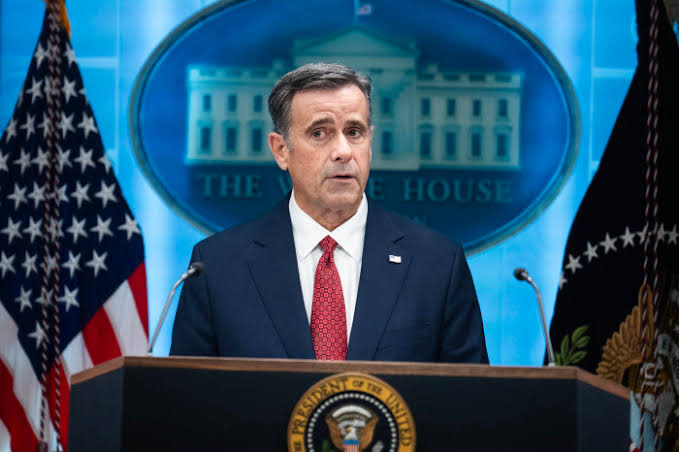
CIA Director John Ratcliffe made an unannounced trip to Moscow on Tuesday, August 25, in the highest-level reported visit to Russia by a Trump administration official since January. The unusual journey, which involved a U.S. Air Force C-17 military transport aircraft, comes as diplomacy over Russia’s war in Ukraine has stalled and tensions between Moscow, Kyiv and Washington remain high.
Neither the White House nor the CIA publicly announced Ratcliffe’s trip or disclosed the purpose of his meetings. U.S. media reports, however, indicate that the CIA chief was in Moscow for discussions with Russian officials. The Kremlin later acknowledged that there had been contacts between the two countries’ security services but provided few details.
The secrecy surrounding the trip is significant. CIA directors rarely travel openly to Moscow, and the last known visit by a sitting CIA chief was in November 2021, when William Burns went to Russia to warn President Vladimir Putin against launching a full-scale invasion of Ukraine.
What happened during John Ratcliffe’s Moscow visit?
CBS News first reported that Ratcliffe was in Moscow, citing people familiar with the situation. Axios subsequently confirmed the trip, citing a U.S. official. Reuters also reported the visit, citing U.S. media reports and unnamed sources.
The trip was not announced in advance, and the U.S. government did not publicly identify Ratcliffe as the passenger aboard the aircraft.
Flight-tracking data provided an important clue. A U.S. Air Force C-17A Globemaster III flew from Joint Base Andrews in Maryland to Riga, Latvia, before continuing to Moscow. The aircraft remained in Moscow for several hours before departing for Riga. The Washington Post reported that the C-17 spent roughly eight and a half hours on the ground in Moscow.
The aircraft was also accompanied by signs of a diplomatic movement. A U.S. diplomatic motorcade was spotted in Moscow, further indicating that a senior American official was in the Russian capital.
Suggested visual: Add a flight-route graphic showing Joint Base Andrews → Riga → Moscow, with the approximate Moscow ground time highlighted.
Why did Ratcliffe travel to Moscow?
The precise purpose of John Ratcliffe’s Moscow visit remains unclear.
The Kremlin has said that the trip involved “contacts between the security services,” according to reporting by The Washington Post. Kremlin spokesman Dmitry Peskov did not provide further details.
Peskov also said that Moscow had no plans to meet with representatives of the U.S. administration that week. That creates an important distinction: the visit appears to have involved intelligence or security channels rather than a publicly announced diplomatic meeting between senior government officials.
Several issues could make intelligence-level communication particularly important at this moment:
- The Russia-Ukraine peace process remains largely stalled.
- Ukraine and Russia have intensified long-range attacks.
- Washington is concerned about possible Russian actions against NATO members.
- The United States and Russia continue to have sensitive intelligence and security issues that require private communication.
- The CIA has previously played a role in negotiations involving detainees and prisoner exchanges.
However, there is no public evidence establishing that Ratcliffe traveled to Moscow to negotiate a Ukraine peace agreement. Any claim about a specific agenda should therefore be treated cautiously until U.S. or Russian officials provide more information.
Did the United States ask Ukraine to pause strikes?
One of the most significant details surrounding the visit is the reported request to Ukraine to temporarily halt certain strikes against Russia.
CBS News reported that the United States told Ukraine a senior delegation would travel to Moscow and asked Kyiv to suspend strikes until the delegation departed. Axios also reported that Washington had asked Ukraine to pause strikes during Ratcliffe’s visit.
The significance of that report lies in the timing.
Ukraine has increasingly used long-range weapons to strike targets deep inside Russian territory, while Russia continues to launch drones and missiles against Ukrainian cities and infrastructure. A temporary reduction in strikes could therefore have been intended to lower the risk of an incident while sensitive U.S.-Russian contacts were taking place.
That does not, by itself, mean that Washington and Moscow had reached a ceasefire agreement.
It may simply reflect the precautions normally associated with a high-level intelligence contact in an active conflict zone.
How does the visit fit into stalled Ukraine diplomacy?
Ratcliffe’s Moscow visit comes at a difficult point in U.S.-led efforts to bring Russia and Ukraine closer to a negotiated settlement.
The Trump administration has sought to push both sides toward negotiations, but major disagreements remain over territory, security guarantees and the terms of any potential ceasefire. Meanwhile, fighting has continued and both Russia and Ukraine have expanded their use of long-range strikes.
That makes an intelligence-level channel potentially useful even when formal diplomacy is struggling.
The CIA has capabilities and relationships that differ from those of the State Department. Intelligence officials can communicate sensitive information privately, assess the intentions of the other side and establish channels that may later support broader negotiations.
This is particularly relevant because U.S.-Russian intelligence contacts have continued despite the deterioration in political relations.
CBS News reported that Ratcliffe has maintained contact with Russian intelligence counterparts and that the CIA was involved in recent U.S.-Russia detainee exchanges. The agency also played a role in the 2024 prisoner exchange that resulted in the release of Wall Street Journal reporter Evan Gershkovich and former U.S. Marine Paul Whelan.
Why is John Ratcliffe’s Moscow visit so unusual?
The most important historical comparison is William Burns’ trip to Moscow in November 2021.
Burns, then CIA director under President Joe Biden, traveled to Russia shortly before the full-scale invasion of Ukraine. During the visit, he met Putin and senior Russian officials and warned them about the consequences of an invasion.
Russia launched its full-scale invasion of Ukraine in February 2022.
The comparison does not mean Ratcliffe’s visit signals an imminent Russian military escalation. The circumstances are different, and there is no public evidence that the two trips have the same purpose.
But the 2021 precedent explains why the current visit has attracted so much attention. A sitting CIA director traveling to Moscow is not routine diplomacy. It generally indicates that Washington believes direct, high-level communication through intelligence channels is important enough to justify the risks and secrecy involved.
Is Ratcliffe expected to meet Vladimir Putin?
There is currently no confirmed indication that Ratcliffe met Putin.
Peskov said there were no planned meetings between the Russian president and the U.S. administration’s representatives during the week. The Kremlin also characterized the visit as involving contacts between security services rather than announcing a presidential meeting.
That makes it important not to conflate Ratcliffe’s presence in Moscow with a Trump-Putin summit.
A meeting between the CIA director and Russian intelligence officials would be significant on its own, even without direct involvement from Putin.
What could Ratcliffe’s visit mean for U.S.-Russia relations?
The immediate message is that Washington and Moscow still maintain channels for sensitive communication despite deep disagreements.
Three developments are particularly important to watch:
- Whether Russia and Ukraine resume meaningful negotiations.
A breakthrough would give context to Ratcliffe’s visit and could indicate that intelligence channels were being used to support wider diplomacy. - Whether further senior U.S. officials travel to Russia.
Another high-level visit could suggest that the Moscow trip was part of a broader diplomatic or security initiative rather than a one-off intelligence contact. - Whether Russia changes its military posture.
Any significant shift in Russian operations against Ukraine or NATO countries could help clarify what Washington was seeking to communicate or assess.
For now, the strongest conclusion is also the simplest: the visit happened, it was unusually secretive, and its precise purpose remains undisclosed.
What we know — and what we do not
Confirmed or strongly reported
- John Ratcliffe traveled to Moscow on August 25.
- U.S. media outlets reported that he was there for meetings.
- A U.S. Air Force C-17 traveled from the United States through Latvia to Moscow.
- A U.S. diplomatic motorcade was observed in Moscow.
- The Kremlin acknowledged contacts between U.S. and Russian security services.
- The visit was Ratcliffe’s first known trip to Russia as CIA director.
- The last known Moscow visit by a sitting CIA director was William Burns’ trip in November 2021.
Still unclear
- Who exactly Ratcliffe met.
- Whether he met Russian intelligence officials, other senior officials, or both.
- Whether Vladimir Putin was involved.
- What specific issues were discussed.
- Whether the visit was directly connected to Ukraine peace negotiations.
- Whether the United States and Russia reached any substantive agreement.
That distinction matters. The unusual flight and the Kremlin’s acknowledgement confirm that something important occurred, but they do not establish the substance of the discussions.
Why the Moscow trip matters now
Ratcliffe’s visit comes at a moment when formal diplomacy appears stuck but Washington and Moscow still have reasons to communicate.
The trip could eventually prove to have been about Ukraine, intelligence cooperation, detainee issues, NATO concerns, Iran, or another classified security matter. At this stage, however, those remain possibilities rather than established facts.
The clearest signal is the decision to use a CIA director and a military transport aircraft for a discreet trip to Moscow.
In an increasingly dangerous relationship between two nuclear-armed powers, the existence of a direct communication channel can matter almost as much as the public diplomacy surrounding it.
For that reason, Ratcliffe’s visit deserves attention even before its agenda becomes public.