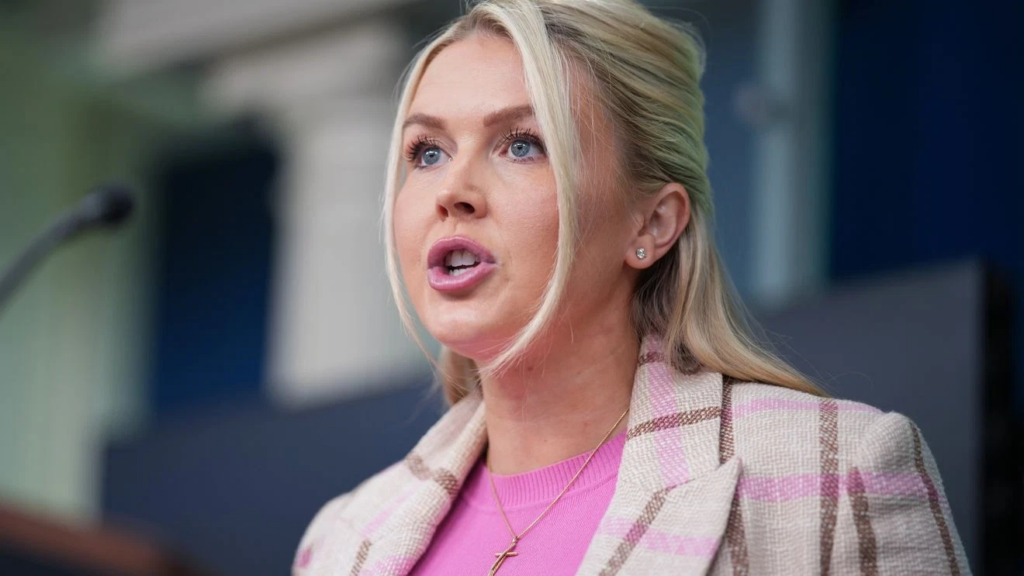
A fresh political flashpoint has emerged over fuel prices, after White House press secretary Karoline Leavitt claimed that gas prices have declined under Donald Trump—a statement critics say runs counter to current economic realities.
The remark, made during a press briefing, has triggered sharp reactions from lawmakers and the public, especially as global oil markets remain volatile.
What did Karoline Leavitt say?
During a recent press conference, Leavitt argued that the administration’s energy policies are helping lower fuel costs.
Her key claim
- Gas prices have decreased over the past year
- The administration’s focus on “energy dominance” is bringing relief at the pump
The statement was framed as evidence of successful economic and energy policy.
Why are critics pushing back?
Criticism stems largely from the timing of the claim, as global fuel prices have been under upward pressure.
The core argument against her claim
Critics say:
- Fuel prices have risen, not fallen, in recent months
- Ongoing geopolitical tensions have disrupted oil supply
- Consumers are experiencing higher prices firsthand
Among those calling out the statement is Shri Thanedar, who described it as misleading and out of touch with everyday reality.
How global events are affecting gas prices
To understand the controversy, it’s important to look beyond domestic policy.
The role of geopolitical tensions
The recent escalation involving Iran has had a direct impact on oil markets:
- Concerns over supply disruptions
- Increased risk premiums in oil pricing
- Market uncertainty is driving volatility
A key factor is the Strait of Hormuz—a critical passage through which a significant portion of the world’s oil supply moves.
Why the Strait of Hormuz matters
- It handles a large share of global crude oil shipments
- Any disruption can immediately affect global prices
- Even the threat of instability can push prices higher
When shipping traffic is restricted or perceived to be at risk, oil prices tend to spike—and that impact flows down to consumers at the pump.
Are gas prices actually rising?
Fuel prices are influenced by multiple factors, not just government policy.
Key drivers of gas prices
- Global crude oil prices
- Refining and distribution costs
- Seasonal demand patterns
- Currency fluctuations
- Geopolitical events
Because oil is traded globally, even domestic policies have limited short-term control over price swings.
Why perceptions differ
There can be a gap between:
- Official averages or long-term trends
- What consumers experience in real time
This gap often fuels political disputes, especially when prices are volatile.
The politics of fuel prices
Gas prices are one of the most visible economic indicators—and one of the most politically sensitive.
Why they matter politically
- Consumers notice changes immediately
- Prices are displayed publicly at every gas station
- They affect transportation, goods, and overall inflation
As a result, statements about fuel costs are closely scrutinized and quickly challenged.
Competing narratives
- Governments often highlight long-term trends or policy goals
- Critics focus on current prices and consumer experience
Both perspectives can be technically defensible depending on the timeframe used—but can still clash in public debate.
Why this controversy is gaining traction
This isn’t just about numbers—it’s about trust.
Key reasons for the backlash
- The claim contradicts recent market trends
- Timing coincides with visible price increases
- Social media amplifies public reaction quickly
In a high-inflation environment, even small discrepancies in messaging can trigger strong responses.
The bigger picture: energy policy vs global reality
The debate underscores a broader truth about energy economics.
What policymakers can and cannot control
Governments can influence:
- Domestic production
- Strategic reserves
- Regulatory frameworks
But they cannot fully control:
- Global oil prices
- International conflicts
- Supply chain disruptions
This tension often leads to political friction when prices rise.
TL;DR
- Karoline Leavitt claimed gas prices have decreased under Donald Trump
- Critics say prices have actually risen, citing global market conditions
- Geopolitical tensions affecting the Strait of Hormuz are pushing oil prices higher
- The controversy reflects a broader clash between political messaging and consumer experience