
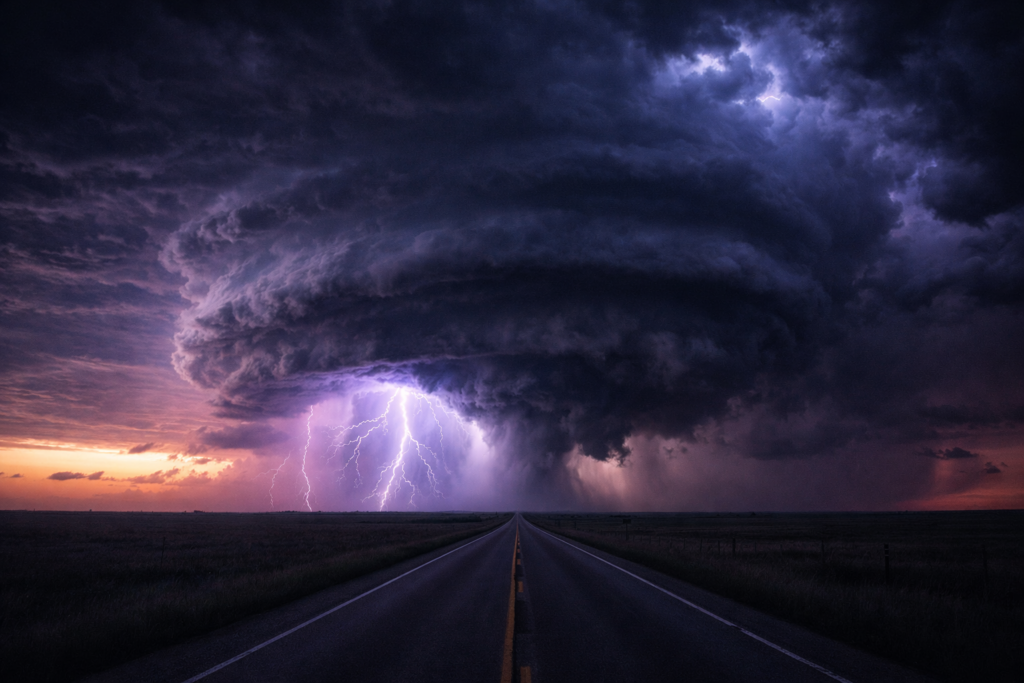
A monster storm system is tearing across the United States right now, combining blizzards, tornadoes, and near-hurricane-force winds into what meteorologists are calling a once-in-a-decade “triple-threat megastorm.” Over 200 million Americans are in its path. But beyond the immediate physical danger, this storm is landing at the worst possible economic moment.
The Core Story: What Is Hitting the U.S. Right Now?
A powerful bomb cyclone, a storm whose central pressure drops at least 24 millibars in 24 hours, is tracking from the Rocky Mountains to the East Coast, as reported by Fox Weather and AccuWeather.
Blizzard conditions are hammering the Upper Midwest, with parts of Wisconsin, Michigan, and Minnesota recording snowfall rates of 2 to 4 inches per hour. Some areas are forecast to receive up to 4 feet of snow.
Severe thunderstorms and tornadoes are threatening the East Coast on Monday, with the Storm Prediction Center issuing a rare Level 4 out of 5 risk for destructive severe weather, including long-track tornadoes, stretching from Virginia to New England, including Washington, D.C.
Wind gusts of 70 to 80 mph are being reported across multiple states. More than 3,000 flights have been canceled nationwide, with major hubs including Atlanta and Charlotte issuing ground stops.
Behind the storm’s cold front, Arctic air is plunging temperatures 12 to 25 degrees below average. Fox Weather reports over 30 new record lows are possible across the South on Tuesday, some records more than 100 years old.
Context & Global Impact: The Hidden Economic Cost
- Supply chain disruptions are immediate. The storm corridor spans major freight rail lines and interstates connecting Midwest manufacturing hubs to East Coast ports. Trucking delays of 24–48 hours are expected across I-80, I-90, and I-95.
- Agriculture takes a direct hit. The freeze arrives during the early spring planting season. Winter wheat crops in Kansas, Oklahoma, and Texas face potential frost damage that could push food prices higher.
- Energy demand is spiking during a supply crunch. Natural gas spot prices have jumped as heating demand surges, layering on top of an energy market already destabilized by $100-per-barrel oil.
- Insured losses could exceed $10 billion. Historical analogs for combined blizzard-tornado events of this scale produced insured losses of $5–15 billion.
- Travel industry losses compound the hit. Over 3,000 flights were canceled, with airlines and hotels absorbing hundreds of millions in lost revenue.
Why This Storm Is Different
What makes this system exceptional is the simultaneous presence of all three threat types, blizzard, tornado, and extreme wind, across such a wide geographic area, combined with the Arctic air mass following immediately behind. The collision of anomalously warm Gulf air with the Arctic intrusion is producing extreme temperature gradients that fuel the most violent severe weather outbreaks.
The Climate Context
Scientists have been connecting “weather whiplash” patterns, sudden swings between warmth and extreme cold, to disruptions in the polar jet stream linked to Arctic warming. The frequency of these high-amplitude jet stream events has increased over the past decade, according to research published in Nature Climate Change.
What’s Next: The Aftermath
The storm system is expected to clear the East Coast by late Tuesday, but Arctic air will linger through Thursday. Power outages could take 3–5 days to fully restore. For an economy already under pressure from war-driven oil shocks and a stalling GDP, this megastorm is one more variable tipping the scales toward a rough first half of 2026.
Frequently Asked Questions
What is a bomb cyclone? A storm whose central pressure drops at least 24 millibars in 24 hours, producing extremely strong winds and intense precipitation.
How many Americans are affected? Over 200 million, spanning the Upper Midwest to the East Coast.
How long will the cold last? Arctic air is expected to keep temperatures below average through Thursday, March 20.