
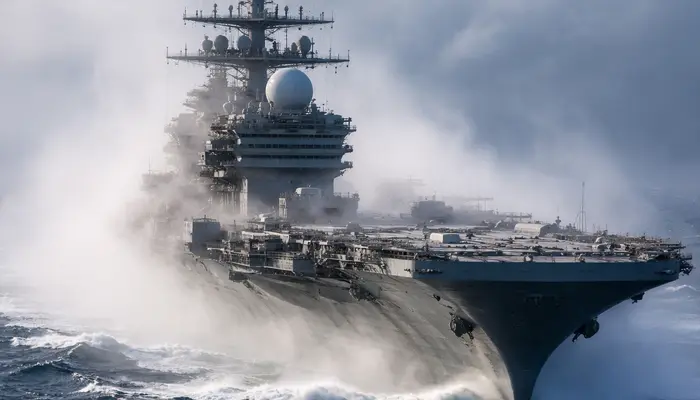
In a moment that sounds almost scripted by chaos itself, a monkey in Thailand briefly collided with high-stakes geopolitics, sidelining a US Navy sailor en route to one of the world’s most volatile flashpoints, the Strait of Hormuz. The strange episode unfolded just as Donald Trump escalated military posture in the region, ordering US forces to take aggressive action against suspected Iranian mine-laying vessels.
The result is a story that blends frontline tension with an unexpected twist, highlighting how even the smallest disruptions can ripple through complex military operations.
What exactly happened in the monkey attack incident?
The incident occurred during a routine stopover in Phuket, where a US Navy sailor assigned to the minesweeper USS Chief encountered a monkey, likely a long-tailed macaque.
The animal scratched the sailor, triggering immediate concern. While the injury itself was not severe, the response was anything but casual.
- The sailor, an electronics technician, was pulled from deployment
- He was evacuated to a US base in Japan for medical evaluation
- The primary concern was exposure to infections such as the rare but dangerous Herpes B virus
Military officials described the episode with dry understatement: “Weird stuff happens… this was definitely an unknown unknown.”
Did the monkey actually derail the US mission?
Not quite, but it did create a temporary disruption.
Despite the sailor’s evacuation:
- The USS Chief continued its deployment
- It operated alongside USS Pioneer
- The broader minesweeping mission proceeded without delay
Officials confirmed there were “no operational impacts” on the mission timeline.
Still, in tightly coordinated military operations, even a single personnel loss can create logistical adjustments behind the scenes.
Why is the Strait of Hormuz mission so critical right now?
The backdrop to this unusual incident is far from trivial. The Strait of Hormuz is one of the most strategically vital chokepoints in the global economy.
Why does the Strait matter so much?
- Roughly 20 percent of the world’s oil supply passes through it during normal conditions
- It connects the Persian Gulf to global shipping lanes
- Any disruption can trigger spikes in global energy prices
In the current conflict involving Iran and US-led forces, the stakes are even higher.
What is happening in the Strait right now?
- Iran has reportedly deployed naval mines in the waterway
- Commercial shipping has been severely disrupted
- Hundreds of vessels are effectively stranded or rerouted
This has turned the mission of US minesweepers into a high-risk, high-importance operation.
What did Trump’s “shoot and kill” order actually mean?
Against this backdrop, President Trump issued a blunt directive: US naval forces are authorized to “shoot and kill” any boats suspected of laying mines in the Strait.
This order reflects:
- A shift toward more aggressive rules of engagement
- An attempt to deter further mining activity
- A signal of escalation in the broader conflict
The directive also underscores the urgency of clearing the Strait, as prolonged disruption could send shockwaves through global markets.
Why are monkey encounters a real risk in places like Phuket?
It may sound like comic relief, but monkey encounters in Thailand are a known hazard.
The reality of macaques in tourist zones
- Long-tailed macaques are common in urban and tourist areas
- They are known to snatch food, bags, and sometimes attack humans
- Encounters can escalate quickly, especially if animals feel threatened
In 2024, thousands of monkeys overran parts of Lopburi, Thailand, highlighting how human-animal interactions can spiral into public safety issues.
Why does the military take such incidents seriously
Even a minor scratch can trigger the following:
- Risk of viral infections like Herpes B
- Mandatory medical evacuation protocols
- Removal from active duty until cleared
For military planners, health risks are treated with the same seriousness as combat injuries.
What does this incident reveal about military operations?
Beyond its unusual nature, the episode offers insight into the unpredictability of real-world operations.
“Unknown unknowns” are part of the job
Military planning accounts for:
- Enemy actions
- Weather conditions
- Equipment failures
But not everything can be anticipated. As this case shows, even wildlife can become an operational variable.
Small disruptions can have cascading effects
While the mission continued, such incidents can:
- Strain personnel availability
- Require last-minute role adjustments
- Add pressure to already complex deployments
It’s a reminder that large-scale operations depend on countless small, human-level factors.
Could incidents like this affect larger geopolitical outcomes?
On their own, no. But collectively, unexpected disruptions can shape the tempo of military operations.
In high-tension environments like the Strait of Hormuz:
- Delays in mine clearance could prolong shipping disruptions
- Extended operations increase costs and risks
- Minor setbacks can accumulate over time
The monkey did not change the mission, but it did briefly intersect with a moment of global consequence.
What should readers take away from this?
This story sits at the crossroads of absurdity and seriousness. On one hand, a monkey scratching a sailor’s side feels almost surreal. On the other hand, it happened within a mission tied to global oil flows and rising geopolitical tension.
It highlights a simple truth: even in an era of advanced military technology and strategic planning, unpredictability remains undefeated.
TL;DR
- A US Navy sailor was scratched by a monkey during a stop in Phuket, Thailand
- He was evacuated for medical care due to infection risks
- The incident did not delay the US minesweeping mission in the Strait of Hormuz
- The mission is part of a broader effort amid rising US-Iran tensions
- Trump has ordered aggressive action against suspected mine-laying vessels
- The episode highlights how unexpected events can intersect with major geopolitical operations