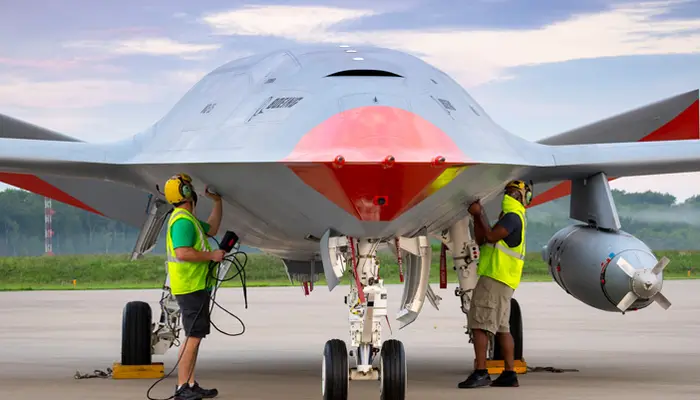
When the MQ-25 Stingray begins routine operations, US aircraft carriers will host something they have never had before: an unmanned aircraft designed to work alongside human pilots, not replace them. Built by Boeing and powered by a Rolls-Royce engine, the MQ-25 is the US Navy’s first carrier-based unmanned aerial vehicle, and its arrival marks a structural change in how carrier air wings operate.
This is not a dramatic, sci-fi leap toward pilotless warfare. It is a quieter, more practical shift, one focused on range, endurance, and sustainability. When flight tests move onto aircraft carriers in early 2026, the Stingray will start reshaping naval aviation in ways that are subtle but profound.
What is the MQ-25 Stingray?
The MQ-25 Stingray is a carrier-capable unmanned aircraft designed primarily for aerial refueling. Unlike armed drones associated with counterterrorism or surveillance missions, the Stingray’s core purpose is logistical. It extends the reach of manned aircraft by delivering fuel where and when it is needed.
Developed by Boeing for the US Navy, the MQ-25 is powered by the Rolls-Royce AE 3007N turbofan engine, a platform already proven on long-endurance unmanned aircraft. The design emphasizes reliability, efficiency, and safe integration with crewed jets on crowded flight decks.
This makes the MQ-25 less a disruptive outsider and more a new crew member, one that never enters the cockpit.
Why did the US Navy need the MQ-25?
For decades, US Navy aircraft carriers have relied on manned fighters to perform aerial refueling duties. F/A-18 Super Hornets, in particular, have routinely been configured as “buddy tankers,” carrying fuel pods instead of weapons.
That approach worked, but it came at a cost.
Using front-line fighters as tankers meant:
- Fewer jets are available for strike and air defense missions
- Increased wear and tear on expensive aircraft
- Shorter effective range for the carrier air wing
As threats evolved and adversaries invested in long-range missiles, the Navy faced a growing challenge. Aircraft carriers needed to project power from farther away, but their aircraft were constrained by fuel limits.
The MQ-25 was designed to solve that problem by taking over the refuelling mission entirely.
By doing so, it frees F/A-18 Super Hornets and F-35C stealth fighters to focus on what they do best: combat operations, electronic warfare, and air defense.
How unmanned refuelling changes carrier operations
At sea, range is power. The farther carrier-based aircraft can fly while still carrying meaningful payloads, the more flexible and survivable a carrier strike group becomes.
The MQ-25 is designed to carry and transfer around 15,000 pounds of fuel at significant distances from the carrier. That capability allows manned aircraft to:
- Launch with heavier weapons loads
- Operate farther from the carrier
- Spend more time on station
Just as importantly, it reduces the operational tempo placed on pilots and aircraft assigned to tanker duties. Over time, that translates into lower maintenance burdens and longer service life for high-value jets.
This is a structural change, not an incremental upgrade.
Can an unmanned aircraft really operate on a carrier?
One of the MQ-25’s most demanding features is its ability to launch and recover autonomously from an aircraft carrier, one of the most complex aviation environments in the world.
Aircraft carriers are moving platforms. They pitch, roll, and heave with the sea. Launch and recovery operations are tightly choreographed, with seconds separating one aircraft from the next.
The MQ-25 is designed to:
- Taxi on deck alongside crewed aircraft
- Launch via catapult without a pilot
- Navigate carrier airspace autonomously
- Recover using arresting gear
While human operators remain in the loop, the aircraft does not rely on real-time piloting during critical phases of flight. That capability represents a major technical milestone for unmanned aviation.
It also sets a precedent. If an unmanned aircraft can safely operate from a carrier, many other missions become possible.
Is the MQ-25 only a tanker?
Refuelling is the Stingray’s primary mission, but it is not necessarily its final one.
The MQ-25 was built with an open systems architecture, meaning its software and hardware can be adapted over time. The Navy has been careful not to oversell future roles, but the potential is clear.
Possible growth paths include:
- Intelligence, surveillance, and reconnaissance missions
- Acting as a communications relay
- Supporting electronic warfare operations
What matters is flexibility. The Navy is investing in a platform that can evolve as operational needs change, rather than locking itself into a single-use design.
Why the Rolls-Royce engine matters
Powering the MQ-25 is the Rolls-Royce AE 3007N turbofan engine, a choice driven by reliability rather than raw thrust.
This engine family is already used on high-endurance unmanned platforms and business jets. Its strengths include:
- Fuel efficiency
- Long maintenance intervals
- Proven performance in unmanned applications
For a tanker aircraft expected to loiter for extended periods, efficiency is critical. The engine supports long on-station times, allowing the MQ-25 to remain available where refuelling demand is highest.
This is another example of the program’s practical design philosophy.
What milestones has the MQ-25 already achieved?
The MQ-25 program has been in development for years and has already crossed several historic milestones.
Since its first flight in 2019, the Stingray has:
- Completed autonomous flight testing
- Conducted deck handling trials
- Performed the first-ever unmanned aerial refuelling of US Navy aircraft
Those refueling tests included successful fuel transfers to manned jets, proving that unmanned and manned aircraft can safely interact in flight.
Production aircraft are now under construction, moving the program from experimentation toward operational reality.
Why was carrier testing delayed to 2026
The US Navy and Boeing recently postponed the first carrier-based flight tests of the MQ-25A until early 2026. While delays often raise concerns, officials have framed this decision as deliberate rather than a reactive response.
Carrier integration is one of the most complex phases of any naval aviation program. The Navy has prioritized:
- Software maturity
- Safety validation
- Integration with existing deck operations
Rather than rushing to meet an arbitrary timeline, the program appears focused on ensuring the aircraft enters service without creating friction on already crowded flight decks.
This cautious approach reflects lessons learned from past acquisition programs.
What the MQ-25 signals about the future of naval aviation
The Stingray is not a dramatic replacement for pilots. It is a sign that the Navy is rethinking how tasks are distributed across its air wing.
Instead of asking expensive, human-crewed fighters to perform support roles, the Navy is assigning those tasks to purpose-built unmanned systems.
That shift suggests a future where:
- Pilots focus on missions requiring judgment and adaptability
- Unmanned aircraft handle endurance-heavy support roles
- Carrier air wings become more efficient and resilient
The MQ-25 is a starting point, not an endpoint.
Why this change matters strategically
As potential adversaries develop longer-range anti-ship weapons, aircraft carriers face pressure to operate farther from contested areas. Extending the reach of carrier aircraft without redesigning the entire fleet is a strategic necessity.
By enabling longer-range operations, the MQ-25 helps preserve the relevance of carriers in high-end conflicts. It does so quietly, without changing the visual identity of naval aviation, but with real operational impact.
This is why the Stingray matters far beyond its size or lack of weapons.
TL;DR
The MQ-25 Stingray is the US Navy’s first carrier-based unmanned aircraft, designed primarily to refuel manned jets at sea. By taking over the tanker role, it extends the range of carrier air wings, reduces strain on fighters, and introduces autonomous operations to the flight deck. When carrier testing begins in early 2026, the MQ-25 will mark a quiet but significant shift in how naval aviation works.