
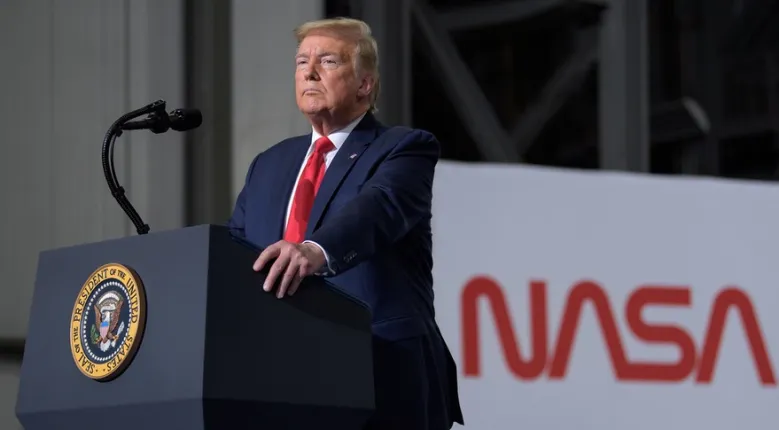
NASA employees are voicing concerns after a new Trump administration order reclassified the space agency under a statute typically reserved for intelligence and national security organizations. The move, issued late last month, raised questions about whether NASA is shifting from spacecraft to spycraft—though the reality appears more bureaucratic than sensational.
What Does the Order Actually Say?
The order places NASA under the Federal Service Labor-Management Relations Statute (FSLMRS), which defines certain federal agencies as primarily engaged in “intelligence, counterintelligence, investigative, or national security work.”
That classification excludes NASA workers from union representation and collective bargaining rights—a major shift for thousands of employees.
NASA Watch founder Keith Cowing, a former scientist at the agency, flagged the change after it initially slipped under the radar. As Futurism and WION report, the new designation is less about altering NASA’s mission and more about labor rights.
Why Are NASA Employees Protesting?
Earlier this week, staff gathered outside NASA headquarters in Washington, DC, to protest the order. Many said stripping their union protections leaves them vulnerable to retaliation.
“A huge part of the reason that I have that independence, and that my colleagues do, is that as a union-represented worker I know that I am protected from unfair retaliation,” Monica Gorman, vice president of the Goddard Engineers, Scientists and Technicians Association, told demonstrators, as quoted by Government Executive.
Several lawsuits have already been filed to block the order, arguing it unfairly undermines employee protections.
Why the “Spy Agency” Label Is Misleading
While the order legally places NASA alongside agencies like the CIA or NSA under FSLMRS, experts stress it doesn’t mean the space agency will pivot to espionage.
Instead:
- Primary implication: Employees lose collective bargaining rights.
- Mission remains: NASA’s scientific and exploratory functions continue.
- Political undertone: The order reflects broader Trump administration moves to curb federal unions.
Still, the unusual classification has fueled speculation about whether the administration wants NASA more directly involved in national security space efforts.
Budget Cuts Deepen the Tension
The controversy comes as the Trump administration proposes slashing NASA’s budget for 2026. On May 2, the White House announced plans to cut funding from $24.8 billion to $18.8 billion—a nearly 25% reduction.
According to The Planetary Society, this would be NASA’s lowest budget since 1961, with science programs taking the heaviest hit.
Instead, Trump has emphasized militarizing space through his “Golden Dome” missile defense program, while pushing NASA to prioritize human exploration of the Moon and Mars.
NASA’s Artemis Mission and the Race With China
Acting NASA chief Sean Duffy has repeatedly stressed that the Artemis mission—to return astronauts to the Moon—is still moving forward, despite funding concerns.
But he acknowledged the administration’s focus has shifted away from Earth sciences. “All of these Earth sciences will be given up,” Duffy said last month, reflecting the White House’s interest in beating China to the lunar surface.
“The president loves space. He asked me directly about the Moon and Mars,” Duffy told reporters. “NASA has enough budget to reach the Moon, but the goal is to do it before China.”
Why This Matters
The combination of labor disputes, budget cuts, and shifting priorities paints a picture of uncertainty for NASA’s workforce and its future direction.
Key implications:
- For employees: Loss of union protections could reshape workplace culture and morale.
- For science: Budget cuts may sideline Earth and climate studies in favor of exploration.
- For geopolitics: The U.S. is doubling down on the Moon and Mars amid rising competition from China.
Whether NASA becomes a “spy agency” is doubtful. But the Trump administration’s policies could redefine what the agency does—and how its employees work—well beyond the 2026 budget cycle.