
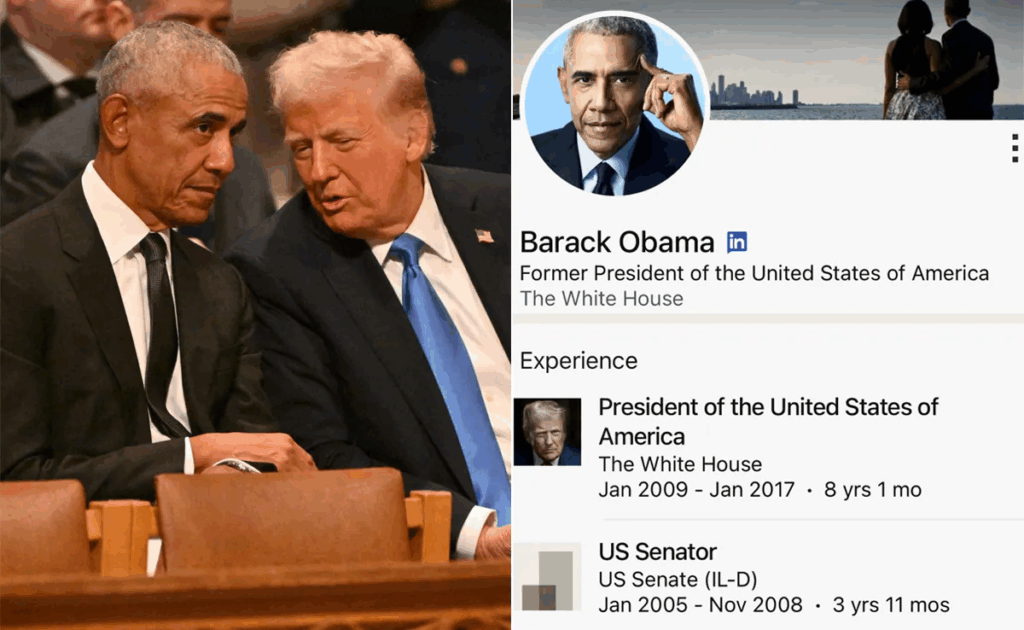
Former US President Barack Obama’s LinkedIn profile recently sparked confusion, and plenty of jokes online, after it began displaying a photo of Donald Trump in his “Experience” section. At first glance, it looked like a hack or a prank. But the explanation is less dramatic and more technical.
What happened to Obama’s LinkedIn profile?
Obama’s profile lists him as “President of the United States at the White House.” Because that job title links directly to the official White House LinkedIn page, any updates on the White House account automatically reflect on his profile.
When the White House page updated its profile image to President Donald Trump’s photo, LinkedIn’s system automatically pulled that image into Obama’s page. The result: Obama’s work history suddenly looked like it was branded with his successor’s face.
This glitch isn’t new. LinkedIn often ties personal work experience entries to official company pages, which can cause mismatches when corporate branding changes. In this case, the “employer,” the White House, happens to change every four or eight years.
Why does LinkedIn pull photos from company pages?
LinkedIn is designed to centralize work experiences. If someone lists a past job at Google, for example, their profile displays the company’s logo. The platform does this to:
- Standardize job titles and employers.
- Make profiles more searchable.
- Help recruiters verify experience.
But unlike private corporations, the White House isn’t a static employer. Its leadership — and branding — shifts with every new president. That means Obama’s past role now reflects Trump’s current image, not his own tenure.
How the internet reacted
The mismatch went viral after screenshots circulated on X (formerly Twitter), where one post gathered more than 2.7 million views. Users were quick to turn the glitch into a meme.
Some comments included:
- “Greatest troll of all time.”
- “This kind of pettiness is why Trump’s favorability drops by the day.”
- “Whoever made the decision needs an immediate raise.”
The humor partly comes from the ongoing rivalry between Obama, the 44th president, and Trump, his Republican successor. Even years after leaving office, both men remain central to America’s political debates.
Why does this matter beyond a laugh?
At first, it’s easy to dismiss the mix-up as a funny internet moment. But it also highlights deeper issues about how digital platforms represent history and leadership.
The challenge of historical accuracy
When LinkedIn ties Obama’s presidency to Trump’s current photo, it blurs the historical record. Future viewers could mistakenly think the profile is inaccurate or hacked. This shows how platform design can unintentionally distort political and historical timelines.
The politics of image control
In politics, optics matter as much as policy. The fact that Trump’s photo appeared on Obama’s profile played into narratives of rivalry and trolling — even though neither man had anything to do with it. It illustrates how little technical quirks can fuel big online conversations.
Lessons for digital identity management
For public figures, brand control on third-party platforms is tricky. Unlike personal websites, LinkedIn and other networks often rely on automated systems. Obama’s team could avoid the mix-up only by unlinking his role from the official White House page — but that would also weaken the authenticity of his résumé.
Obama and Trump’s complicated dynamic
The incident also revived discussions about the relationship between the two leaders. Despite being frequent adversaries in policy and rhetoric, they’ve occasionally been seen in cordial settings — most recently chatting at former President Jimmy Carter’s funeral in January 2025.
Trump himself downplayed the moment, saying:
“I didn’t realise how friendly it looked. I said, ‘Boy, they look like two people that like each other.’ And we probably do. We have a little different philosophies, right? But we probably do.”
That remark underscored their unusual bond: ideological opposites who nonetheless share the rare experience of having led the country.
The takeaway
Barack Obama’s LinkedIn profile showing Donald Trump’s face isn’t sabotage or trolling — it’s a side effect of how LinkedIn links jobs to official employer pages. Still, in today’s hyper-politicized climate, even a technical quirk can become a viral talking point.
For readers, the episode is a reminder that digital platforms shape not just our personal résumés but also the way history and leadership are visually represented online.