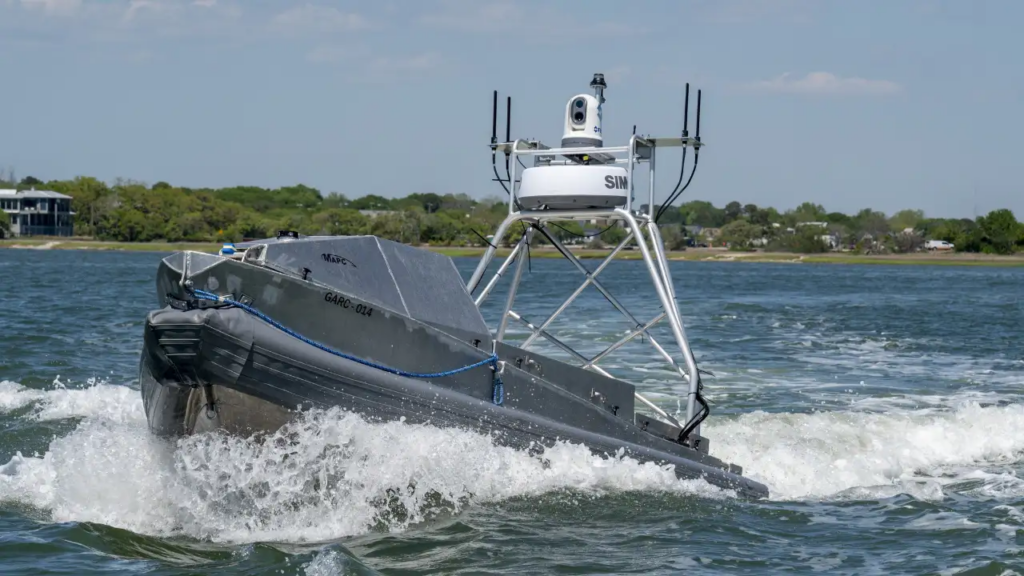
The U.S. Department of Defense has launched a $300 million initiative to accelerate the development of uncrewed surface vessels capable of deploying small uncrewed aerial systems (UAS) for surveillance and strike missions. The effort, known as the Suitable Warfighting Adaptive Payloads–Unmanned Surface Vessel (SWAP-USV) Challenge, is being led by the Defense Innovation Unit (DIU). The program seeks commercially available, rapidly deployable systems that can help counter increasingly common low-cost maritime threats, including uncrewed boats and drones.
The initiative combines prize funding with potential procurement opportunities, aiming to transition successful technologies into military service.
What Is the SWAP-USV Challenge?
The Suitable Warfighting Adaptive Payloads–Unmanned Surface Vessel (SWAP-USV) Challenge is a Defense Innovation Unit program designed to identify mature, commercially available autonomous maritime systems.
Rather than funding early-stage research, the Pentagon is seeking technologies that are already well developed and could be field-tested within approximately 120 days.
The goal is to rapidly evaluate systems that could support future U.S. naval and joint operations.
Why Is the Pentagon Pursuing This Program?
According to the program solicitation, the Department of Defense is seeking more cost-effective ways to address emerging maritime threats.
Recent conflicts have demonstrated that relatively inexpensive uncrewed boats and aerial drones can threaten significantly more expensive military platforms.
The Pentagon says it wants systems capable of delivering effective operational capabilities without relying solely on high-cost warships, aircraft, or missile interceptors.
The program reflects a broader trend toward integrating autonomous systems into military operations.
What Capabilities Are Being Sought?
The Pentagon’s solicitation outlines several desired capabilities for participating systems.
The uncrewed surface vessel should be able to:
- Carry, launch, and control at least two integrated aerial drones.
- Conduct intelligence, surveillance, and reconnaissance (ISR) missions.
- Support communications relay.
- Perform electronic warfare functions.
- Deliver payloads to designated locations.
- Conduct precision engagement missions under human operator control.
According to the solicitation, the combined payload capacity of the onboard drones should be at least two kilograms for kinetic missions.
The exact weapons or payload configurations would depend on future operational requirements and applicable legal and policy frameworks.
Requirements for Mobility and Deployment
The Defense Innovation Unit is also emphasizing rapid deployment.
Preferred systems should be transportable using:
- Standard shipping containers.
- Road trailers.
- C-17 Globemaster III transport aircraft.
- C-130 Hercules transport aircraft.
The solicitation also favors systems capable of operating from austere or unimproved launch locations, including containerized deployment concepts.
These requirements are intended to improve flexibility during expeditionary and distributed operations.
Autonomous Maritime Missions
Beyond deploying drones, the proposed vessels are expected to perform a range of autonomous maritime tasks.
Desired capabilities include:
- Persistent maritime surveillance.
- Tracking vessels of interest.
- Shadowing selected targets.
- Intercepting maneuvering boats.
- Operating in coastal, ocean, and riverine environments.
- Remaining on station for extended periods with limited logistical support.
The Pentagon expects these systems to reduce personnel requirements while expanding operational coverage.
How Is the Competition Structured?
The SWAP-USV Challenge will be conducted in three competitive phases, referred to as “Sprints.”
Sprint One
- Operational testing planned for autumn 2026.
- Approximately $40 million in prize funding.
- Focus on demonstrating immediate operational readiness.
Sprint Two
- Testing planned for early 2027.
- Another $40 million in prize funding.
- Greater emphasis on interoperability, autonomy, and expanded payload options.
Sprint Three
- Scheduled for summer 2027.
- $20 million in prize funding.
- Additional objectives are expected to be announced later.
In total, the competition offers:
- $100 million in prize funding.
- Up to $200 million in potential procurement contracts for successful technologies.
Companies may enter at different stages depending on the maturity of their systems, although final placement will be determined by the government.
Why This Matters
Navies worldwide are increasingly adapting to the rapid spread of low-cost autonomous technologies.
Recent conflicts have highlighted how relatively inexpensive drones and uncrewed vessels can threaten traditional military platforms, prompting defense organizations to invest in systems that are more scalable, adaptable, and cost-effective.
The SWAP-USV Challenge is part of the Pentagon’s broader effort to accelerate the adoption of commercially developed autonomous technologies while shortening the timeline between innovation and operational deployment.
The Bottom Line
The Pentagon’s new SWAP-USV Challenge aims to accelerate the development of autonomous surface vessels capable of deploying small drones for surveillance and precision missions. Backed by $300 million in prize funding and potential procurement opportunities, the initiative seeks mature technologies that can provide a lower-cost response to evolving maritime threats while expanding the U.S. military’s autonomous capabilities.
TL;DR
- The Pentagon has announced the $300 million SWAP-USV Challenge.
- The program seeks autonomous surface vessels capable of launching and controlling multiple small drones.
- The initiative is intended to provide a lower-cost response to maritime drone threats.
- The competition includes $100 million in prize funding and up to $200 million in potential procurement contracts.
- Companies have until August 10 to submit proposals for the first phase.