
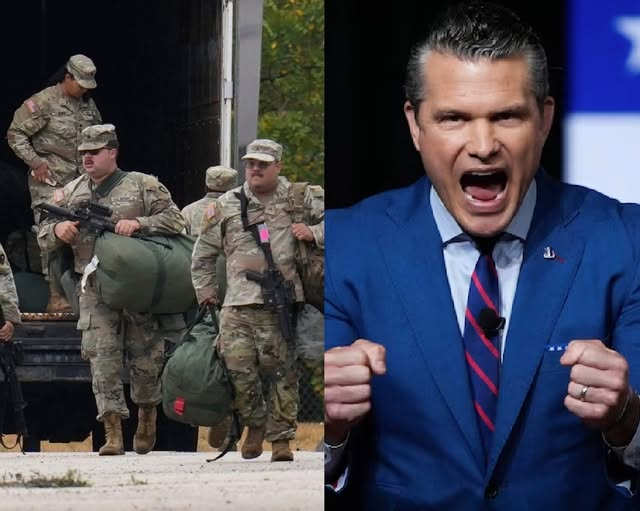
The Pentagon is tightening its fitness policies under US Secretary of War Pete Hegseth, who announced the dismissal of several Texas National Guard troops for failing to meet physical fitness standards. His blunt message, “Standards are back”, has ignited both praise and controversy across the military community.
The decision followed a viral image showing a group of Texas National Guard members arriving in Chicago, which triggered online debate over the appearance and combat readiness of US troops.
Why Pete Hegseth’s fitness purge matters
Hegseth’s move marks a sharp departure from recent years of leniency in US military fitness policies. The former Army officer and Fox News host has long argued that relaxed standards have weakened the country’s defense readiness and morale.
“If the Secretary of War can do regular, hard PT, so can every member of our joint force,” Hegseth reportedly told officers at Marine Corps University last month. “Hot yoga and stretching don’t count.”
His latest order, which reportedly replaced several Texas Guard soldiers after they failed to meet service-specific height, weight, and physical fitness requirements, underscores his determination to restore traditional military discipline.
The viral photo that sparked the controversy
The current storm began after a photo by AP photographer Erin Hooley showed the Texas National Guard arriving in Illinois last week. The image quickly spread online, drawing ridicule from social media users who mocked the soldiers’ physiques.
Hegseth amplified the conversation by reposting an article about the troops’ removal, captioned:
“Standards are back at The @DeptofWar.”
While it remains unclear whether the individuals in the viral image were among those dismissed, the event reignited national discussion on the military’s readiness standards, and on whether public shaming plays a role in enforcing them.
The official response from the National Guard
In a statement issued on October 9, the National Guard reaffirmed that all personnel must meet service-specific requirements “at all times.”
“When mobilizing for active duty, members go through a validation process to ensure they meet requirements. On the rare occasions when members are found not in compliance, they will not go on mission,” the statement read. “They will be returned to their home station, and replacements who do meet standards will take their places.”
This formal process, not viral outrage, appears to have triggered the replacements in Texas. However, Hegseth’s comments have amplified the issue into a broader conversation about accountability in the armed forces.
Hegseth’s long-standing crusade against ‘fat troops’
Pete Hegseth’s fitness rhetoric isn’t new. Since assuming his post earlier in 2025, he has repeatedly criticized what he calls the “softening” of the US military, targeting both physical and cultural shifts within the ranks.
A decorated Army veteran himself, Hegseth has argued that physical fitness directly impacts discipline, resilience, and battlefield performance. He has publicly referred to “fat generals” as symbolic of deeper institutional decay, saying that “a military that excuses weakness invites defeat.”
His approach has divided opinion:
- Supporters see it as a necessary reset for a force they view as slipping into complacency.
- Critics argue that such rhetoric stigmatizes service members and overlooks the complexity of recruitment, retention, and wellness challenges within the modern military.
The broader implications: readiness, image, and morale
The controversy lands at a time when the US military faces recruitment shortfalls and shifting cultural expectations. Analysts suggest Hegseth’s crackdown may appeal to traditionalists but could risk alienating younger recruits who value inclusivity and mental health balance alongside physical rigor.
Defense policy experts also point out that while fitness standards are vital, publicly framing soldiers as “fat” risks undermining morale and deterring potential recruits. A 2023 RAND study found that body composition alone isn’t a perfect predictor of performance, with factors like endurance, training, and psychological resilience playing equally key roles.
Still, for Hegseth and his allies, the message is clear: the US military’s credibility, both at home and abroad, depends on visible strength and discipline.
What happens next
As the Department of War moves forward, officials are expected to review fitness compliance across state Guard units, particularly those mobilized for federal missions.
Observers believe the administration may issue updated body composition and physical readiness benchmarks, alongside clearer enforcement protocols — signaling that the new standards won’t be symbolic but sustained.
For now, Hegseth’s declaration that “standards are back” has effectively drawn a line: a leaner, tougher image of the US military, regardless of the public backlash it invites.
TL;DR — Key Takeaways
- Who: US Secretary of War Pete Hegseth
- What: Replaced Texas National Guard members who failed fitness standards
- Why: Part of his effort to restore physical discipline in the military
- Controversy: Sparked by a viral image of allegedly overweight troops
- Quote: “Standards are back at The @DeptofWar”
- Impact: Divided opinions over readiness vs. body-shaming in the military