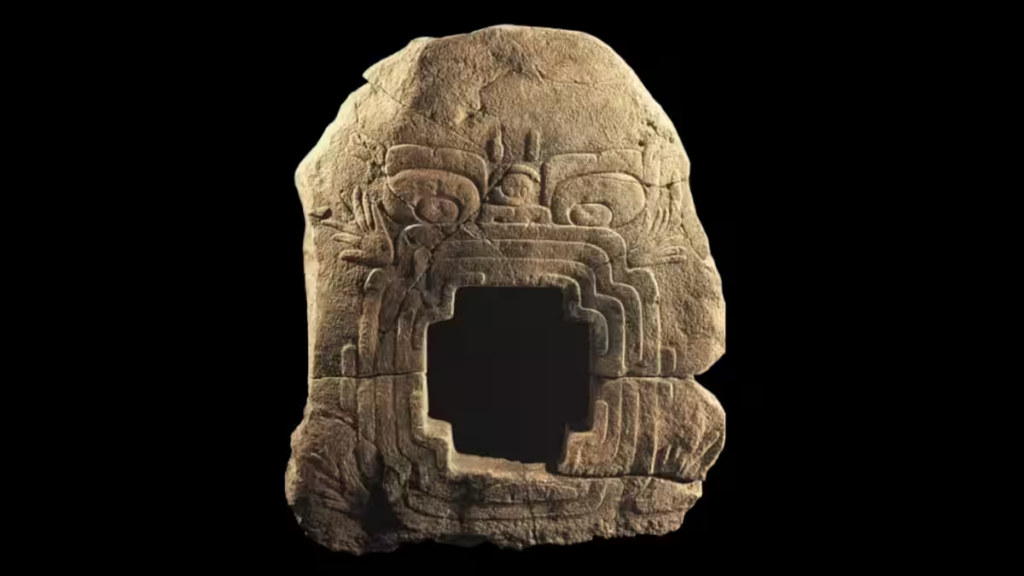
For decades, it existed as a ghost in academic footnotes. An enormous stone Olmec Cave mask, sacred to one of the earliest civilisations in the Americas, vanished from Mexico sometime in the early 20th century. This month, that missing artifact resurfaced thousands of miles away in Denver, ending a long, fragmented journey that says as much about ancient belief systems as it does about modern art trafficking.
Known as the Olmec Cave Mask or Portal al Inframundo, the monument is more than a sculpture. For the Olmec, it was a threshold between worlds. For modern investigators, it became a puzzle scattered across continents, museums, and private collections.
Below is what we know about the artifact, how it disappeared, why it was broken into pieces, and what its recovery means for the global debate over cultural restitution.
What is the Olmec “portal to the underworld”?
A sacred monument carved nearly 2,700 years ago
The Olmec Cave Mask dates back roughly to 700 BCE, placing it among the oldest known large-scale stone carvings in Mesoamerica. Measuring about six feet tall and five feet wide, the monument depicts Tepeyollotlicuhti, a jaguar deity associated with caves, echoes, earthquakes, and the underworld.
Unlike decorative sculpture, this mask was architectural in purpose. Archaeologists believe it once framed the entrance of a cave or ritual space in Chalcatzingo, in what is now the Mexican state of Morelos. The gaping mouth was not a symbolic flourish. It was meant to be passed through.
In Olmec cosmology, caves were portals. They marked points where humans could communicate with ancestors, gods, and forces beneath the earth. This is why scholars refer to the artefact as a “passage to the underworld,” not merely a mask.
Why the jaguar mattered to the Olmec
The jaguar appears repeatedly in Olmec art, often blending human and animal features. It symbolised power, fertility, and the dangerous liminal space between life and death.
In the Cave Mask, the flared eyes and open jaws amplify that tension. The monument was not meant to be admired from afar. It was meant to confront, intimidate, and transform those who approached it.
This context matters because once removed from its original setting, much of the artifact’s meaning was stripped away.
How was the Olmec artifact stolen and lost?
Looted in the early 20th century, before protections existed
The Cave Mask was taken from Chalcatzingo sometime in the early 1900s, a period when Mexico’s antiquities laws were weakly enforced and international demand for pre-Columbian art was rising fast.
Large stone objects posed a problem for traffickers. The solution was brutal but effective. The monument was deliberately broken into pieces.
According to Mexico’s National Institute of Anthropology and History, the mask was cut into at least 25 separate fragments. This made it easier to transport discreetly and sell incrementally.
At the time, such practices were common and rarely punished.
A long journey through museums and private collections
After leaving Mexico, the fragments circulated through a shadowy network of collectors and institutions. Over the decades, pieces appeared in:
- Private collections in the United States
- Museum holdings with incomplete provenance records
- Academic references without clear documentation
At some point, the fragments were reassembled, though not carefully. Conservators later found modern additions, including metal bolts, cement reinforcements, and reconstructed sections that were not historically accurate.
These changes stabilised the structure but compromised its integrity.
INAH officials later acknowledged that while some elements were original, others were added using techniques and materials that would not meet today’s conservation standards.
How was the “portal to the underworld” rediscovered in Denver?
The key role of scholars and investigators
The first breakthrough came from archaeologist David Grove, who suspected that a known Olmec monument in circulation matched descriptions of the missing Chalcatzingo piece.
That hypothesis was later confirmed by INAH researcher Mario Córdova Tello, who traced the artefact’s provenance through archival records and stylistic analysis.
By 2023, the reconstructed monument had surfaced in Denver. This triggered involvement from the Manhattan District Attorney’s Antiquities Trafficking Unit, a specialised team focused on recovering stolen cultural property.
Officers secured the artifact and coordinated with Mexican authorities to arrange its return.
What officials have said publicly?
New York District Attorney Alvin Bragg described the Olmec Cave Mask as “a rare window into the past of Olmec society,” noting that it had been intentionally broken apart to facilitate smuggling.
INAH officials confirmed the extent of the damage and explained that modern materials were added during reassembly to make the monument visually coherent, even if historically flawed.
This transparency is significant. It acknowledges both the success of recovery and the irreversible harm caused by looting.
Why does the return of this Olmec artifact matter?
Restoring cultural context, not just ownership
Repatriation is often framed as a legal or diplomatic issue. In this case, it is also an intellectual one.
The Olmec Cave Mask was never meant to exist as an isolated museum object. Its meaning depends on its location, orientation, and relationship to the surrounding landscape.
Returning it to Mexico allows scholars to reinterpret the artifact within its original cultural framework, rather than through a Western display lens.
This shift changes how history is written.
A symbol in the wider restitution debate
The recovery comes at a time when museums worldwide are facing mounting pressure to return artifacts acquired through colonial-era looting or dubious transactions.
Recent cases involving African bronzes, Southeast Asian sculptures, and Indigenous remains have intensified scrutiny of museum collections.
The Olmec Cave Mask adds to that momentum by illustrating three uncomfortable truths:
- Many artefacts were left in their countries illegally
- Documentation was often intentionally vague
- Restoration sometimes prioritised display over accuracy
What challenges remain after recovery?
Conservation dilemmas and ethical questions
Now that the artifact has returned to Mexico, conservators face difficult decisions. Should modern reinforcements be removed, even if that risks structural instability? Or should the object remain as a hybrid of ancient and modern intervention?
There is no easy answer.
INAH has indicated that further study and careful conservation will be required to balance stability with authenticity.
This raises broader questions about how much restoration is too much, especially for objects damaged by theft rather than time.
Gaps in the historical record
Even with the artifact back home, some knowledge is permanently lost. The exact circumstances of its removal, early ownership, and partial reconstructions may never be fully documented.
This is the hidden cost of antiquities trafficking. It erases context, not just stone.
TL;DR: Why this discovery matters
- The Olmec Cave Mask is a 2,700-year-old sacred monument linked to underworld rituals
- It was stolen from Chalcatzingo, Mexico, in the early 20th century
- Traffickers broke it into 25 pieces to smuggle it abroad
- The artefact resurfaced in Denver in 2023
- US authorities worked with Mexico to return it
- Its recovery highlights ongoing issues around looted antiquities and museum ethics