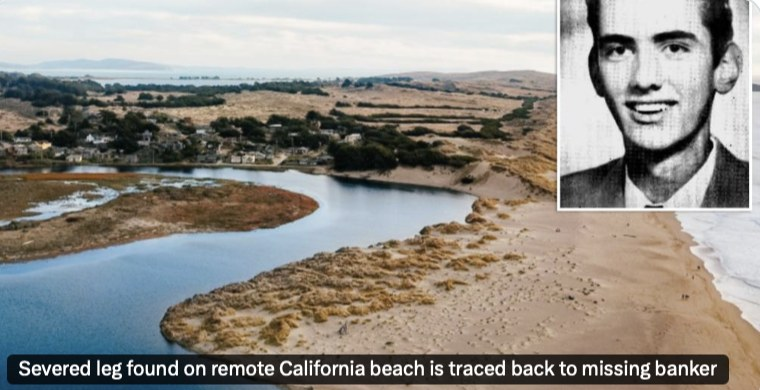
A quiet stretch of California coastline called Salmon Creek has yielded one of the strangest forensic stories in recent memory: a severed leg found years apart, two separate “John Doe” cases, and a missing man from 1999 all converging into a single identity.
Nearly three decades after he vanished, Walter Karl Kinney has been identified again. This time, through DNA science that didn’t exist when the case first went cold.
What happened in the Salmon Creek severed leg case?
The case began in 1999, when Kinney, a 59-year-old banker from Santa Rosa, disappeared without a trace.
Later that same year, a single severed leg was discovered near Bodega Head. The only clue was a size 12 shoe fitted with a custom orthopedic insert.
Without immediate identification, the remains were initially classified as belonging to an unknown individual.
How was the victim first identified?
The breakthrough came in 2003, not through DNA, but through something far more analog: medical records.
The first identification
- Kinney’s daughter reported his disappearance to authorities
- Investigators obtained his medical history
- X-rays of his feet were compared with the recovered remains
- A match confirmed his identity
Kinney was officially declared dead, and the case faded from public attention.
At that point, it seemed the mystery had reached its conclusion.
What changed in 2022?
More than two decades later, the story resurfaced in an unexpected way.
A family walking along Salmon Creek Beach stumbled upon a bone protruding from the sand. It wasn’t just any bone. It still had surgical hardware attached.
What investigators found
- A long bone, likely from a leg
- Surgical implants still intact
- No additional remains nearby
Despite extensive searches, authorities could not locate other body parts or immediately identify the remains. The case became known as “Salmon Creek John Doe.”
How did DNA finally solve the case?
The turning point came when the DNA Doe Project joined the investigation.
This nonprofit specializes in forensic genealogy, a technique that combines DNA analysis with family tree research.
How the identification worked
- DNA was extracted from the 2022 remains
- A genetic profile was created
- Researchers traced familial connections through genealogy databases
- A match was found linking back to Kinney’s family
The result was unexpected. The DNA confirmed that the 2022 remains belonged to the same man already identified in 2003.
In other words, Kinney had effectively been identified twice, decades apart, through two entirely different scientific methods.
Why is this case so unusual?
Cases involving unidentified remains are not uncommon. But this one stands out for several reasons.
What makes it unique
- The same individual was classified as “John Doe” twice
- Identification methods evolved from X-rays to advanced DNA analysis
- Remains surfaced decades apart in the same general area
- Only partial remains were ever recovered
According to investigators, it’s extremely rare for a person to be re-identified in this way.
What does this reveal about forensic science?
This case highlights just how much forensic technology has advanced since the late 1990s.
Then vs now
1999–2003:
- Reliance on physical evidence
- Dental records and X-rays
- Manual identification processes
2020s:
- DNA sequencing
- Genetic genealogy databases
- Algorithm-driven family tree reconstruction
The shift is not just technological. It has fundamentally changed how cold cases are approached and solved.
What remains unanswered?
Despite the identification, key questions about Kinney’s disappearance remain unresolved.
Lingering mysteries
- What caused his death?
- How did the remains become separated?
- Why were parts discovered decades apart?
- Were environmental factors or human actions involved?
Authorities have not publicly confirmed whether foul play is suspected.
Ocean currents, coastal erosion, and wildlife activity can all contribute to the dispersal of remains over time, especially along rugged coastlines like Northern California.
Why cases like this matter
At its core, this story is about more than a forensic anomaly.
It reflects the growing power of science to revisit the past and extract answers long thought lost.
Broader implications
- Cold cases can be reopened with new technology
- Families may finally receive long-delayed closure
- Law enforcement gains new tools for unresolved investigations
- Public databases play an increasing role in solving crimes
The human element behind the headlines
It’s easy to get lost in the strangeness of the case. A severed leg. A double identification. Decades of mystery.
But at the center is a person who disappeared and a family that spent years without answers.
For them, this isn’t just a scientific milestone. It’s a piece of closure, however incomplete.
TL;DR
- A severed leg found in 2022 was identified as Walter Kinney, missing since 1999
- He had already been identified once in 2003 using X-rays
- DNA testing in 2026 confirmed the match again
- The case is rare because the same person was identified twice as “John Doe”
- Advances in forensic science made the second identification possible