
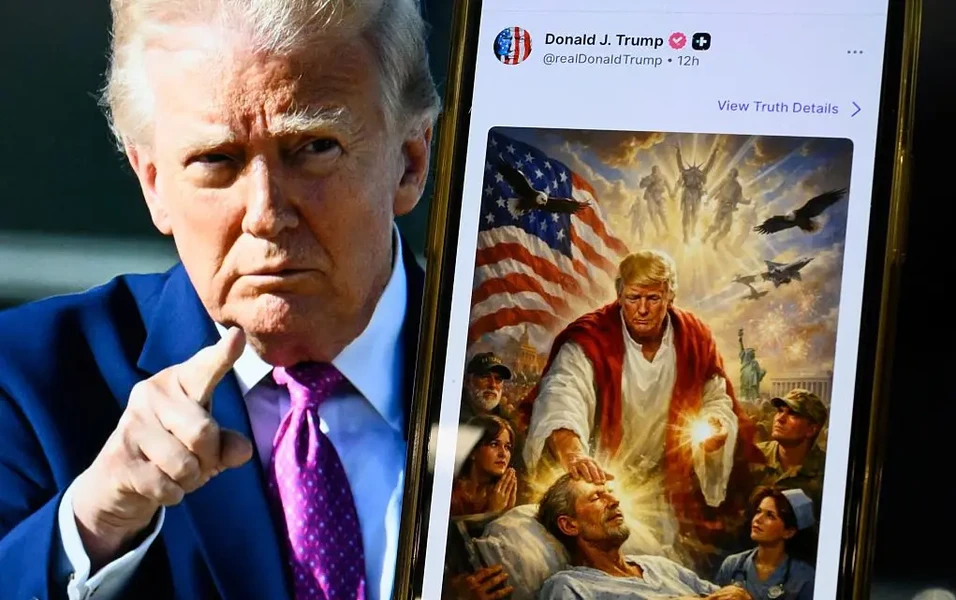
Within hours of posting it, Donald Trump removed an AI-generated image that appeared to depict him as Jesus Christ. This image quickly stirred confusion, criticism, and debate across political and religious lines.
Now, the president says the decision to delete the post had little to do with backlash and everything to do with how people interpreted it.
But the episode raises a bigger question: in an era of AI-generated content, how much control do public figures really have over how they’re perceived?
What Happened in the Trump AI Image Controversy?
The controversy began when Trump shared an AI-generated image on Truth Social. The illustration showed him in flowing robes, placing a hand on a man in a hospital bed, with a glowing light emanating from the other—visual cues many interpreted as religious symbolism.
Critics quickly labeled it as portraying Trump as a Christ-like figure.
Trump, however, offered a different explanation.
He said he believed the image depicted him “as a doctor,” pointing to the presence of medical staff and a Red Cross symbol in the scene.
In an interview with CBS News, Trump explained why he ultimately took the post down:
- “People were confused.”
- “I didn’t want to have anybody be confused.”
- “Normally I don’t like doing that,” he added, referring to deleting posts.
Despite the imagery’s strong religious undertones, Trump maintained that “most people” saw it the same way he did—as a medical-themed depiction rather than a spiritual one.
Why Did the Image Spark Such Strong Reactions?
The Power of Religious Symbolism in Politics
Images that evoke religious themes carry enormous cultural weight—especially in the United States, where faith and politics often intersect.
The visual elements in the AI image triggered several associations:
- Flowing robes resembling traditional depictions of Jesus
- A healing gesture toward a patient
- Radiant light suggesting divine intervention
Even if unintended, these cues made the interpretation almost inevitable.
Why it matters:
Religious imagery in political messaging can:
- Strengthen support among certain groups
- Alienate others
- Spark ethical and theological criticism
This explains why even a single image can dominate a news cycle.
The Role of AI in Amplifying Ambiguity
AI-generated content introduces a new layer of complexity.
Unlike traditional media, AI visuals:
- Blend symbols from different contexts
- Can be misinterpreted more easily
- Often lack clear authorship or intent
In this case, the ambiguity worked against Trump.
Did Criticism Influence the Deletion?
One of the most visible critics was Riley Gaines, a conservative activist and frequent Trump supporter.
Gaines publicly questioned the post on X (formerly Twitter), writing:
- “Is he looking for a response?”
- “Does he actually like this?”
- “God shall not be mocked.”
Despite the criticism, Trump dismissed the idea that her comments played any role in his decision.
“I didn’t listen to Riley Gaines. I’m not a big fan of Riley, actually,” he said.
Interestingly, Gaines later softened her stance, noting:
- The post “missed the mark”
- She continues to support Trump and his agenda
This shift highlights a broader dynamic: disagreement within political allies doesn’t always translate into lasting division.
What Does This Say About Trump’s Media Strategy?
A Pattern of Provocative Visual Messaging
Trump has long used unconventional media tactics to dominate attention cycles. This incident fits a broader pattern:
- Eye-catching visuals
- Ambiguous messaging
- Rapid response to backlash
Even when content is removed, the attention often lingers.
Key insight:
Deleting a post doesn’t erase its impact—it often amplifies it.
Managing Perception in the AI Era
The Trump AI image controversy underscores a growing challenge for public figures:
Once AI-generated content is shared, its interpretation is no longer fully controllable.
Leaders now have to account for:
- Rapid viral spread
- Multiple interpretations
- Cultural and religious sensitivities
This marks a shift from traditional media control to interpretation management.
Why the Trump AI Image Controversy Matters Beyond Politics
1. AI Content Is Outpacing Context
The speed at which AI images are created and shared often exceeds the time needed to explain them.
This creates a gap:
- Content spreads instantly
- Clarification comes later—if at all
2. Visual Literacy Is Becoming Essential
Audiences now need to interpret:
- AI-generated cues
- Symbolic imagery
- Context-less visuals
Without that literacy, misinterpretations become more common.
3. Public Figures Face Higher Stakes
For politicians, the margin for error is shrinking.
Even unintended symbolism can:
- Trigger backlash
- Distract from policy messaging
- Create unnecessary controversies
How Could This Have Been Avoided?
This situation offers practical lessons for political communication teams:
Clear Framing Matters
- Add captions or context to ambiguous visuals
- Anticipate likely interpretations
Pre-Publication Review
- Evaluate imagery for cultural and religious signals
- Test content with diverse internal audiences
Rapid Clarification
- Address confusion immediately
- Avoid letting interpretations spiral
The Bigger Picture: AI, Influence, and Interpretation
The Trump AI image controversy isn’t just about one post—it’s a case study in how technology is reshaping public communication.
We’re entering a phase where:
- Images can be generated instantly
- Meaning is crowdsourced in real time
- Intent is often secondary to perception
For political leaders, that means one thing:
Every image is now a message—whether intended or not.
TL;DR
- Donald Trump deleted an AI-generated image after confusion over its meaning.
- Critics interpreted it as depicting him as Jesus, while Trump said it showed him as a doctor.
- Riley Gaines publicly criticised the post but remains supportive overall.
- The incident highlights the risks of AI-generated visuals in political messaging.
- In today’s media environment, perception often outweighs intent.