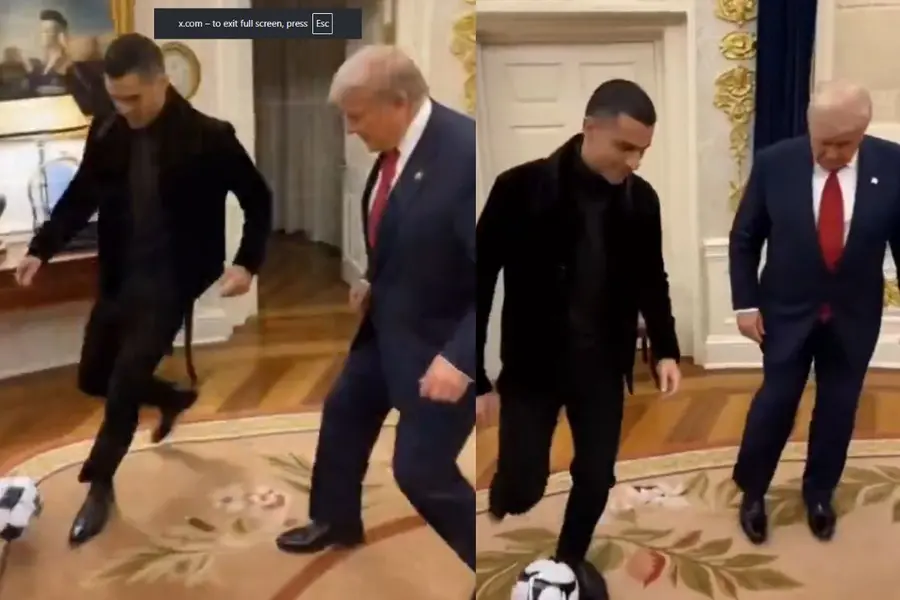
US President Donald Trump posted a new AI-generated video on Thursday showing himself kicking a football around the Oval Office with Cristiano Ronaldo. The clip went viral immediately, but the reaction revealed more than a moment of digital entertainment. It highlighted how political branding, celebrity endorsements, and AI-generated imagery increasingly intersect in the Trump era.
The post came shortly after Ronaldo visited the White House during the formal dinner held for Saudi Crown Prince Mohammed bin Salman, marking the footballer’s first US appearance since 2016. Trump also presented him with a golden key to the White House, a symbolic gift that prompted a warm thank-you from Ronaldo online.
Beyond the spectacle, the video is part of a broader trend: politicians using AI visuals to shape narratives, signal alliances, and create viral moments that bypass traditional media filters. This article explains the video, the politics surrounding it, and the deeper implications for digital transparency.
What the AI video showed
The 20-second video, posted on Trump’s Truth Social account, depicted Trump and Ronaldo trading football tricks inside the Oval Office. The two juggle the ball, spin, kick, and pass it with the ease of professional players, a scenario impossible in real life and intentionally fantastical.
Trump captioned the clip: “Ronaldo is a GREAT GUY. Loved meeting him at the White House. Really smart, and cool!!! President DJT.”
The video blended entertainment with political messaging, presenting Trump as relatable, humorous, and connected to global icons.
Watch the video here
Why Trump is posting AI videos now
AI videos have become a staple of Trump’s online presence during his second term. They serve multiple strategic purposes:
• They bypass traditional media gatekeepers.
• They create shareable moments that energize online supporters.
• They reinforce Trump’s relationships with influential figures like athletes, musicians, and business leaders.
• They allow political storytelling unconstrained by physical reality.
AI-generated visuals are also cheaper and faster to produce than conventional video production, and they give Trump’s digital team enormous creative freedom.
Ronaldo’s global fame amplifies that effect. His appearance (even virtually) helps Trump reach international audiences and younger demographic groups who may otherwise be politically disengaged.
How Ronaldo’s real White House visit led to the viral clip
Days before the AI video dropped, Ronaldo attended a formal dinner at the White House held for Saudi Crown Prince Mohammed bin Salman. His appearance drew significant media attention, both because he is one of the world’s most recognized athletes and because the visit came amid shifting US-Saudi relations.
Ronaldo attended the event with his fiancée, Georgina Rodríguez. It was his first trip to the United States in nearly a decade, and Trump seized the moment to elevate the encounter online.
During the visit, Trump presented Ronaldo with a golden key to the White House, a symbolic gesture rooted in an old tradition of gifting influential visitors a ceremonial “key to the city.” Ronaldo later thanked Trump publicly, framing the moment as an opportunity to inspire younger generations.
This paired well with the AI video narrative. In effect, the digital clip became an extension of the real-world reception.
What Saudi Arabia’s visit has to do with the moment
The AI video wasn’t posted in a political vacuum. Mohammed bin Salman’s visit to Washington marked his first US trip since American intelligence agencies linked him to the 2018 murder of journalist Jamal Khashoggi, a claim he denies.
Trump downplayed past tensions, saying the crown prince “knew nothing about it” and urging a forward-looking relationship focused on strategic cooperation. In that context, Ronaldo’s presence at the dinner was a soft-power boost: a global sports icon bridging a sensitive diplomatic moment.
The AI video, while lighthearted, helped keep the focus on celebrity and spectacle rather than political controversy.
The growing concern over AI in political communication
While many viewers saw the clip as harmless fun, digital governance experts warn that frequent use of AI-generated political videos raises important questions:
1. It blurs the line between satire and official communication
When a sitting president posts AI-generated videos from his official accounts, viewers may struggle to distinguish humor from formal messaging.
2. It normalises AI-created depictions of political events
Even playful AI imagery can contribute to the public becoming more accepting of manipulated visuals. That acceptance may make future deception easier.
3. It sets a precedent for other leaders
Political AI videos are now part of global campaigning. Trump’s use of the medium accelerates its adoption.
4. It sparks debate about disclosure
Should political AI content be labeled? Should official accounts be required to differentiate AI from reality?
These are unresolved questions that US policymakers and tech regulators continue to wrestle with.
Why the video resonated so widely online
The video checked several boxes that drive virality:
• Big celebrity + powerful politician
• Fantastical scenario that audiences instantly recognize as artificial
• Light, humorous tone during a heavy political cycle
• Shareable format optimized for TikTok, Instagram, and X
• Global recognition due to Ronaldo’s fan base
The video’s spread across platforms shows how political communication now depends on entertainment value as much as policy.
TL;DR: What this moment reveals
• Trump posted a new AI-generated video of himself playing football with Cristiano Ronaldo inside the Oval Office.
• The clip followed Ronaldo’s real visit to the White House during Mohammed bin Salman’s US trip.
• Trump gifted Ronaldo a ceremonial golden key, which sparked positive social media exchanges.
• The AI video is part of Trump’s broader strategy to use digital manipulation tools for messaging and engagement.
• Experts warn that widespread use of AI in political communication can erode trust and blur reality.
• The viral response shows how political messaging increasingly blends entertainment, celebrity, and AI.