
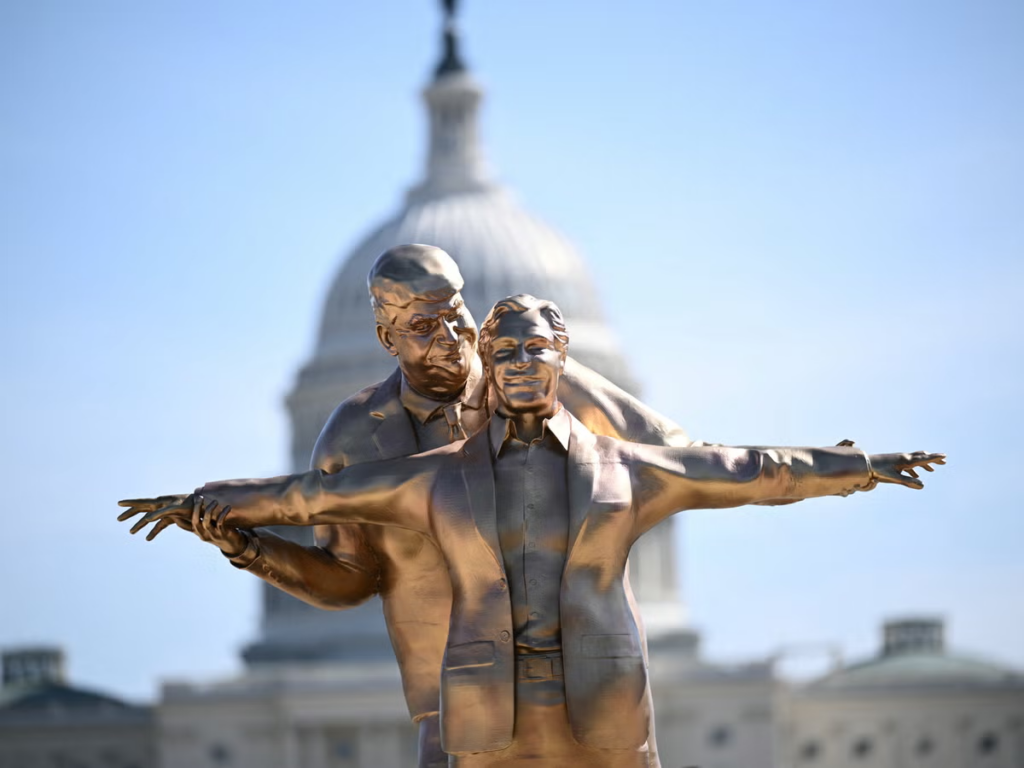
A Trump–Epstein protest statue that appeared overnight on the National Mall in Washington, D.C., has quickly become one of the most talked-about political art installations of the year.
The nearly 12-foot sculpture—spray-painted gold and modelled after the famous Titanic bow scene—depicts former U.S. President Donald Trump standing behind Jeffrey Epstein, the disgraced financier who died in federal custody in 2019 while awaiting trial on sex-trafficking charges.
Within hours of its appearance early Tuesday morning, videos and photos of the installation spread widely across social media platforms. By midday, the artwork had drawn both crowds on the Mall and intense online debate about political satire, free expression, and the boundaries of protest art in America’s most symbolic public spaces.
What Is the Trump–Epstein Protest Statue?
The installation recreates the iconic Titanic moment when characters Jack and Rose stand together at the front of the doomed ship. But instead of Hollywood romance, the sculpture replaces the characters with Trump and Epstein.
The figures are posed facing the Washington Monument, with Trump positioned behind Epstein in the same stance used in the 1997 film.
Key visual details of the installation
According to reporting by The Washington Post:
- The sculpture stood approximately 12 feet tall.
- Both figures were spray-painted metallic gold, a colour often associated with Trump’s branding aesthetic.
- The structure resembled the bow of the Titanic, extending outward like the ship’s famous scene.
- The installation appeared without prior announcement, suggesting a coordinated overnight placement.
The theatrical imagery ensured the piece would quickly capture attention—both from passersby and from social media users sharing images across platforms like X, Instagram, and TikTok.
What Did the Plaques and Banners Say?
The statue’s base included satirical plaques that framed the artwork as a parody of the Titanic love story.
One inscription read:
“The tragic love story between Jack and Rose was built on luxurious travel, raucous parties, and secret nude sketches. This monument honors the bond between Donald Trump and Jeffrey Epstein, a friendship seemingly built on luxurious travel, raucous parties and secret nude sketches.”
In addition to the statue, the artists installed ten banners between the sculpture and the U.S. Capitol.
Each banner featured:
- A photograph of Trump and Epstein together
- The phrase “Make America Safe Again”
- An altered Department of Justice emblem, where the word Justice appeared redacted
The messaging appeared designed to connect the sculpture to broader criticism surrounding the Epstein case and lingering questions about powerful figures linked to the financier.
Who Created the Trump–Epstein Protest Statue?
The artwork is believed to be the work of Secret Handshake, an anonymous artist collective known for installing provocative political sculptures in Washington.
The group has built a reputation for:
- Unannounced public art installations
- Satirical depictions of political figures
- Short-lived pieces are often removed quickly by authorities
Previous installation targeting Trump and Epstein
In September 2025, the same collective reportedly placed another sculpture outside the U.S. Capitol showing Trump and Epstein holding hands.
That earlier piece was removed within hours by authorities, but gained significant attention online before it disappeared.
Why the Installation Appeared Now
The timing of the statue appears deliberate.
It surfaced amid renewed attention surrounding recently released documents related to the Epstein case. The files have sparked fresh debate about individuals who had social or professional connections with Epstein over the years.
Trump has repeatedly faced scrutiny over past interactions with Epstein, though he has also stated publicly that he distanced himself from Epstein long before the financier’s 2019 arrest.
Background on Trump and Epstein’s relationship
Public records and past media reports show that:
- Trump and Epstein were social acquaintances in the 1990s and early 2000s.
- They were photographed together at events in New York and Palm Beach.
- Trump later said he banned Epstein from Mar-a-Lago after an alleged incident involving a club member’s daughter.
Why Political Protest Art Often Targets Washington
Washington, D.C.—especially the National Mall—is one of the most symbolic public spaces in the United States.
Political artists frequently use the area because:
- It sits between the Capitol and the White House, making it visually tied to federal power.
- Installations there receive immediate media attention.
- Tourists and government workers ensure a large built-in audience.
However, placing unauthorised art in the area can violate federal regulations.
As a result, many guerrilla installations are removed quickly by authorities, which paradoxically can amplify their reach online.
The Role of Social Media in Amplifying Guerrilla Art
The Trump–Epstein protest statue demonstrates how temporary physical art can achieve massive digital visibility.
Within hours of the installation:
- Videos circulated widely on Instagram and TikTok.
- Political commentators debated the piece on X and cable news.
- Photos became trending posts across multiple platforms.
For activist artists, that digital amplification is often the real goal.
A sculpture that lasts only a few hours in Washington can still reach millions of viewers worldwide through social media.
The Controversy Surrounding the Epstein Case
Jeffrey Epstein remains one of the most controversial figures in modern American criminal history.
Epstein was accused by federal prosecutors of operating a sex-trafficking network involving underage girls.
Key facts frequently cited in coverage include:
- Epstein was arrested in July 2019 on federal sex-trafficking charges.
- He died in custody in August 2019 at the Metropolitan Correctional Centre in New York.
- His death was officially ruled a suicide, though it has fueled numerous conspiracy theories.
Why Satirical Political Art Still Matters
Political satire has long been part of American protest culture.
From editorial cartoons in the 1800s to street art and installations today, artists have used humour and exaggeration to critique powerful figures.
The Trump–Epstein protest statue fits into that tradition by:
- Using pop-culture imagery recognisable to millions
- Combining visual satire with political messaging
- Provoking public debate rather than offering straightforward commentary
Whether viewers interpret the sculpture as activism, art, or provocation, its rapid spread suggests the message resonated with audiences.
TL;DR
- A 12-foot Trump–Epstein protest statue appeared overnight on the National Mall.
- The sculpture recreated the famous Titanic bow scene using Donald Trump and Jeffrey Epstein.
- Satirical plaques and banners referenced their past social connection.
- The artwork is believed to be by the anonymous collective Secret Handshake.
- Videos of the installation quickly went viral across social media.
- The piece appeared amid renewed attention surrounding documents related to the Epstein case.