
Quick Summary
In a landmark 75-minute negotiation at Trump’s Turnberry golf resort, President Trump and EU Commission President Ursula von der Leyen finalized a preliminary trade agreement valued at $1.6 trillion. The deal requires the EU to purchase $750 billion in American energy products, invest $600 billion in the U.S., impose 15% tariffs on most EU goods entering the U.S., and acquire substantial U.S. military equipment. While marketed as a major win for the U.S., the agreement drew mixed reactions over its asymmetrical terms and potential economic impacts.
What Is the Trump-EU Trade Deal?
The deal sets a 15% tariff on nearly all European goods imported to the U.S., a compromise between Trump’s initial 30% tariff threat and the EU’s preference for zero tariffs. Key terms include:
- The EU committing to $750 billion in purchases of American energy products.
- An additional $600 billion infusion of new investment in the U.S. economy.
- Agreement for the EU to purchase significant amounts of U.S. military equipment (exact figures pending).
- Zero tariffs on selected strategic products such as aircraft parts, chemicals, certain generics, semiconductor equipment, and critical raw materials.
Steel and aluminum imports will maintain the current 50% tariffs, with the EU considering a quota system for these sectors. Pharmaceuticals, the EU’s largest export to the U.S., remain excluded as Trump pursues the reshoring of drug manufacturing.
According to Trump, this “biggest deal ever made” aims to rebalance the trade relationship with the EU—the largest collective U.S. trading partner, with a total trade volume of nearly $2 trillion last year.
How Did the Deal Come Together?
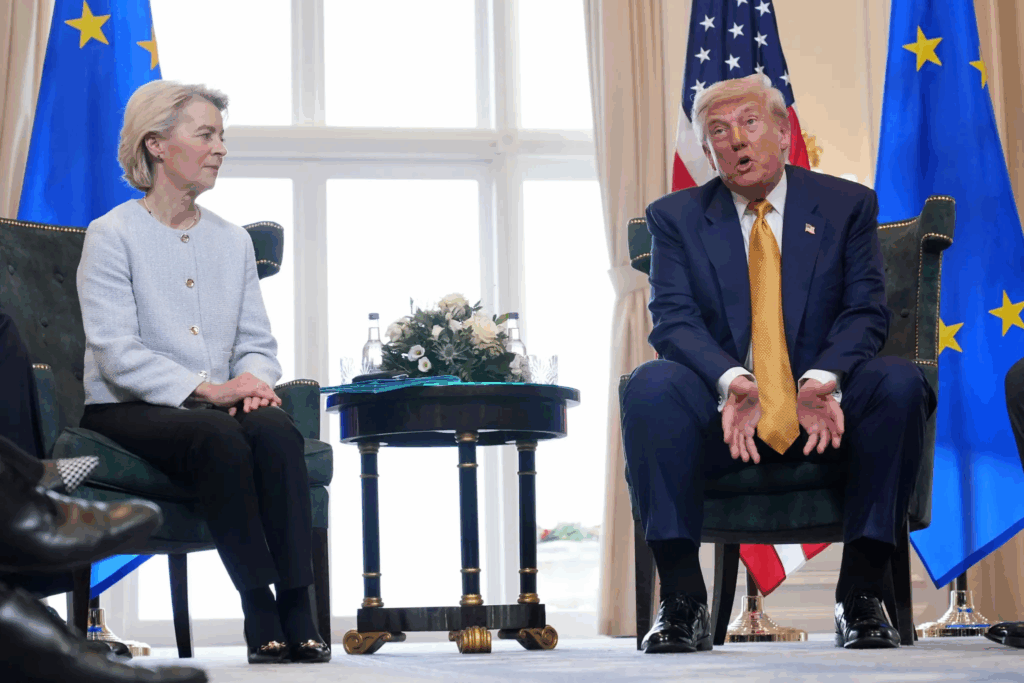
After months of tension, Trump met with Ursula von der Leyen on July 27, 2025, at Trump’s Scottish golf resort. The two leaders spent just 75 minutes in private talks before their joint announcement of an agreement. Von der Leyen described the negotiations as “very difficult” but hailed Trump as a “tough negotiator,” to which Trump added, “and fair.” Both leaders indicated the deal was achievable after some sticking points were resolved, noting that prior to talks the chances of striking an agreement were 50-50.
Why Are the Tariffs Set at 15%?
The 15% tariff is a middle ground reflecting earlier U.S. agreements with other countries like Japan. European officials initially sought a 10% tariff mirroring the U.S. baseline for foreign goods, but Trump held firm on 15%. This rate remains half of the threatened 30% “Liberation Day” tariff Trump warned would take effect August 1 if no deal was reached. Trump also confirmed no delay on this deadline in remarks following the agreement.
What Are the Key Areas of Impact?
Trade and Industry
- The new tariffs are expected to raise the cost of European goods entering the U.S., shifting trade balances and potentially impacting American consumer prices.
- U.S. automakers and farmers, hit previously by tariffs, stand to gain relief through lowered EU trade barriers and investments.
- Steel and aluminum tariffs remain high, with the EU exploring quota mechanisms to soften the impact.
- Pharmaceuticals remain excluded, reflecting Trump’s push to boost U.S. drug manufacturing.
Strategic and Military Cooperation
- A significant element is the EU’s purchase commitment for American military equipment, reinforcing transatlantic defense ties. The exact scope remains unspecified.
Economic Scale
- The vast scale ($1.6 trillion) of this agreement marks it as one of the largest recent trade deals, covering goods, services, and investments across transatlantic markets.
What Do Experts and Politicians Say?
Republican lawmakers have celebrated the deal as a major win:
- Rep. Ashley Hinson called it “another historic trade deal.”
- Commerce Secretary Howard Lutnick called it a “significant breakthrough,” highlighting the EU’s opening of its large market to U.S. standards.
- Stephen Miran, chair of the Council of Economic Advisers, challenged skeptics, encouraging apologies to Trump for doubting the ability to enforce 15% tariffs without retaliation.
Conversely, some economists warn about potential downsides:
- Concerns over protectionism leading to higher consumer prices.
- Potential impacts on U.S. economic growth if tariffs and investment restrictions tighten too much.
Why Does This Deal Matter?
This deal shifts a crucial axis of global trade policy by recalibrating the world’s two biggest economies’ tariff relations. It signals:
- A tougher U.S. trading stance is willing to enforce tariffs on close allies for better terms.
- A template for future negotiations with other major partners like China, Canada, and Mexico.
- A strategic economic partnership that blends market access with defense cooperation.
What’s Next?
Trump has announced similar preliminary deals with other nations and indicated ongoing work toward broader agreements by mid-August. The real effects of the EU deal will depend on implementation details, enforcement, and any retaliatory measures.