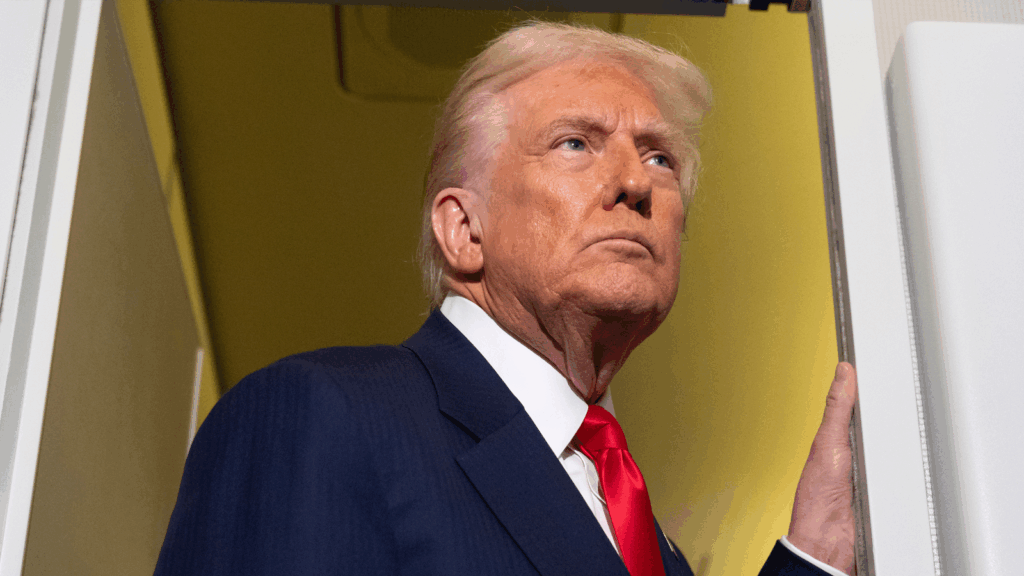
President Donald Trump has called on Senate Republicans to invoke the “nuclear option,” eliminating the filibuster, to pass a spending bill and end a government shutdown that has now lasted more than a month. The move has divided GOP leadership, who argue that scrapping the filibuster could damage Senate traditions and deepen partisan divides in Washington.
What’s happening in Washington?
The U.S. government has been partially shut down for more than 30 days, one of the longest in the nation’s history. Federal agencies are closed, salaries for government employees have gone unpaid, and key programs like tax credits have expired.
Amid mounting frustration, President Donald Trump urged Senate Republicans to end the filibuster, a long-standing procedural rule that allows the minority party to block legislation by extending debate indefinitely. Trump wants Republicans to use the “nuclear option,” which would let them pass a funding bill with a simple majority, bypassing Democratic opposition.
The Senate, gridlocked over funding disputes, is set to reconvene on November 3 to continue negotiations.
What exactly is the filibuster?
The filibuster is a procedural tool unique to the U.S. Senate that allows lawmakers to delay or block votes on legislation by prolonging debate.
- Origins: The practice wasn’t written into the Constitution. In 1806, Vice President Aaron Burr proposed removing the “previous question” motion, unintentionally allowing unlimited debate.
- Modern Rules: To overcome a filibuster, 60 senators must vote for “cloture,” a motion to end debate and move to a vote.
- Real-World Impact: This means any legislation without 60 votes in favor can effectively be stalled indefinitely.
In its early history, the filibuster was often used to block civil rights legislation, and in recent decades, both parties have used it to prevent major bills from advancing.
Why does the filibuster matter so much?
Supporters argue that the filibuster protects minority rights and forces bipartisan compromise. It prevents the Senate from becoming a majoritarian chamber like the House of Representatives.
Critics, however, see it as a tool for legislative paralysis. They say it allows a small minority of senators to block bills supported by most Americans, even those addressing urgent issues like government funding or healthcare reform.
As one former Senate staffer put it, the filibuster has become “a veto power for the minority.”
How has the filibuster been bypassed before?
The so-called “nuclear option” has been used twice, but never for general legislation.
- 2013: Democrats eliminated the filibuster for most judicial nominations, frustrated by Republican blockades.
- 2017: Republicans extended that move to Supreme Court nominees, allowing Justice Neil Gorsuch’s confirmation by a simple majority.
If applied to ordinary legislation, it would allow any ruling party with 51 votes to pass sweeping laws without bipartisan input, a move that could reshape U.S. governance for decades.
What’s Trump demanding, and why now?
Trump’s frustration stems from Senate Democrats repeatedly blocking Republican stopgap funding bills. Without their support, the GOP cannot reach the 60-vote threshold required to end debate.
By pushing to end the filibuster, Trump hopes to fast-track a Republican-only funding bill to reopen the government. He argues that the rule is outdated and obstructive.
However, critics warn that Trump’s demand is politically risky. Once eliminated, the filibuster cannot easily be restored, and Democrats could use the same simple-majority power in the future to push through their own agenda.
Will Senate Republicans agree?
Unlikely.
Senate Majority Leader John Thune and several senior Republicans have expressed opposition to eliminating the filibuster, viewing it as a pillar of Senate tradition. They fear that scrapping it could permanently damage the chamber’s reputation as a forum for deliberation and compromise.
“The filibuster is what makes the Senate the Senate,” one Republican senator reportedly said. “End it, and we become just another version of the House.”
Their stance highlights a broader concern: while ending the filibuster might help Republicans now, it could backfire when power shifts.
What happens next?
The Senate’s next session on November 3 is expected to be contentious. Without a bipartisan breakthrough, the shutdown could continue, deepening economic and political fallout.
If Republicans resist Trump’s call, the focus may shift to negotiations over a narrower funding bill that can attract limited Democratic support.
Meanwhile, the filibuster debate has reignited long-standing questions about how, or whether, the U.S. government can function effectively in an era of deep partisan divide.
A quick history of the filibuster’s evolution
| Year | Event | Significance |
|---|---|---|
| 1789 | Senate rules allowed unlimited debate | Changed the balance of power in confirmations |
| 1806 | VP Aaron Burr removed “previous question” motion | Opened the door to unlimited debate |
| 1917 | The early Senate had no formal debate limits | Allowed a two-thirds majority to end the debate |
| 1975 | Cloture threshold reduced to 60 votes | Made ending filibusters slightly easier |
| 2013 | Republicans extended to the Supreme Court nominees | Changed balance of power in confirmations |
| 2017 | Democrats used the nuclear option for most nominations | Enabled confirmations by simple majority |
The bigger picture
The filibuster debate isn’t just about a shutdown, it’s about how America governs itself.
Supporters see it as a safeguard against rash policymaking. Critics see it as a symbol of dysfunction that keeps Congress from solving real problems.
Trump’s push has revived a long-running tension between governing efficiency and institutional stability. Whether Republicans take the nuclear route or not, the filibuster question will likely shape U.S. politics long after this shutdown ends.