
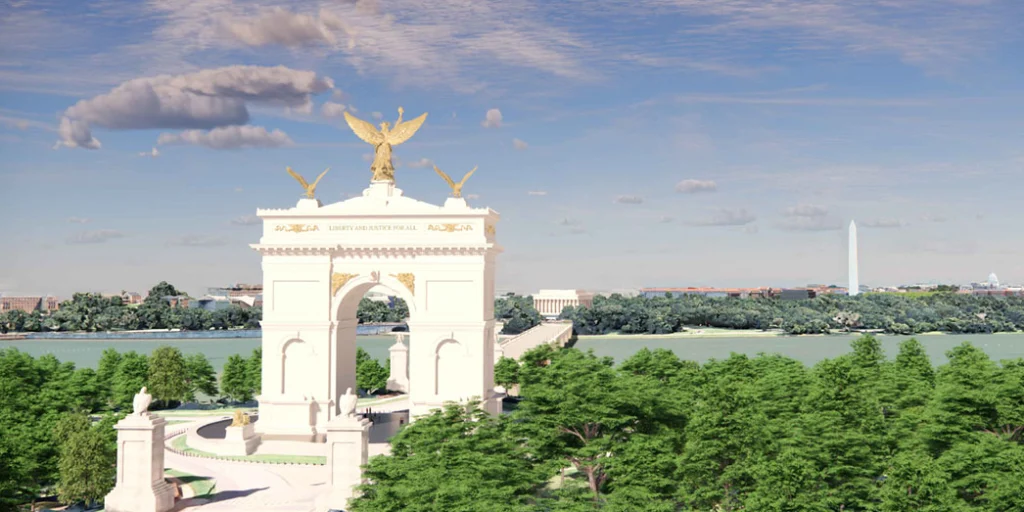
The Trump administration has unveiled design renderings for a towering new monument—the proposed “Triumphal Arch,” also referred to as the “Independence Arch”—as part of plans to mark America’s 250th anniversary of independence.
Set to rise at Memorial Circle, at the western end of the Arlington Memorial Bridge, the structure would sit across the Potomac River from the Lincoln Memorial—placing it in one of the most symbolically charged landscapes in the United States.
The proposal is already drawing attention not just for its scale and design, but also for questions around funding, legality, and its visual impact on the National Mall.
What Is the “Independence Arch” Proposal?
The proposed monument is envisioned as a centerpiece of the United States’ 250th Independence anniversary celebrations, often referred to as the semiquincentennial.
Key Details at a Glance
- Height: 250 feet
- Location: Memorial Circle, Arlington Memorial Bridge
- Purpose: Commemorate 250 years of American independence
- Design firm: Harrison Design
- Status: Submitted to the U.S. Interior Department and the Commission of Fine Arts
At 250 feet, the structure would be more than double the height of the Lincoln Memorial (100 feet) and significantly taller than Paris’ Arc de Triomphe, which stands at about 165 feet.
The scale alone places it among the most ambitious monument proposals in modern U.S. history.
What Would the Monument Look Like?
The design leans heavily into neoclassical architecture, echoing European triumphal arches while layering in distinctly American symbolism.
Core Design Features
- A 60-foot gilded Lady Liberty statue crowning the arch
- Two golden eagles flanking the top
- Four golden lions positioned at the base
- Prominent inscriptions, including:
- “One nation under God”
- “Liberty and Justice for All”
The visual language draws direct comparisons to classical imperial arches, particularly the Arc de Triomphe, but scales it up dramatically.
The Architect Behind the Vision
The project involves architect Nicolas Leo Charbonneau, described by sources as a specialist in sacred and classical architecture.
A source familiar with the project characterized him as “a classical architect, not just someone replicating columns,” suggesting an effort to position the design as authentic rather than derivative.
Why This Location Matters
The proposed site is not incidental—it sits at a critical visual and symbolic axis in Washington, D.C.
A Contested Sightline
The arch would stand along the line connecting the following:
- The Lincoln Memorial
- The Arlington National Cemetery
Critics argue that placing a massive structure here could:
- Obstruct historic sightlines
- Alter the visual balance of the National Mall
- Disrupt the contemplative character of existing memorials
Who Is Funding the Project?
Funding has become one of the most contentious aspects of the proposal.
Initial Claims vs. Current Reality
Initially, Donald Trump stated that the arch would be privately funded, potentially linked to the proposed White House Ballroom project.
However:
- The $400 million ballroom initiative has been halted by a federal judge, pending congressional approval
- The administration has appealed the ruling
- Federal budget documents now indicate that at least $15 million in taxpayer funds have been allocated through the National Endowment for the Humanities
This shift—from private to partial public funding—has intensified scrutiny and political pushback.
Legal Challenges and Opposition
The project is already facing legal resistance, particularly from veterans’ groups.
Lawsuit from Vietnam War Veterans
A group of Vietnam War veterans has filed suit seeking to halt construction, citing:
- Lack of congressional approval
- Improper use of federal funds
- Potential disruption of historic memorial views
Their argument centers on both procedural concerns and cultural preservation, framing the arch as incompatible with the existing memorial landscape.
Broader Concerns
Beyond the lawsuit, critics have raised additional questions:
- Should new monumental architecture rival or overshadow existing landmarks?
- Does the design align with the historical tone of Washington’s core monuments?
- What precedent does this set for future large-scale additions?
Why the Proposal Is So Polarizing
The “Independence Arch” sits at the intersection of architecture, politics, and national identity.
Supporters Say:
- It’s a bold tribute to America’s 250th anniversary
- The scale reflects the significance of the milestone
- Classical design reinforces continuity with historical traditions
Critics Argue:
- It risks overwhelming existing landmarks
- The funding process lacks transparency
- The symbolism may feel politically charged rather than unifying
This divide reflects a broader debate about how nations commemorate history—and who gets to decide.
What Happens Next?
The project is still in the proposal and review phase, with several hurdles ahead:
Key Steps to Watch
- Review by the U.S. Commission of Fine Arts
- Approval (or rejection) by Congress
- Outcome of ongoing legal challenges
- Public and political response
Given the scale, cost, and location, the project is unlikely to move forward quickly—or quietly.
TL;DR
- The Trump administration has proposed a 250-foot “Independence Arch” for America’s 250th anniversary.
- It would be located near the Arlington Memorial Bridge, across from the Lincoln Memorial.
- The design includes gilded statues, eagles, and patriotic inscriptions.
- Funding has shifted from private claims to partial public money, raising concerns.
- A lawsuit from Vietnam War veterans challenges the project’s legality and impact.
- The proposal has sparked a wider debate over architecture, symbolism, and national identity.