
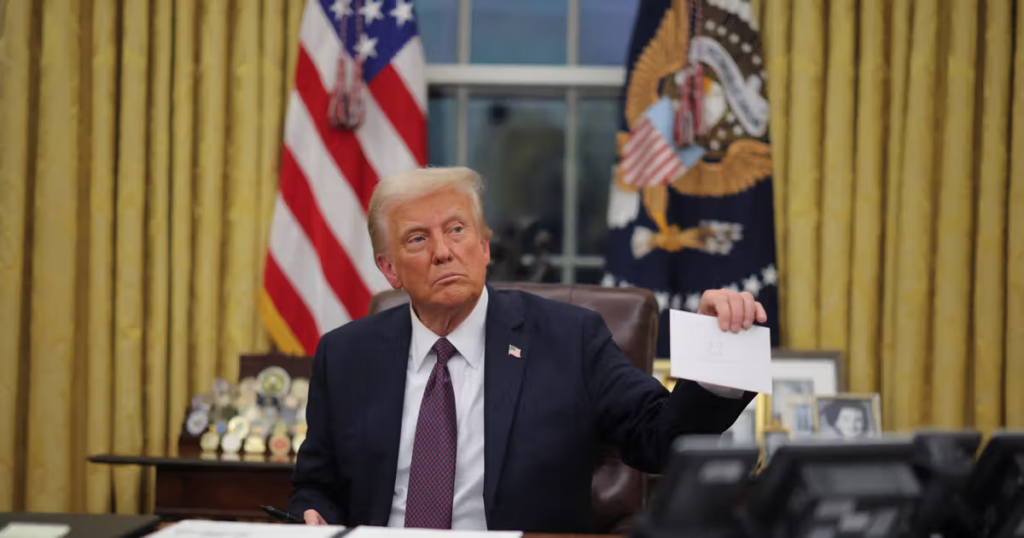
US President Donald Trump has injected fresh volatility into US–Iran relations by claiming that Tehran halted 800 planned executions following American pressure, while warning that “all options” remain on the table if Iran’s violent crackdown on protesters continues.
The statement, delivered by the White House and amplified through official briefings, is not just a humanitarian claim. It is a calculated escalation signal, one designed to project leverage, deterrence, and moral authority at a moment when Iran is facing sustained internal unrest and growing international scrutiny.
TL;DR
- The White House claims Iran stopped 800 planned executions after pressure from Donald Trump
- The US has imposed new sanctions targeting Iranian security officials
- Trump’s team insists “all options” remain available, including military action
- The execution claim is unverified publicly, but strategically significant
- The messaging blends human rights pressure with classic deterrence signaling
What is Trump claiming about Iran and the executions
According to the White House, Trump was informed that Iran had halted 800 executions that were scheduled to take place amid nationwide protests. The claim was delivered publicly by White House Press Secretary Karoline Leavitt, who framed the development as a direct consequence of US pressure.
The administration presented the pause as evidence that Iran’s leadership is responsive, at least partially, to direct warnings from Washington. The emphasis was not only on saving lives but also on demonstrating influence over a regime that routinely dismisses Western criticism.
There has been no independent confirmation from Iranian authorities or international watchdogs regarding the alleged execution halt. However, the White House has not retreated from the claim, instead repeating it as proof that Trump’s approach is already producing tangible outcomes.
In parallel, the administration stressed that Trump is “closely monitoring the situation on the ground,” language intended to underscore personal involvement and executive control over any next steps.
Why the US is escalating rhetoric now
The timing of this announcement matters.
Iran is facing sustained protests that challenge the authority of its theocratic leadership. These demonstrations, unlike many previous episodes of unrest, have spread geographically and socially, drawing in students, workers, and minority communities. The regime’s response has been harsh, with reports of mass arrests, violent crackdowns, and death sentences linked to protest activity.
By highlighting executions rather than street violence alone, the US reframes the crisis around irreversible state actions. Executions carry a moral finality that sanctions statements and diplomatic condemnations often lack. They also resonate more powerfully with international audiences and human rights organizations.
For Trump, this framing serves multiple purposes:
- It elevates the stakes of Iran’s actions
- It justifies tougher US measures under a humanitarian rationale
- It positions Washington as an active deterrent rather than a passive observer
The rhetoric also lands at a moment when Iran’s regional posture remains tense, with proxy conflicts and nuclear concerns never far from diplomatic discussions.
How “all options remain on the table” functions as a signal
The phrase “all options remain on the table” is familiar in US foreign policy, especially in dealings with Iran. But under Trump, that language has historically carried sharper edges.
During his previous tenure, similar phrasing preceded:
- Expanded sanctions campaigns
- Targeted military strikes
- Aggressive maritime and air force posturing
At the same time, it has also been used as a deterrent without immediate follow-through, designed to freeze adversaries into caution rather than provoke outright conflict.
In this case, the White House has been careful to avoid specifying what those options are. Press Secretary Karoline Leavitt dismissed reports suggesting imminent military action, calling them speculative and based on anonymous sourcing.
That ambiguity is intentional. It keeps Tehran guessing, reassures domestic audiences of strength, and avoids committing the US to a timeline or specific course of action.
These are the pressure tools the US is using against Iran
Here’s a breakdown of how Washington is applying pressure across multiple fronts:
| Pressure Tool | How It’s Being Used | Strategic Purpose |
|---|
| Targeted sanctions | New measures against Iranian security officials | Raise internal regime costs |
| Public execution claims | Highlighting alleged halt of 800 executions | Frame US leverage as effective |
| Military ambiguity | “All options on the table” messaging | Deter further escalation |
| Diplomatic isolation | Reinforcing Iran’s pariah status | Limit international sympathy |
| Media signaling | High-visibility briefings | Shape global narrative |
The sanctions announced alongside the rhetoric target senior figures involved in internal security decisions, including officials accused of authorizing violence against protesters. The US Treasury’s move signals that Washington is focusing not just on institutions but on individual decision-makers.
What this means for Iran’s leadership
From Tehran’s perspective, the US messaging presents a complex challenge.
Backing down publicly risks projecting weakness, especially amid domestic unrest. Ignoring the pressure entirely, however, raises the risk of further sanctions or even limited military action that could worsen Iran’s economic and security position.
If executions were indeed paused, even temporarily, it suggests that Iran’s leadership is calibrating its response to avoid crossing certain international red lines. That does not indicate reform, but it does indicate sensitivity to external pressure when internal stability is already strained.
The emphasis on executions also places Iran’s judiciary and security apparatus under a brighter spotlight, potentially complicating internal power dynamics among hardliners and pragmatists.
What this means for protesters on the ground
For protesters, US involvement is a double-edged sword.
On one hand, international attention and pressure can limit the regime’s willingness to employ its most extreme measures. The possibility that executions were delayed or halted, even briefly, would be a meaningful reprieve for those facing death sentences.
On the other hand, overt US pressure can feed the regime’s narrative that protests are foreign-backed, justifying further repression behind closed doors.
Historically, Iranian protest movements have survived not because of foreign intervention, but because of sustained internal momentum. External pressure can help at the margins, but it rarely determines outcomes on its own.
How could this escalate or de-escalate next
Several paths remain plausible.
Escalation could take the form of:
- Additional US sanctions
- Cyber operations or covert actions
- Limited military strikes framed as deterrence
De-escalation could emerge if:
- Iran quietly reduces executions and visible repression
- Protests lose momentum without mass bloodshed
- Diplomatic backchannels succeed in lowering tensions
What is unlikely, at least in the short term, is a dramatic diplomatic breakthrough. The rhetoric from both sides suggests posturing rather than reconciliation.
Why this claim matters even if it’s disputed
Even without independent verification, the execution halt claim matters because of how it is being used.
It allows the Trump administration to argue that pressure works. It reframes sanctions and threats not as abstract policy tools, but as life-saving interventions. And it raises the political cost for Iran if executions resume, since doing so would now contradict a widely publicized narrative.
The claim also places international media and human rights groups in a reactive position, forcing scrutiny of Iran’s judicial actions in the days and weeks ahead.
As reported by Reuters, the White House has made clear that Trump alone will decide how far to push this confrontation, with only a small circle of advisers involved in those deliberations.
How this situation can evolve and what you should watch next
The most important indicators going forward will not be rhetoric alone, but actions.
Watch for:
- Whether Iran resumes or quietly continues execution pauses
- Expansion of US sanctions beyond symbolic targets
- Shifts in military posture in the Gulf region
- Changes in protest intensity inside Iran
For now, Trump’s message is clear. The US is positioning itself as both a moral and strategic actor, willing to claim credit for lives spared while keeping the threat of force deliberately unresolved.
Whether that approach reduces violence or merely reshapes it remains the central question.