
Suspense continues to hang over Venezuela’s political future following the US-led military operation that resulted in the capture of President Nicolas Maduro. As questions swirl around who could lead the country next, a new report suggests that a personal grievance may be shaping Washington’s political calculations.
According to The Washington Post, US President Donald Trump is reluctant to endorse Venezuelan opposition leader Maria Corina Machado because she accepted the Nobel Peace Prize, an award Trump himself had long sought.
Why Trump is reportedly unhappy with Maria Machado
Citing two unnamed individuals close to the White House, the Washington Post reported that Machado’s acceptance of the Nobel Peace Prize was seen as an unforgivable misstep in Trump’s inner circle. One source described it as the “ultimate sin,” while another claimed the decision cost her a real chance at leading Venezuela.
According to the report, one of the sources said that had Machado declined the prize and publicly credited Trump, she might already be Venezuela’s president. The remark highlights how deeply personal recognition and perceived slights can influence Trump’s political endorsements.
For much of 2025, Trump openly promoted himself as a contender for the Nobel Peace Prize, repeatedly citing his role in resolving multiple international conflicts. Despite vocal support from allies, he ultimately did not receive the award.
Why Maria Machado is back in focus now
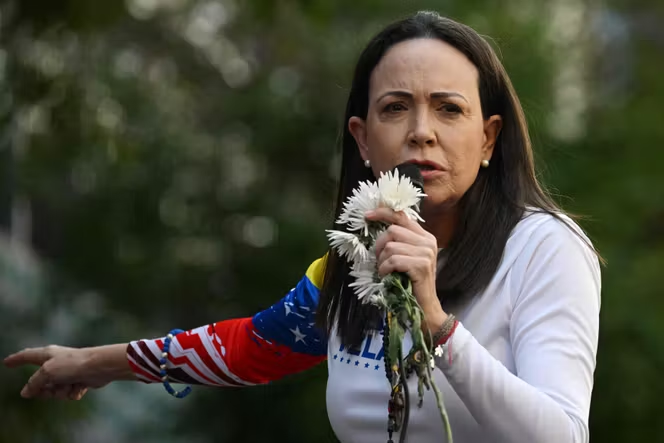
Machado, who won the 2025 Nobel Peace Prize, has returned to the global spotlight following the US operation in Venezuela and Maduro’s removal from power. Long regarded as one of the most prominent opposition figures in the country, she was widely viewed as a potential beneficiary of Maduro’s downfall.
Those expectations were tempered after Trump publicly questioned her political standing. While describing her as a “nice woman,” he said she lacked sufficient support and respect within Venezuela. He also stated that the United States would not allow anyone to simply take over from where Maduro “left off,” signaling a more controlled and possibly prolonged transition.
Machado’s stance on the US operation
Despite Trump’s reported frustration, Machado has openly supported the US action against Maduro. In a post on X following the operation, she hailed the development as a turning point for Venezuela.
In her message, she said it was time for freedom and argued that Maduro would now face international justice for crimes committed against Venezuelans and citizens of other countries. Her statement aligned closely with Washington’s justification for the operation, even as Trump withheld political endorsement.
Machado is believed to be in Oslo, Norway, where she traveled last month to formally receive the Nobel Peace Prize. Reports say her departure from Venezuela involved elaborate security measures, including disguises, boat transfers through rough seas, and a flight out of the country after more than a year spent in hiding.
What Trump has said about Venezuela’s political future
As attention shifts from Maduro’s capture to the question of governance, Trump has downplayed the idea of immediate elections. Speaking to reporters on Monday, he said the priority was fixing Venezuela rather than rushing into a vote.
His comments echoed those of US Secretary of State Marco Rubio, who has said elections would be premature at this stage. Trump also warned that the United States could carry out a second strike if authorities in Venezuela fail to “behave,” reinforcing the administration’s hardline posture.
What this means for Venezuela’s next phase
The report underscores how Venezuela’s transition may depend as much on Washington’s internal politics as on dynamics inside the country itself. Machado remains a symbol of opposition for many Venezuelans, but without clear US backing, her path to leadership appears uncertain.
At the same time, Trump’s reluctance to endorse any immediate successor suggests the US may favor a longer period of oversight or restructuring before supporting a new political figure.
As Venezuela moves into an uncharted phase, the intersection of personal politics, international recognition, and geopolitical strategy is shaping outcomes in ways few could have predicted.