
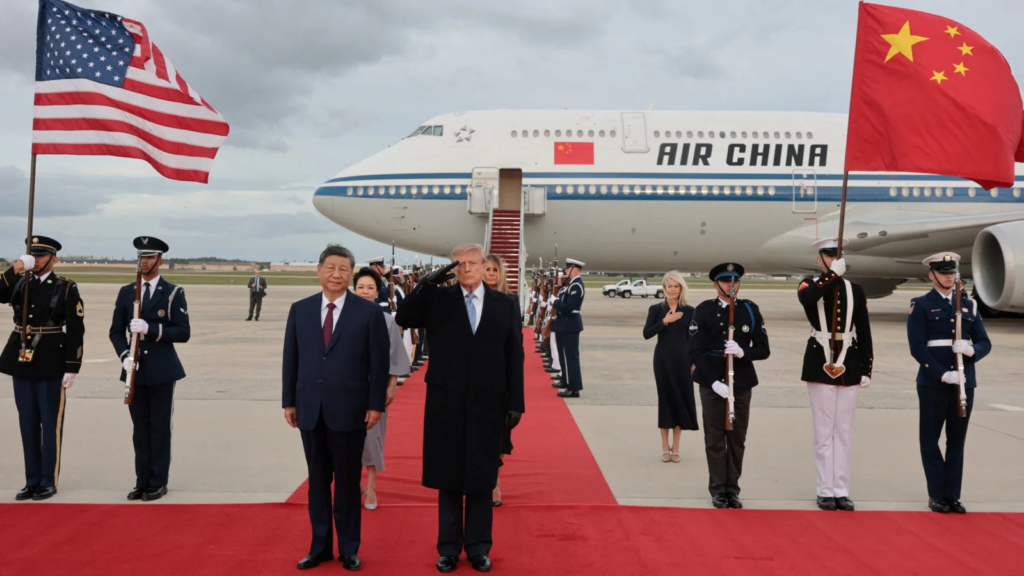
President Donald Trump gave Chinese President Xi Jinping an unusually personal welcome during Xi’s White House visit, mixing state ceremony with jokes, compliments and a tour of some of the president’s latest additions to the complex. Trump personally greeted Xi at Joint Base Andrews on Wednesday before welcoming him at the White House the following day. During their September 24 meeting, Trump showed Xi the new South Lawn helipad, took him inside Marine One and pointed out a provocative display involving former President Joe Biden.
Trump also repeatedly praised his relationship with Xi, calling it a “truly great friendship”. Xi responded warmly at several moments, but his public remarks remained more focused on the broader US-China relationship and issues such as Taiwan, artificial intelligence and Iran.
That contrast has raised a question about the summit’s underlying dynamic: was this simply Trump’s preferred diplomatic style, or was Xi signalling that he viewed the relationship in much more conventional state-to-state terms?
Trump gives Xi a highly personal White House tour
Trump used the White House setting to showcase more than the formal trappings of a state visit.
He took Xi to the newly completed helipad on the South Lawn, a project Trump had previously said would impress the Chinese leader. The granite landing area was built to accommodate the newer presidential helicopters and was formally inaugurated earlier in the week.
Trump then showed Xi Marine One, the presidential helicopter used for the president’s official travel. The White House itself later published video of Trump giving Xi a tour of both the aircraft and the new helipad.
The tour was unusual because Marine One is not merely a ceremonial helicopter. It is part of the highly secure presidential transportation system, making Trump’s decision to show Xi around the aircraft a visually striking moment during the visit.
Trump makes a joke about Biden in front of Xi
One of the more talked-about moments came inside the White House.
Trump pointed Xi toward an image displayed where former President Joe Biden’s portrait would ordinarily appear. Instead of a conventional portrait, the display referenced an autopen, a device used for mechanically reproducing a person’s signature.
“Trump, and then Trump, and this is the autopen,” Trump said as Xi laughed.
Trump also pointed to a photograph from an earlier meeting with Xi and joked, “Who is that? I don’t recognise him!” before praising the Chinese leader and saying the United States had “a lot of respect” for him.
The exchange was captured on video shared by a White House aide and quickly became one of the most widely discussed images from the visit.
Trump keeps the tone informal
Trump’s interaction with Xi went beyond scripted diplomatic language.
He was seen repeatedly touching Xi’s arm while speaking with him, adding a visibly informal element to the encounter.
At another point, reporters asked the two leaders about major geopolitical disputes involving Iran, Taiwan and artificial intelligence.
Rather than addressing those issues in that moment, Trump talked about Xi’s interest in granite.
“He likes granite,” Trump said, adding that Xi was an expert on stone and appreciated good granite.
Xi briefly laughed at the comment.
The exchange illustrated how quickly Trump moved from high-stakes geopolitical issues to personal conversation and humor during the public portions of the visit.
Xi’s response was warmer, but more measured
Xi did not appear to reject the friendly tone.
He laughed at Trump’s jokes and participated in the informal interaction, including the tour of Marine One.
But the Chinese president’s own remarks were more focused on national interests and the broader relationship between Washington and Beijing.
Xi emphasized the need for both countries to manage their relationship responsibly and coexist peacefully. He also reiterated Chinese concerns over Taiwan and other strategic questions.
That difference in emphasis has become one of the most notable features of the summit.
Trump’s public approach centered heavily on personal rapport. Xi’s language was more consistent with China’s long-standing diplomatic emphasis on sovereignty, stability and state-to-state relations.
Does Xi see Trump as a personal friend?
There is no direct way to measure a leader’s private feelings from a public diplomatic appearance.
What can be observed is how each man framed the relationship.
Trump repeatedly spoke about friendship and personal chemistry. Xi spoke about responsibility, coexistence and the long-term management of bilateral ties.
Ryan Hass, a former Obama administration China adviser and current Brookings Institution expert, highlighted precisely that difference. He wrote that Xi tends to speak in terms of state-to-state relations and power, while Trump emphasizes personal chemistry.
The contrast does not necessarily mean Xi was rejecting Trump’s approach. Chinese diplomacy often places greater emphasis on institutions, national interests and long-term strategic relationships than on the public display of personal rapport.
The airport welcome was part of the message
Trump’s effort to make the visit personal began before Xi reached the White House.
The US president personally went to Joint Base Andrews to greet Xi when he arrived on Wednesday, a rare protocol gesture for an incoming foreign leader.
The administration had announced beforehand that Trump would attend the arrival ceremony, followed by White House meetings and a state dinner.
The unusual airport welcome helped establish the tone that continued during Thursday’s events.
Rather than limiting the encounter to formal meetings, Trump made several visible gestures designed to underscore the importance he placed on the visit.
Why was the helipad so important?
The new helipad has become something of a signature Trump project at the White House.
Trump had repeatedly discussed the granite landing pad during the months before Xi’s arrival, including how it would accommodate the newer presidential helicopters and protect the South Lawn.
The project was also part of a wider set of White House renovations pursued during Trump’s second term.
That made the helipad more than an aviation facility during Xi’s visit. It became part of the presentation Trump wanted to make to the Chinese leader.
Trump’s decision to personally show Xi the site turned an infrastructure project into a diplomatic backdrop.
Why did Trump show Xi Marine One?
Marine One is one of the most recognizable symbols of the US presidency.
While the term refers to the presidential helicopter when the president is aboard, the aircraft themselves are specially configured for secure executive transportation.
Showing Xi the interior of Marine One was therefore a more unusual gesture than simply pointing out the helicopter on the South Lawn.
Associated Press reporting said Trump and Xi entered the helicopter with a small group of aides and interpreters, spoke with pilots and looked around the aircraft before leaving.
The moment reinforced the highly informal character of parts of the visit even as the two governments were negotiating serious issues behind closed doors.
What were the bigger issues behind the ceremony?
The friendly imagery should not obscure the difficult agenda facing Washington and Beijing.
The two governments continue to compete over trade, advanced technology, artificial intelligence and critical minerals.
Taiwan remains one of the most sensitive issues in the relationship, while Iran has also become part of the wider geopolitical discussion.
The summit was therefore taking place in an environment where economic cooperation and strategic competition exist simultaneously.
Trump and Xi may exchange smiles in front of cameras, but their governments still have sharply different positions on several major issues.
AI adds another layer to the relationship
Artificial intelligence was another major topic surrounding the summit.
Trump has argued that the United States should continue accelerating AI development and has recently promoted the term “super intelligence” to describe the technology.
China, meanwhile, has pushed for greater discussion of AI governance and safety while seeking to maintain its own technological development.
The issue is particularly sensitive because AI has both commercial and national-security implications.
The two countries are competing over advanced chips, computing infrastructure, software capabilities and access to talent, making AI both a potential area of cooperation and another arena of strategic rivalry.
Taiwan remains a fundamental dividing line
The friendly atmosphere also did not erase the disagreement over Taiwan.
Beijing regards Taiwan as part of China and opposes US military support for the island.
Washington does not maintain formal diplomatic relations with Taiwan but has longstanding security and economic ties with Taipei.
Xi used the summit period to reiterate China’s position on Taiwan and stressed the importance of how Washington approaches the issue.
Trump, meanwhile, did not publicly offer a major new concession on Taiwan during the highly visible portions of the visit.
That leaves the issue unresolved despite the carefully managed public warmth.
Trade may be where the relationship gets practical
The economic relationship provides the clearest area where both governments have incentives to prevent further deterioration.
US and Chinese officials have been working to extend a trade truce while addressing tariffs, rare-earth exports, agricultural purchases and other commercial disputes.
A two-month extension of the existing trade truce was announced shortly before or during the summit period, offering both sides additional time to negotiate.
That development gives the friendly public atmosphere a practical context. Both governments have reasons to stabilize trade even while their strategic competition continues.
Xi’s state visit has symbolic value for China too
The summit is not only about what Trump wants to display.
For Beijing, a full state visit to the White House provides Xi with a high-profile demonstration of China’s importance in the US relationship.
That symbolism matters because the two countries are competing for influence across trade, technology, diplomacy and global institutions.
Judith Shapiro, a China specialist at American University, told AFP that the visit could be understood partly through the lens of China’s desire for recognition and respect.
From that perspective, the White House ceremony itself is part of the diplomatic outcome, regardless of whether the leaders reach breakthroughs on the most contentious issues.
Personal chemistry versus strategic interests
The Trump-Xi meeting highlights a recurring tension in high-level diplomacy.
Leaders can establish rapport without resolving their governments’ underlying disputes.
A warmer personal relationship can help prevent negotiations from collapsing, create channels for communication and make it easier to manage crises.
But personal chemistry does not eliminate differences over territory, technology, trade or national security.
The public scenes at the White House therefore tell only part of the story.
Trump’s gestures toward Xi were unmistakably warm. Xi appeared willing to participate in that atmosphere. But the substance of the relationship remains defined by competing national interests.
Why the optics matter
Diplomatic optics can influence how both countries present a summit to their domestic audiences.
Trump can point to the state visit, airport welcome and personal interaction as evidence of a functioning relationship with Xi.
Beijing can point to Xi’s reception at the White House as recognition of China’s status as a major global power.
At the same time, neither side has to abandon its position on difficult issues to participate in the ceremony.
That is what makes the imagery so interesting: the warmth is real as a diplomatic performance, but it exists alongside unresolved strategic disagreements.
What did Xi and Trump actually accomplish?
The summit’s public symbolism was easier to see than any transformative policy breakthrough.
The two sides continued talks on trade and technology, while issues including Taiwan, AI and Iran remained difficult.
The immediate value of the meeting therefore appears to lie partly in maintaining direct communication and preventing the relationship from sliding back into an uncontrolled confrontation.
Whether that stability lasts will depend on what happens after the cameras disappear.
What happens next?
Xi’s state visit concludes after a series of formal meetings, ceremonial events and the White House state dinner.
The next test will be whether the cordial atmosphere translates into concrete follow-through on trade, technology and other areas of disagreement.
For Trump, the visit allowed him to present Xi with the highly personal diplomacy he has favoured with major foreign leaders.
For Xi, the White House reception provided a platform to reaffirm China’s status and positions while keeping direct communication with Washington open.
The images from the visit may be remembered for the jokes, the granite and the Marine One tour.
But behind those scenes remains a relationship defined by competition as much as cooperation, with Taiwan, AI, trade and broader strategic influence still unresolved.
The question is therefore not simply whether Trump and Xi looked friendly.
It is whether the carefully staged warmth can survive the hard negotiations that follow.