
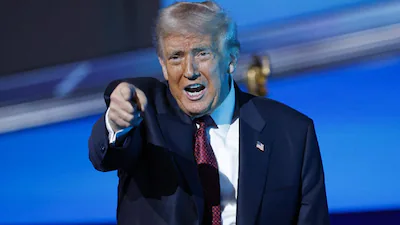
President Donald Trump says he plans to sue the BBC for $1–5 billion over an edited video of his 2021 speech that the broadcaster admits created a misleading impression. The controversy has already triggered senior resignations inside the BBC and sparked political ripples in both Washington and London.
Why Trump Is Threatening a Multi-Billion-Dollar Lawsuit Against the BBC
President Donald Trump has signaled that he will file a lawsuit seeking up to $5 billion from the BBC, accusing the British broadcaster of defamation and “cheating” after it aired an edited clip of his speech ahead of the January 6 Capitol riot.
The lawsuit threat, Trump’s most aggressive move yet in the dispute, comes after the BBC acknowledged the edit “wrongly gave the impression” that Trump directly urged violent action.
Trump told reporters aboard Air Force One:
“We’ll sue them for anywhere between a billion and five billion dollars… They’ve even admitted that they cheated.”
What Sparked the Controversy?
On Monday, the BBC confirmed that an edited segment of Trump’s 2021 speech was broadcast in a way that implied he had directly called for violence before the Capitol riot. According to the broadcaster, the clip was shortened in a manner that removed important context.
BBC Leadership Fallout
The mistake triggered swift consequences inside the organization:
- The director-general resigned.
- The head of news also stepped down.
- The BBC’s chair, Samir Shah, sent a letter to Trump acknowledging the error and apologizing.
The apology stated that both he and the corporation were “sorry for the editing of the president’s speech,” as reported in a BBC statement shared with major news agencies.
How Big Is Trump’s Legal Claim and Is It Realistic?
Trump told reporters the lawsuit would be filed “probably some time next week,” and that damages could reach $1–5 billion.
For context, defamation awards—especially against major media organizations, rarely cross into the billions. But Trump’s history with aggressive legal posturing makes the threat newsworthy regardless of the eventual outcome.
What Trump Is Arguing
Based on statements so far, Trump appears to be asserting:
- The edited clip harmed his reputation.
- The BBC admitted fault (a potential linchpin for a defamation claim).
- The organization acted negligently or maliciously.
Where Legal Experts May Disagree
Under U.S. law, public figures must prove “actual malice”—that the broadcaster knowingly or recklessly aired false information.
Even with an apology, this threshold is notably hard to meet.
A good external source to cite would be a First Amendment or media law scholar from a U.S. university (e.g., Columbia Journalism School or Harvard’s Berkman Klein Center).
Why Trump Is Bringing the UK Into the Conversation
Trump insisted that “the people of the UK are very angry” and labeled the BBC “fake news.”
There’s no evidence of widespread public outrage, but the BBC remains a national institution, and missteps tend to attract heavy scrutiny in Britain.
Where Prime Minister Keir Starmer Fits In
Trump also claimed he would raise the matter with UK Prime Minister Keir Starmer, saying Starmer is “very embarrassed.”
Starmer’s public stance so far:
- He has defended the independence of the BBC.
- He has not taken sides in the dispute.
- He has avoided direct criticism of Trump.
This tension—Trump invoking political embarrassment vs. Starmer prioritizing institutional independence, adds a diplomatic wrinkle.
Consider embedding a quote box here, highlighting Starmer’s past statements on media freedom.
Why the BBC Error Matters Beyond One Incident
The controversy touches a larger debate about:
1. Media Trust and Accountability
The BBC’s misstep comes at a time when misinformation claims, political bias accusations, and polarized audiences have already put news organizations under intense scrutiny.
2. Trump’s Ongoing Narrative Against “Fake News”
Trump has repeatedly targeted the U.S. press. Expanding his criticism to the BBC gives him a new international stage for an old talking point.
3. The Power of Edited Clips
Shortened or out-of-context video segments can dramatically affect public perception.
A suggested visual: an infographic showing how selective editing can change the meaning of political speech.
4. Diplomatic Sensitivities
Trump floating the matter in discussions with the UK prime minister underscores how media controversies can bleed into foreign relations—especially with a partner nation where public broadcasting holds symbolic weight.
What Happens Next?
If Trump Files the Lawsuit
- It would likely be filed in U.S. courts.
- The BBC’s legal exposure would depend on jurisdictional issues, the content aired, and where it was shown.
- The case could take years, even if dismissed early.
If He Doesn’t
- The threat alone may shape public perception during an election cycle.
- Media organizations might tighten editorial checks to avoid high-profile mistakes.
For the BBC
Even with apologies and resignations, the broadcaster will face questions about oversight, editorial standards, and political neutrality.
For readers seeking broader context, consider linking to pieces on:
- The BBC’s internal governance.
- Defamation law in the U.S. vs. the UK.
- Past disputes between political leaders and media organizations.
The Bigger Picture
Trump suing the BBC—or threatening to—signals the collision of three powerful forces:
- Political narratives that thrive on media conflict.
- Institutional missteps that can reverberate globally.
- A digital ecosystem where a few seconds of video can reshape public debate instantly.
Whether the lawsuit materializes or fades, the incident is another reminder of how fragile public trust is—and how quickly a single edit can ignite an international political firestorm.