
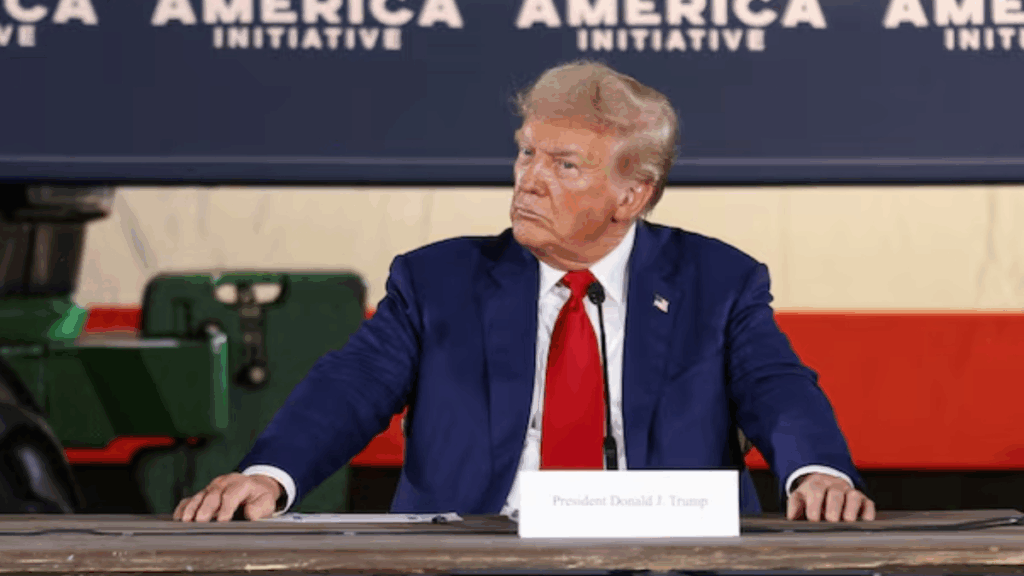
Why are Trump’s new tariffs making headlines?
President Donald Trump is officially setting the stage for another major round of tariffs—this time potentially affecting up to a dozen countries, with import duties as high as 70%. The announcement follows the passage of his multi-trillion-dollar spending bill, dubbed the “Big Beautiful Bill”, as Trump looks for new ways to fund his administration’s domestic agenda.
Starting August 1, select nations will begin receiving formal notices outlining the tariffs. While some countries, including China, Vietnam, and the UK, have secured deals to soften the blow, most others—including India—are still negotiating in hopes of avoiding the full brunt of Trump’s economic retaliation.
The move signals a dramatic shift in U.S. trade policy with implications for global commerce, supply chains, and inflation—all in the run-up to the 2026 midterm elections.
What exactly is Trump proposing?
Letters go out July 5, tariffs hit August 1
Trump confirmed on July 3 that his administration would begin issuing formal letters to about 10–12 nations starting July 5, with others to follow. These notices will officially inform trading partners of the impending tariffs. As per Trump’s declaration, there will be no extension to the previously set July 9 negotiation deadline.
Tariff range: 10% to 70%
The announced tariff bands are broad:
- Lower-tier tariffs: 10–20%
- Mid-tier tariffs: 40%
- Top-tier tariffs: Up to 70%
This upper ceiling surpasses even the 60% Trump proposed during his so-called “Liberation Day” speech on April 2. However, the administration has not released a public list detailing which goods or sectors would be most affected.
Consider adding a chart here comparing projected tariff rates by country (India, China, UK, Vietnam, etc.) and how they stack against current WTO norms.
Which countries are most at risk?
Already struck deals
- China: Reached an initial understanding with the U.S., though details remain under wraps.
- Vietnam: Agreed to a 20% tariff on direct exports and a 40% tariff on transshipped goods.
- United Kingdom: Secured a preliminary arrangement, believed to involve certain exemptions.
In negotiations
- India: Engaged in intensive talks with Washington. A “mini trade deal” is reportedly in the works and expected to be finalized by July 9.
- Canada: Negotiations collapsed after Ottawa imposed digital taxes on U.S. tech firms.
Countries yet to respond
Roughly half of the targeted nations have not made their positions public. This uncertainty is creating anxiety in global markets, particularly among small exporters dependent on U.S. demand.
What’s driving the tariff push?
Funding Trump’s domestic agenda
With the “One Big Beautiful Bill” now signed, Trump is under pressure to deliver results. The tariffs are being positioned as a direct revenue stream, especially as interest rates remain high and inflation poses a political risk.
Trump told reporters, “The money will start to come into the United States on August 1.” The statement underscores his belief that tariff income will help offset massive government spending commitments, especially on infrastructure, energy, and manufacturing.
Why does this matter to the world economy?
Impact on supply chains
High tariffs could reconfigure global supply chains. Businesses in Asia, Europe, and North America that export to the U.S. may be forced to either reroute trade, absorb higher costs, or pass them on to consumers.
Potential inflation trigger
While the tariffs are meant to raise revenue, they could backfire by:
- Raising consumer prices in the U.S.
- Increasing input costs for American manufacturers.
- Triggering retaliatory tariffs, affecting U.S. exports abroad.
According to the Peterson Institute for International Economics, Trump’s earlier trade war with China resulted in U.S. consumers paying an estimated $57 billion in added costs over 18 months. (Consider citing updated figures if available.)
Will these tariffs be legally challenged?
Trade experts suggest that while the President has authority to impose tariffs under certain trade laws, especially Section 232 (national security) and Section 301 (unfair trade practices), blanket tariffs as high as 70% may face scrutiny in U.S. courts or through the World Trade Organization (WTO).
If countries feel unjustly targeted, disputes may arise under WTO frameworks, potentially leading to long legal battles and further trade uncertainty.
What happens next?
July 9: Key deadline for diplomacy
Countries hoping to avoid the harshest tariffs must wrap up deals with the U.S. before July 9. After that, Trump has indicated a strong preference for issuing the letters and enforcing the tariffs, whether or not negotiations are complete.
August 1: Tariffs go live
If no deals are reached, the tariff regime will kick in without exception, marking a major escalation in Trump’s second-term trade strategy.
- Trump’s new import tariffs—ranging from 10% to 70%—will start on August 1, 2025.
- Formal notices go out to up to 12 countries starting July 5.
- Only China, Vietnam, and the UK have preliminary deals to limit tariff impact.
- India is still negotiating a deal before the July 9 deadline.
- Tariffs aim to fund Trump’s recently passed $4.5 trillion spending bill.
- The global ripple effects could include disrupted supply chains, rising prices, and retaliatory trade measures.