
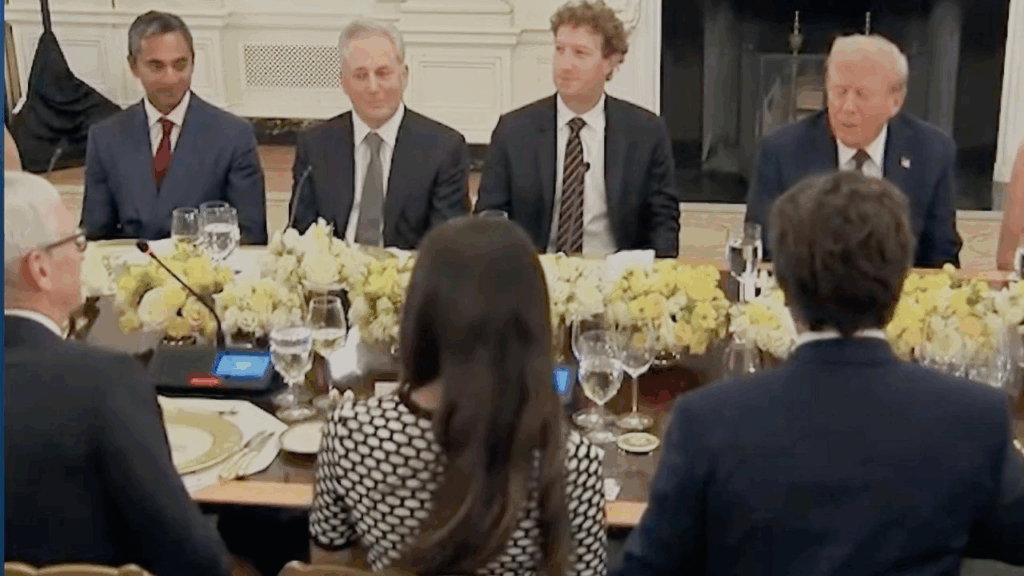
US President Donald Trump turned a celebratory White House dinner with America’s biggest tech leaders into a moment of high-stakes business talk when he publicly grilled Apple CEO Tim Cook on how much his company would invest in the United States.
The dinner, hosted by Trump and First Lady Melania Trump, brought together the heads of some of the world’s most influential technology firms, signaling the administration’s focus on reshoring investment and keeping innovation anchored in America.
What happened at Trump’s dinner with tech CEOs?
During the event, Trump praised Tim Cook, calling him a “remarkable leader” who had done “an incredible job with Apple.” Cook thanked Trump in return, highlighting the president’s role in creating conditions that encouraged Apple to expand its US footprint.
“I want to thank you for setting the tone such that we could make a major investment in the United States… That says a lot about your focus and your leadership and your focus on innovation,” Cook said.
But Trump, never one to let a high-profile moment pass without pressing for more, quickly followed with a pointed question:
“You know you were elsewhere, now you’re really coming home in a big way. How much will you be investing?”
Cook responded with a figure that grabbed headlines: $600 billion.
Why Trump pressed Tim Cook on Apple’s investment
Trump’s question carried a deeper context. Apple, despite being an iconic American brand, has long relied heavily on global manufacturing, particularly in China and, more recently, India. Trump’s comment — “you were elsewhere, now you’re really coming home” — was a veiled reference to Apple’s foreign supply chains and Cook’s growing interest in India’s booming tech market.
By pushing Cook on stage, Trump reinforced his broader “America First” message: that the US economy should be the primary beneficiary of American innovation.
The scale of Apple’s US investment
Cook’s declaration of a $600 billion US investment is one of the largest commitments by a private company in recent memory. While details of how that sum will be allocated remain unclear, industry analysts suggest it could include:
- Expanding Apple’s manufacturing facilities and chip development in the US.
- Scaling up investments in renewable energy and data centers.
- Funding research into artificial intelligence and next-generation hardware.
- Creating tens of thousands of high-paying jobs.
If realized, the figure would dwarf Apple’s previous US-focused initiatives, including a $430 billion commitment announced in 2021.
Who attended the high-profile White House dinner?
The guest list underscored the scale of the moment. Alongside Tim Cook were some of the biggest names in global technology:
- Bill Gates (Microsoft co-founder)
- Mark Zuckerberg (Meta CEO)
- Sam Altman (OpenAI CEO)
- Sundar Pichai (Google CEO)
- Satya Nadella (Microsoft CEO)
- Sanjay Mehrotra (Micron CEO)
- Vivek Ranadivé (TIBCO Software chairman)
- Shyam Sankar (Palantir executive)
Notably, five Indian-origin tech leaders were in attendance, reflecting the increasingly global and diverse face of American tech leadership.
How social media reacted
Clips of Trump’s exchange with Cook quickly went viral. Online reactions ranged from patriotic enthusiasm to skepticism.
- “Bringing more manufacturing back to the US is what America voted for,” one user wrote.
- Another countered, “Why do I always get the feeling that we’re about to get screwed.”
- One comment summed up the mood: “The amount of capital being discussed in this one meeting is just incredible. A huge day for the future of the US economy and the next wave of technological innovation.”
For Apple fans, Cook’s announcement offered reassurance. As one user posted: “I feel less bad owning Apple products now, I guess.”
Why this matters for the US economy
Apple’s pledge aligns with Trump’s broader push to reduce reliance on overseas manufacturing and strengthen domestic industries. With tech shaping the future of work, national security, and global competitiveness, investments of this scale could:
- Boost US manufacturing resilience against supply chain shocks.
- Create a wave of high-skilled jobs in semiconductors, AI, and advanced hardware.
- Help the US compete with China in emerging technologies.
But skeptics warn that translating headline figures into real economic impact takes time — and often falls short of initial promises. Whether Apple follows through on its $600 billion commitment will be closely watched in the coming years.
The bottom line
Trump’s dinner with America’s tech elite wasn’t just a photo-op. It became a stage for the president to push his pro-investment agenda and for Apple to signal that its future is tied more closely to the United States.
Tim Cook’s $600 billion pledge could reshape the American tech landscape, if it materializes. For now, the exchange underscores the central role of the White House in shaping not only policy but also the direction of the nation’s most powerful companies.