
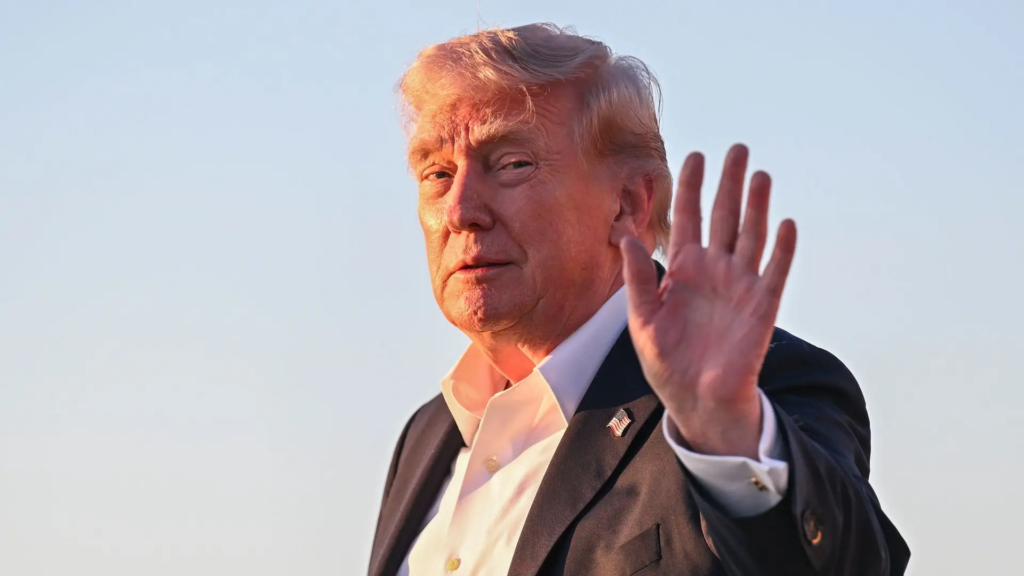
US President Donald Trump is once again facing scrutiny over his health after making his third known medical visit in just over a year — this time following online speculation triggered by a viral video that appeared to show him “swaying” during a public appearance.
The 79-year-old visited Walter Reed National Military Medical Center for what he later described as a routine six-month physical examination. But the timing of the appointment, combined with renewed attention on his diagnosed circulatory condition, has intensified debate about presidential transparency and aging in American politics.
TL;DR
- Trump visited Walter Reed for his third known medical appointment in 13 months.
- The visit came hours after social media users circulated a video claiming he appeared unsteady.
- Trump later posted that his physical “checked out PERFECTLY.”
- His physician has confirmed he has chronic venous insufficiency, a common vein condition in older adults.
- Doctors say the condition is generally manageable and not usually life-threatening.
- Questions about the health of aging political leaders are becoming increasingly central ahead of the 2028 political cycle.
Why Trump’s Walter Reed Visit Is Drawing Attention
According to reports, this was Trump’s:
- Annual physical visit following his April 2025 examination
- Return trip after an October “scheduled follow-up”
- Third medical-related appointment within 13 months
Trump also reportedly visited a dentist in Florida earlier this month.
While presidents routinely undergo medical evaluations, repeated visits inevitably attract public interest — especially when the White House offers limited details.
Trump attempted to shut down speculation quickly with a post on Truth Social:
“Everything checked out PERFECTLY.”
That message echoed a long-standing pattern in Trump’s public communications: projecting strength, stamina, and physical resilience.
What Is Chronic Venous Insufficiency?
Trump’s physician has publicly acknowledged that the president has chronic venous insufficiency (CVI), a relatively common condition among older adults.
How Chronic Venous Insufficiency Works
Normally, veins use one-way valves to help move blood back toward the heart. In chronic venous insufficiency, those valves weaken or become damaged.
As a result:
- Blood can pool in the legs
- Circulation becomes less efficient
- Swelling and discomfort may develop over time
According to Johns Hopkins Medicine, the condition affects roughly 1 in 20 adults and becomes more common after age 50.
What Symptoms Are Linked to the Condition?
Symptoms of chronic venous insufficiency can vary from mild discomfort to more serious complications if untreated.
Common Symptoms Include
- Aching or tired legs
- Swelling in the lower legs and ankles
- Nighttime leg cramps
- Tingling or burning sensations
- Varicose veins
- Skin discoloration
- A feeling of heaviness in the legs
- Itchy or flaky skin
- Ulcers near the ankles in severe cases
Doctors say the condition is usually manageable through:
- Compression therapy
- Exercise
- Weight management
- Medication in some cases
In advanced cases, surgical procedures may be necessary.
Is Trump’s Condition Serious?
Medical experts generally do not classify chronic venous insufficiency as life-threatening.
Trump’s physician, Sean Barbabella, reportedly said there was:
- No evidence of deep vein thrombosis
- No arterial disease
- No indication of more dangerous vascular complications
The White House has maintained that Trump remains in “excellent” health.
Still, because CVI affects circulation and mobility, visible symptoms — such as swelling or altered gait — often become highly noticeable in public appearances.
That partly explains why videos of Trump walking, standing, or shifting posture regularly go viral online.
The “Bulge” and “Swaying” Speculation
Recent online discussions also focused on:
- An unusual bulge visible beneath Trump’s clothing
- Footage that some viewers interpreted as balance issues
None of those claims have been medically substantiated.
Health experts frequently caution against diagnosing public figures based solely on social media clips or photographs, particularly when:
- Videos are edited
- Angles distort movement
- Short clips lack context
Why Presidential Health Becomes a Political Issue
Questions about the health of US presidents are hardly new.
American voters have historically scrutinized:
- Joe Biden for age-related concerns
- Ronald Reagan during his second term
- Franklin D. Roosevelt over hidden wartime illnesses
But the conversation around Trump carries a uniquely modern dimension because of social media.
Every stumble, facial expression, pause, or physical movement now:
- Gets clipped into viral videos
- Becomes political ammunition
- Fuels conspiracy theories across partisan lines
That environment makes even routine medical visits politically charged.
The Broader Debate Around Aging Leaders
Trump turns 80 next month, placing renewed focus on the age of America’s political leadership.
The United States has seen a steady rise in the average age of:
- Presidents
- Senators
- Congressional leaders
Critics argue older leaders face:
- Greater health risks
- Reduced stamina
- Increased cognitive scrutiny
Supporters counter that:
- Experience matters more than age
- Physical conditions do not necessarily affect leadership ability
- Public speculation often becomes exaggerated and partisan
Trump himself has repeatedly portrayed his health as superior to that of his political rivals, making medical transparency an especially sensitive issue for his administration.
Why Transparency Matters
Presidential health disclosures sit in a gray area between:
- Public interest
- Personal medical privacy
Unlike ordinary citizens, presidents control nuclear codes, military operations, and high-level diplomacy. That creates pressure for greater disclosure.
At the same time, administrations historically reveal only limited details unless a condition becomes severe.
Trump’s latest visit illustrates that tension clearly:
- The White House confirmed the appointment
- Trump declared the results “perfect”
- But detailed medical findings remain limited
That gap leaves room for speculation — especially online.
The Bottom Line
At this stage, there is no public evidence suggesting Trump faces a major medical crisis.
His diagnosed condition — chronic venous insufficiency — is common among older adults and is reportedly under control.
Still, the combination of:
- repeated medical visits,
- viral health speculation,
- and Trump’s approaching 80th birthday
means scrutiny over his physical condition is unlikely to fade anytime soon.
And in the social media era, even a routine doctor’s appointment can quickly become a national political story.