
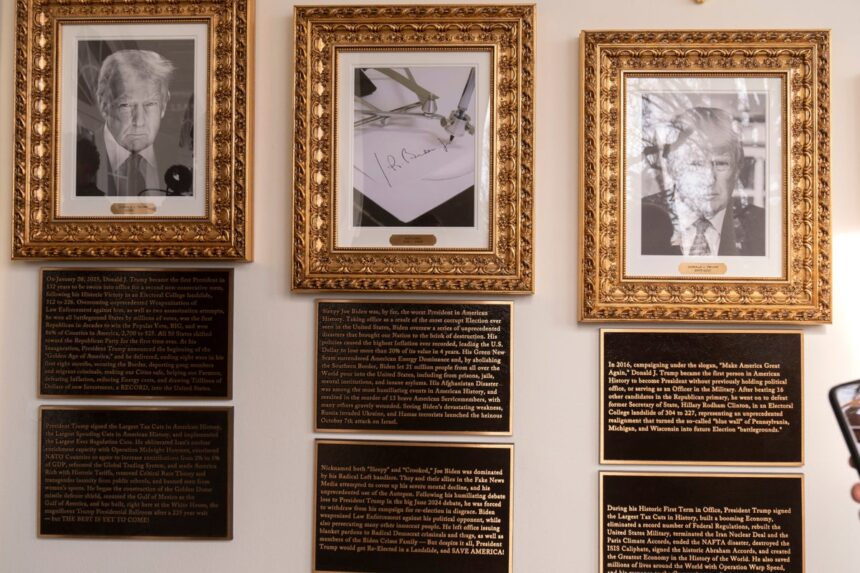
In a move that has reignited debates over presidential decorum and the politicization of history, Donald Trump has reportedly ordered the installation of plaques beneath portraits of former US presidents inside the White House—using the text to disparage and make unsubstantiated claims about several of his predecessors, including Joe Biden and Barack Obama.
The plaques, which the White House says were written personally by Trump, have transformed a traditionally ceremonial space into what critics describe as a political statement and supporters frame as classic Trump-style bluntness.
At the center of the controversy is how history is being framed inside the seat of American executive power—and whether a president should be editorializing about his predecessors from the White House walls.
What Is Trump’s White House “Wall of Fame”?
The display, which Trump reportedly calls the “Presidential Walk of Fame,” is located along the West Wing Colonnade, an area frequently used by staff, officials, and visiting dignitaries.
How the Display Is Set Up
According to reporting by ABC News
- Portraits of US presidents arranged in chronological order
- Individual plaques beneath each portrait
- Language that goes far beyond neutral historical summaries
The White House has stated that the plaques were authored by Trump himself, rather than by historians or curatorial staff.
Notably, Joe Biden’s portrait is missing from the display, an omission that has drawn immediate attention and criticism.
Why Are Trump’s Plaques Controversial?
Traditionally, presidential portraits and accompanying text in the White House are factual, restrained, and bipartisan in tone. Trump’s plaques depart sharply from that norm.
Opinionated Language in a Historic Space
Rather than summarizing terms in office, major legislation, or historical context, the plaques reportedly feature:
- Derisive nicknames
- Subjective judgments
- Claims that contradict established historical consensus
In style and tone, critics say the plaques resemble Trump’s posts on Truth Social, transplanted onto White House walls.
This shift raises a central question: Should the White House present history—or prosecute political arguments?
What Do the Plaques Say About Barack Obama?
One of the most discussed plaques is the one beneath Barack Obama’s portrait.
According to reports, the plaque describes Obama as:
“One of the most divisive political figures”
It also criticizes the Affordable Care Act, labeling it the “Unaffordable Care Act,” and claims it directly led to Democrats losing control of Congress.
Why This Matters
While Obama’s presidency remains debated politically, historians generally describe the Affordable Care Act as one of the most significant healthcare reforms in US history.
Presenting a single, partisan interpretation, without context or counterbalance, marks a departure from how presidential history is typically displayed in the White House.
Joe Biden’s Plaque: The Harshest Language
The most severe language is reportedly reserved for Joe Biden.
According to descriptions of the plaque, it states:
“Sleepy Joe was, by far, the worst President in American history.”
It further claims Biden took office as a result of:
“The most corrupt election ever seen in the United States”
Fact-Checking Is Critical Here
Multiple courts, election officials, and independent audits have found no evidence supporting claims that the 2020 election was corrupt or stolen. These allegations have been widely debunked.
This makes the Biden plaque particularly controversial, as it places unfounded claims inside a government building, potentially blurring the line between political rhetoric and official record.
Bill Clinton and the Long Shadow of 2016
The plaque beneath Bill Clinton’s portrait reportedly downplays his legislative achievements, attributing policy successes to “Republicans in Congress.”
It also references the 2016 presidential election, in which Hillary Clinton lost to Trump, reigniting a rivalry that has defined much of Trump’s political identity.
Why the Clinton Plaque Stands Out
- It shifts focus from Clinton’s presidency to Trump’s own electoral victory
- It personalizes history, rather than contextualizing it
- It reinforces Trump’s habit of framing past presidencies through his own political battles
This approach effectively turns the gallery into a narrative centered on Trump himself.
Praise for Allies: Reagan as the Exception
Not all plaques are critical. Ronald Reagan’s plaque, in particular, is notably warm.
Trump reportedly praises Reagan as
- “The Great Communicator”
- A president who left office with high approval ratings
- Someone who “was a fan” of Donald Trump
The plaque also emphasizes Trump’s admiration for Reagan, creating a reciprocal narrative.
Selective Reverence
The contrast is striking: President Trump receives glowing treatment, while rivals or critics are sharply condemned. This selective framing underscores the personal nature of the project.
Is This Normal for the White House?
Historically, no.
While presidents have always shaped their legacy, White House displays have traditionally avoided partisan commentary.
They serve several purposes:
- Educating visitors
- Honoring the institution, not individuals
- Presenting a shared national history
Trump’s plaques challenge that tradition by turning commemoration into commentary.
Trump, Trolling, and the Politics of Provocation
Supporters argue this is simply Trump being Trump, direct, provocative, and unapologetic. Critics see it as institutional trolling, bringing campaign-style attacks into the White House itself.
Trump has a long history of using provocation as a political tool:
- Nicknames like “Sleepy Joe” or “Crooked Hillary”
- Social media attacks on critics
- Blurring lines between governance and campaigning
The plaques appear to extend that approach into physical space.
A Note on Recent Controversy and Accuracy
The plaques controversy comes amid broader criticism of Trump’s rhetoric and conduct. However, claims circulating online about the murder or death of actor-director Rob Reiner are false.
Rob Reiner is alive, and reports suggesting otherwise are inaccurate. Any statements attributed to Trump regarding Reiner’s death should be treated with caution and independently verified before publication.
This underscores a larger issue: the importance of fact-checking political claims, especially when misinformation spreads rapidly online.
Why This Moment Matters Beyond the Plaques
At its core, this controversy isn’t just about wording on a wall.
It raises deeper questions:
- Who controls historical narrative inside government institutions?
- Can official spaces remain neutral in hyper-partisan times?
- What happens when political branding overtakes public history?
International outlets have noted the story has drawn global attention—not because of policy, but because it reflects how American politics now performs itself.
TL;DR
- Donald Trump installed plaques under presidential portraits in the White House
- The plaques contain partisan, opinionated language
- Joe Biden’s plaque includes unsubstantiated election claims
- Barack Obama and Bill Clinton receive critical treatment
- Ronald Reagan is praised warmly
- Critics say the move politicises a traditionally neutral space
- Supporters call it transparency and honesty
- The controversy highlights how history, power, and provocation intersect