
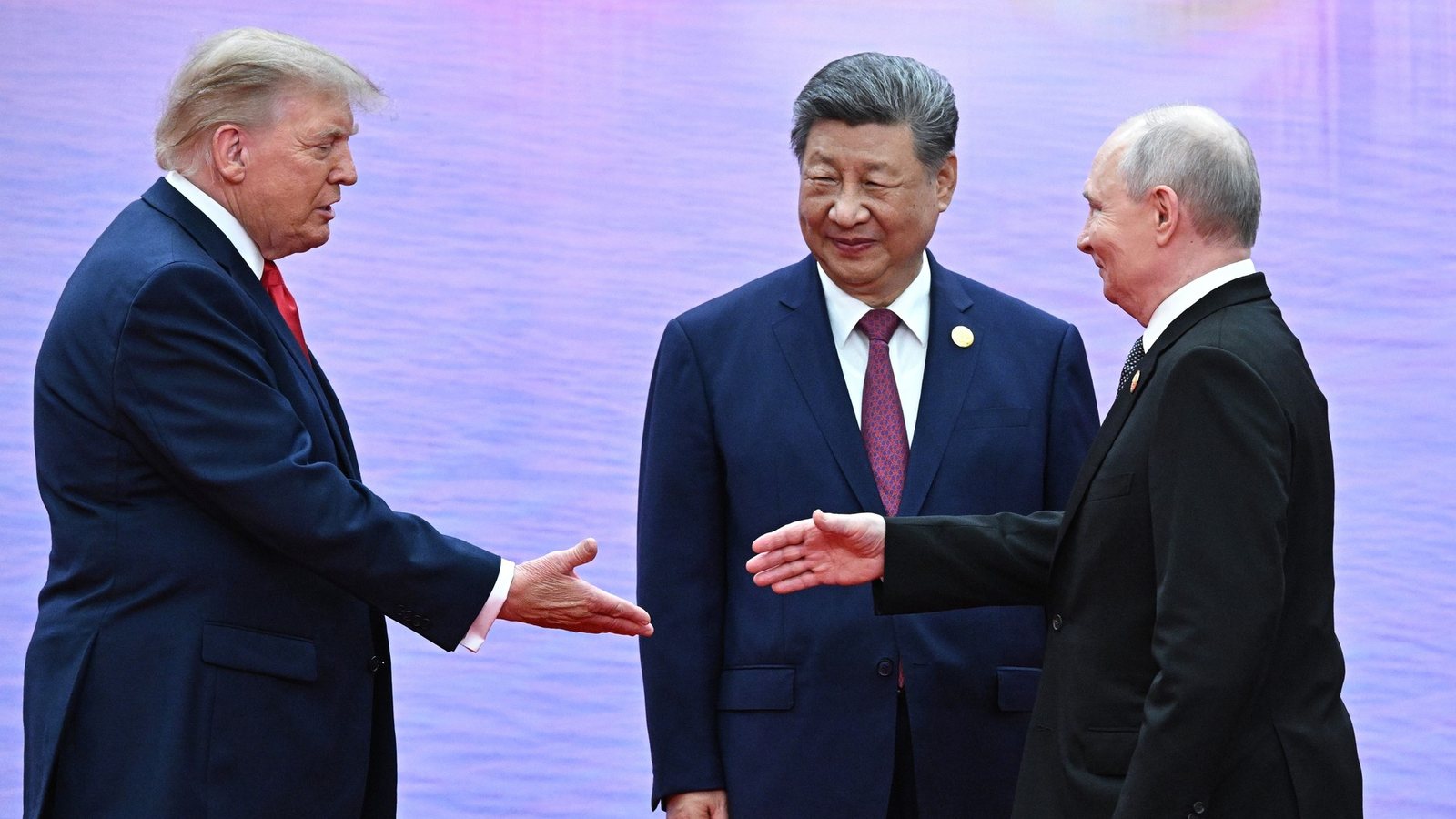

The Trump Xi Putin declaration from Shenzhen is five days old, and it is still a list of intentions with no calendar attached.
Issued on Nov. 19 after the first three-way meeting of the American, Chinese and Russian leaders, it has four points. They cover talks on nuclear risk, more refined fuel, United Nations reform and limits on international courts. No date, venue or negotiator has been named for any of it.
The one concrete promise is a nuclear dialogue. That is the closest Washington has come to the three-way arms talks President Trump has wanted since the New START treaty with Russia expired in February, and it is still a long way short of them.
A declaration, not a peace deal
The White House published the text on Nov. 19 as the U.S.-Russia-China Heads of State Declaration toward Peace. China’s Foreign Ministry posted the same four points as the China-Russia-U.S. Heads of State Declaration toward Peace, with its own leader named first. We compared the two point by point, and the four commitments read the same.
Neither version describes a signing. Both say the leaders “committed to maintaining strategic stability and international security.” Coverage that calls it a signed peace agreement overstates what happened. It ends no war and creates no obligations.
The talks took place at Kylin Villa, a Shenzhen state guesthouse, during an Asia-Pacific Economic Cooperation summit that brought tight security to the city.
Russia’s TASS put the session at 4:27 p.m. to 5:57 p.m. local time, about 90 minutes. The Associated Press, counting only the closed-door portion, put it at roughly 70 minutes. The three made no joint appearance before the press afterward.
“We are really making history,” Trump told the room. He said the three countries were “uniquely positioned” to discuss cutting nuclear arsenals, the AP reported. Putin called the format “useful and substantive.” Xi, Reuters reported, said that “when major powers live in harmony, the world is at peace.”
The nuclear line is old. The dialogue is the new part
The fourth point reaffirms “that a nuclear war cannot be won and must never be fought.” That sentence is not new.
The same three countries, with Britain and France, put it in a joint statement on Jan. 3, 2022. Seven weeks later, Russia invaded Ukraine.
What Shenzhen adds is a promise of talks. The three “will conduct a dialogue on reducing nuclear risks and preventing the proliferation of nuclear weapons.” It sets no timetable, no limits and no verification.
Reuters noted that the leaders announced no plan for the trilateral arms reduction talks Trump wants, which China has consistently refused. Beijing’s position follows the numbers. China has a little over 600 warheads, the AP reported, while the US and Russia each hold more than 5,000.
Daryl Kimball of the Arms Control Association called the reaffirmation positive but said more concrete action was needed. He also told the AP that “one meeting will not likely produce dramatic breakthroughs.”
Trump’s own remarks the next day pointed at the gap. At a White House news conference on Nov. 20, he said China was “going at it hot and heavy.” He added, “They’ll catch us within 10 years,” the AP reported. Secretary of State Marco Rubio defended the meeting. “The idea that these three leaders should not engage on a regular basis is not just absurd, it’s dangerous.”
Fuel, the UN and a line aimed at the ICC
The other three points are thinner. The leaders “plan to increase the production and supply of refined petroleum products.” They also stress “stable energy flows.” That reads against the US war with Iran, which has repeatedly shut the Strait of Hormuz. But the text names no volumes and no country.
On the UN, the three “committed to reform the UN” so it can respond more effectively to global challenges. It does not say which reforms, and all three hold Security Council vetoes that any change would have to survive.
The third point drew the sharpest criticism in the European press. It calls state consent and the immunity of state officials “of paramount importance.” It also says the International Criminal Court and similar bodies “must not abuse their jurisdiction.” The ICC issued an arrest warrant for Putin in March 2023 over the deportation of Ukrainian children. None of the three countries is a party to the court.
For Washington, the clause is not a departure. Trump signed an executive order sanctioning the ICC on Feb. 6, 2025, arguing it has no jurisdiction over states that have not consented.
What is new is the US putting that view in writing alongside the leader the court wants to arrest. Jonathan Eyal of the RUSI think tank told Reuters the pushback against international courts was the summit’s most notable result.
Silent on Ukraine and Iran
The declaration does not mention Russia’s war in Ukraine, the Iran conflict, Taiwan or North Korea. Kremlin spokesman Dmitry Peskov said the trilateral session did not focus on Ukraine. At his own news conference in Shenzhen, Putin said Russia had accepted US compromise proposals from the August 2025 Anchorage talks. Kyiv and European capitals, he said, were not ready to, Georgia Today reported.
Reaction since has split along familiar lines. Senate Democratic leader Chuck Schumer called the meeting “a historic embarrassment,” and German Chancellor Friedrich Merz said, “A Yalta format will not bring peace,” Reuters reported.
Ukrainian President Volodymyr Zelenskyy told CNN on Nov. 20 that Putin is “a killer,” after Trump called the Russian leader “my friend” in Shenzhen.
Trump has not backed off. “I have fantastic relationships with Putin. That’s a very good thing,” he said at the White House briefing, according to the Kyiv Post.
The war the declaration skips has not paused for diplomacy before. On Nov. 2, a Russian strike on a Ukrainian aid point killed 40 people, hours before talks in Abu Dhabi were announced.
Who has to do what next
Chinese Foreign Minister Wang Yi said the three countries would keep coordinating at the working level, Reuters reported. Kremlin aide Yuri Ushakov said it was too early to say whether the three-way format would meet again. Putin said he wanted it to.
As of Nov. 24, no government has named officials for the nuclear risk dialogue or set a first meeting. The leaders spent about 90 minutes together. Whether their declaration amounts to more than that afternoon depends on a working-level session that no capital has yet put on the calendar.