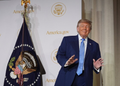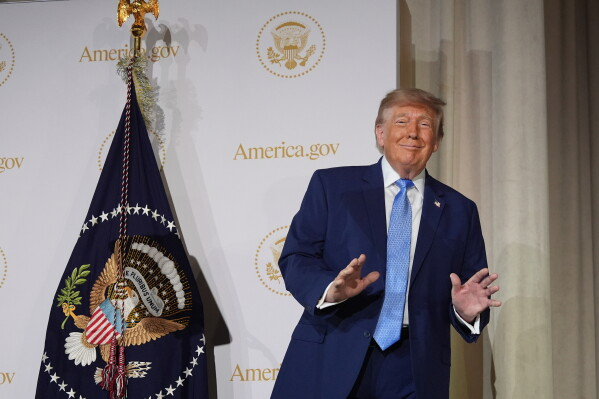
US President Donald Trump’s latest White House meeting with the technology industry produced more than a new voluntary agreement on AI safety.
It also introduced a new vocabulary for the technology.
On September 29, Trump announced a voluntary White House Accord on Super Intelligence, with six major technology executives signing commitments covering internal safety controls, external audits and board-level oversight of advanced AI systems. Separately, Trump signed an executive order directing federal agencies to use the terms “Super Intelligence” and “SI” instead of “artificial intelligence” and “AI” in the relevant federal context.
The meeting also gave the technology a new industrial metaphor. Nvidia CEO Jensen Huang described the infrastructure being built around advanced AI as a generation of “superintelligence factories,” pointing to the enormous investment in chips, computers, data centers and electricity needed to operate increasingly capable systems.
Yet perhaps the most important detail from the summit was not who signed the accord, but who did not.
The White House gathering brought together a much larger group of technology executives than the six people who signed the voluntary commitment.
Who signed Trump’s “Super Intelligence” accord?
The six technology executives identified as signatories were:
- Google CEO Sundar Pichai
- Anthropic CEO Dario Amodei
- Meta CEO Mark Zuckerberg
- OpenAI President Greg Brockman
- Nvidia CEO Jensen Huang
- xAI CEO Elon Musk
Trump also said he had signed the agreement. The document is titled the “White House Accord on Super Intelligence: Joint Commitment on Frontier Responsibilities.”
The agreement is voluntary. It is not legislation passed by Congress and does not establish a new federal regulatory regime.
Instead, participating companies commit to putting several layers of safeguards around their frontier AI systems.
What does the accord require?
The agreement outlines four broad layers of responsibility.
First, companies are expected to establish robust internal controls for monitoring advanced models during development and deployment. These controls are intended to identify problems involving areas such as cybersecurity, biosecurity, chemical risks and unauthorized access.
Second, companies are expected to establish internal teams responsible for checking whether those controls are actually functioning and ensuring that identified problems are addressed.
Third, the companies commit to working with independent external auditors to assess whether their safety systems are operating as intended.
Fourth, the agreement calls for an independent committee within each company’s board of directors to oversee the internal and external assessments and ensure that problems receive appropriate attention.
The companies also agreed to meet regularly to develop standards and best practices for AI safety.
The accord leaves open the possibility that some of these measures could eventually be incorporated into laws or formal regulations. For now, however, enforcement remains largely a matter of corporate commitment rather than government mandate.
Why is Trump calling AI “Super Intelligence”?
The terminology change is more than a phrase used during the luncheon.
Trump signed an executive order on September 29 directing federal agencies to integrate “super intelligence” into the administration’s approach to government technology. The White House is also using “Super Intelligence” and “SI” in connection with its new America.gov government-services platform.
The distinction matters because “artificial intelligence” is an established technical and policy term covering a very broad range of systems, from relatively simple machine-learning applications to frontier models.
“Super intelligence,” by contrast, generally evokes systems that are substantially more capable than humans across a broad range of intellectual tasks.
At the White House event, however, Trump used the term broadly when discussing the next stage of AI development. The administration’s official terminology now places “SI” at the center of its federal technology messaging.
That does not mean every AI system has suddenly become “superintelligent.” Rather, it represents a change in how the Trump administration describes and frames the technology.
Why are data centers suddenly being called “superintelligence factories”?
The terminology also reflects a larger shift in the AI industry.
The race to build increasingly capable models is no longer primarily a software story. It requires vast amounts of computing power, advanced semiconductors, data centers and electricity.
That is where Nvidia CEO Jensen Huang’s comments became significant.
Speaking after the White House meeting, Huang described the current expansion as an enormous infrastructure build-out involving chip plants, computer plants and factories. He characterized the transformation as an industrial revolution and emphasized the scale of investment flowing into the sector.
Other reporting has highlighted Huang’s description of data centers as “superintelligence factories,” a phrase that captures how these facilities are increasingly viewed as production infrastructure for AI systems rather than simply large buildings filled with servers.
The physical requirements are becoming an increasingly important part of the policy debate.
A powerful AI model needs enormous quantities of computing capacity. That computing capacity requires electricity, cooling systems, networking equipment and specialized chips. Data centers can also place pressure on local power grids and communities.
Trump acknowledged some of those concerns during the event and said technology companies should form partnerships with communities where data centers are built, including by contributing financially to local priorities such as schools and teachers.
The AI debate is therefore expanding beyond questions about chatbots and algorithms.
It is increasingly a debate about industrial policy, energy, infrastructure, employment and local economic impacts.
Who attended the White House AI meeting but did not sign?
The list of attendees was substantially larger than the group that signed the accord.
Microsoft CEO Satya Nadella attended the White House luncheon but was not among the six technology executives identified as signatories.
Amazon founder Jeff Bezos was also among the attendees. Amazon CEO Andy Jassy was not listed as a signatory.
The broader guest list also included executives from companies such as AMD, Broadcom, Micron, Palo Alto Networks and ServiceNow, as well as other technology investors and government officials. Axios reported that 31 people were confirmed for the luncheon, illustrating how much broader the gathering was than the final group of signatories.
Apple was another notable absence. Reporting on the attendee list said neither Apple CEO John Ternus nor former CEO Tim Cook attended.
That absence, however, should not automatically be treated as a statement of opposition to the agreement. The available reporting establishes attendance and signing information, but does not establish why individual executives or companies did not participate.
Why does the voluntary nature of the accord matter?
The distinction between a voluntary accord and a law is central to understanding what happened at the White House.
The participating companies have publicly committed themselves to specific internal processes and external assessments. But the agreement does not itself create the kind of statutory obligations that would apply through federal legislation.
Trump has emphasized self-regulation, saying there is a belief that the industry should engage in “tremendous self-regulation.” The administration has also framed AI leadership as an area where the United States needs to maintain its technological advantage.
Supporters of the approach can point to the fact that the companies are voluntarily accepting additional layers of monitoring and auditing.
Critics, meanwhile, have focused on the lack of a formal government enforcement mechanism and questions surrounding the independence and transparency of external evaluations. Some analysts have also noted that the accord does not require companies to publicly release the results of those evaluations.
Those differences explain why the document’s legal status is just as important as its language.
It is a commitment by major AI companies to establish common safety practices, but it is not a substitute for legislation or regulation.
What the White House summit says about the next phase of AI
The September 29 meeting brought several strands of the US AI debate together in one place.
There is the race to develop increasingly powerful models. There is the question of how those models should be tested and monitored. There is the political debate over government regulation versus industry self-governance.
And increasingly, there is the physical infrastructure required to make the technology work.
The White House accord attempts to address one part of that equation by creating a common framework for internal controls, independent auditing and board oversight.
Trump’s terminology change addresses another: how the federal government talks about the technology itself.
Meanwhile, Huang’s “superintelligence factories” description points toward a third issue — the industrial scale of the AI build-out.
Taken together, the developments show that the US AI debate is moving beyond the question of what chatbots can do.
The emerging questions are increasingly about who controls advanced systems, how companies are held accountable for them, how their risks are independently evaluated and how much infrastructure the AI economy will require.
For now, the White House has chosen voluntary commitments over a new federal AI safety law.
Whether those commitments develop into formal regulations later remains an open question. The accord itself explicitly leaves that possibility on the table.
TL;DR
- Trump hosted a major AI industry luncheon at the White House on September 29, 2026.
- Six technology executives signed the voluntary White House Accord on Super Intelligence.
- The signatories were Sundar Pichai, Dario Amodei, Mark Zuckerberg, Greg Brockman, Jensen Huang and Elon Musk.
- The accord calls for internal safety controls, dedicated monitoring teams, independent external audits and board-level oversight.
- Trump separately signed an executive order directing federal agencies to use “Super Intelligence” and “SI” in place of “artificial intelligence” and “AI” in the relevant federal context.
- Microsoft CEO Satya Nadella and Amazon founder Jeff Bezos attended but were not among the six technology signatories.
- Apple executives John Ternus and Tim Cook were not reported as attendees.
- Nvidia’s Jensen Huang described the massive AI infrastructure build-out in terms of “superintelligence factories.”
- The agreement is voluntary and does not carry the legal force of federal legislation.
- Its future significance will depend partly on how companies implement the commitments and whether similar safeguards eventually become formal regulation.