
Quick Summary
- A Missouri man died after contracting a rare Naegleria fowleri infection while water skiing.
- The amoeba enters through the nose and attacks the brain, causing primary amebic meningoencephalitis (PAM).
- The infection is almost always fatal but remains extremely rare, with fewer than 10 US cases annually.
- Precautions include using nose clips, avoiding sediment in warm shallow waters, and never using untreated tap water for nasal rinsing.
A Missouri man has died from a rare brain infection caused by Naegleria fowleri, also known as the “brain-eating amoeba,” after water skiing at the Lake of the Ozarks. The Missouri Department of Health and Senior Services (DHSS) confirmed the case, calling it an exceptionally rare but deadly occurrence.
What happened at Lake of the Ozarks?
The individual fell ill earlier this month after participating in water activities at the popular Lake of the Ozarks, a major summer destination in Missouri. On August 13, officials confirmed that the cause was Naegleria fowleri, a microscopic amoeba that destroys brain tissue and leads to primary amebic meningoencephalitis (PAM).
This marks only the third recorded case in Missouri. The state previously reported infections in 1987 and 2022. Nationwide, just 167 cases have been documented since 1962, with fewer than 10 occurring each year in the US.
While extremely rare, PAM is almost always fatal. The fatality rate stands at over 97%, with only a handful of survivors worldwide.
What is Naegleria fowleri?
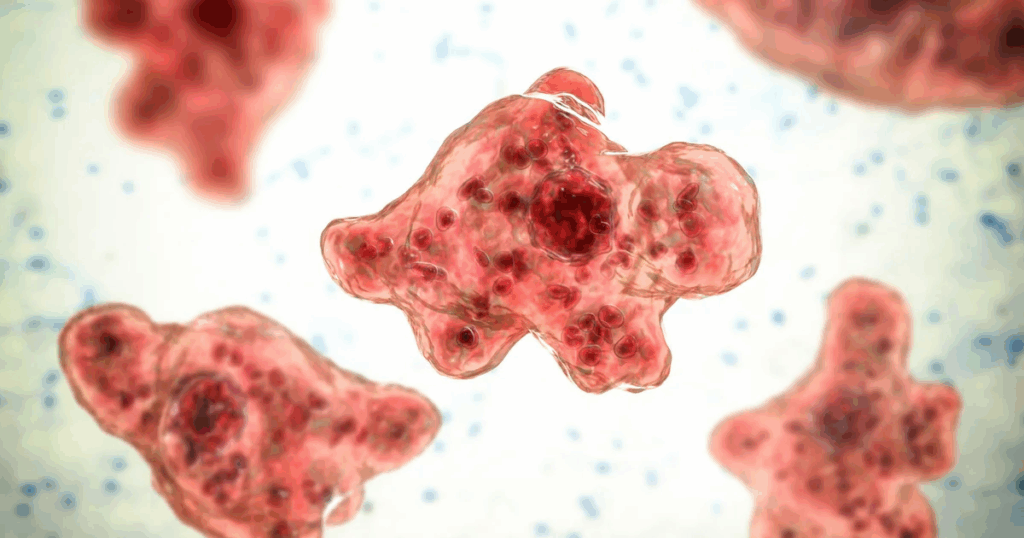
Naegleria fowleri is a free-living, single-celled amoeba that thrives in warm freshwater environments such as lakes, rivers, hot springs, and poorly maintained swimming pools.
- It infects humans when contaminated water enters through the nose.
- The amoeba then travels to the brain, where it destroys tissue.
- The infection cannot spread from person to person, and it cannot be contracted by swallowing contaminated water.
The infection it causes, PAM, progresses rapidly. Early symptoms such as headache, fever, nausea, and vomiting typically appear within one to 12 days of exposure. As the disease advances, patients may experience seizures, confusion, hallucinations, and coma.
Most patients die within one to two weeks of symptom onset.
Why is the infection so deadly?
The danger lies in how fast the amoeba attacks the brain and the difficulty of diagnosis. Early symptoms mimic viral meningitis, which can delay treatment. By the time PAM is correctly identified, the infection is often too advanced to treat effectively. Current therapies include antifungal drugs such as amphotericin B, as well as antibiotics like rifampin and azithromycin. In rare cases, a drug called miltefosine combined with therapeutic hypothermia (cooling the body) has saved patients, but survival remains rare.
How common are brain-eating amoeba infections in the US?
Despite alarming headlines, infections are exceedingly rare:
- Only 167 confirmed cases in the US since 1962.
- Fewer than 10 cases are reported annually.
- Missouri has reported just three cases, including this one.
Most infections occur in southern US states with warmer climates, but cases have been detected as far north as Minnesota. Experts suggest climate change may be expanding the amoeba’s range as water temperatures rise.
How can people protect themselves?
Health officials emphasize that while the risk is extremely low, precautions are recommended when swimming in warm freshwater:
- Hold your nose shut, use nose clips, or keep your head above water.
- Avoid stirring up sediment in shallow warm areas, where amoeba concentrations are higher.
- Do not submerge your head in hot springs or untreated geothermal waters.
- Use only distilled, sterile, or previously boiled water for nasal rinsing or neti pots.
The DHSS stresses that recreational water users should “assume that Naegleria fowleri is present in warm freshwater across the US,” but also underscores that infection remains very rare.
Why does this matter?
Cases like this highlight the delicate balance between rare but deadly pathogens and recreational water use. Millions swim, boat, or water ski in lakes each year without incident, yet a single infection attracts nationwide attention.
Public health experts argue that better awareness, not panic, is the answer. By understanding how the amoeba spreads and taking precautions, the already tiny risk can be minimized.