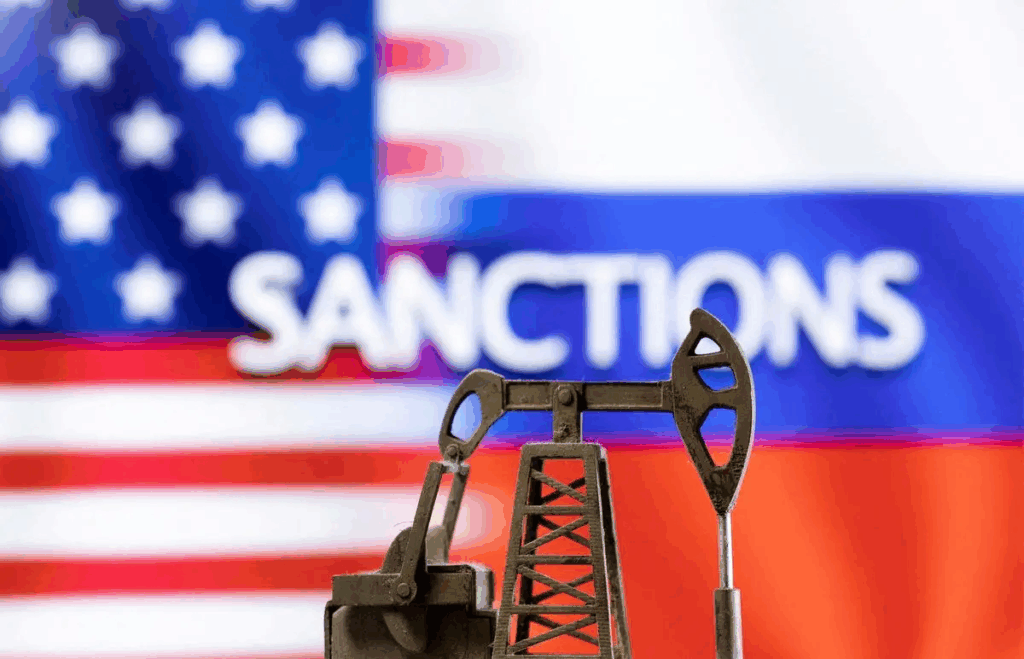
New US sanctions on Russian oil giants Rosneft and Lukoil are about to reshape global energy flows. Nearly 48 million barrels of crude, already on tankers, may be stuck at sea as buyers hesitate and shipping routes twist into confusion. India and China, long the biggest customers, are suddenly cautious. Freight rates are soaring, shadow routes are expanding, and the next few months could bring volatility as markets search for a new equilibrium.
What’s Happening With the New US Sanctions?
New US sanctions on Russian oil exports take effect Friday, and they’re already causing turbulence across global markets. The Biden administration recently blacklisted Rosneft PJSC and Lukoil PJSC, two of Russia’s biggest energy companies. That move alone sent a shock through traders and refiners.
These sanctions target firms and middlemen who help move Russian crude. In effect, the US is tightening the screws not only on Russia but also on anyone who touches its oil—even if that touchpoint is a ship loading barrels in the Baltic or a trader booking insurance in Dubai.
The immediate fallout: nearly 48 million barrels of Rosneft and Lukoil crude, mostly Urals and ESPO, are now floating with uncertain futures.
How Did We End Up With 48 Million Barrels at Sea?
A Market That’s Suddenly Pulling Back
Analytics firm Kpler estimates that roughly 50 tankers carrying Russian crude are heading toward China and India, the two countries that have kept Moscow’s oil lifeline alive since 2022. But dozens of other tankers are now drifting offshore with “TBD” destinations.
These vessels are spread across maritime corridors like
- The Baltic Sea
- The Suez Canal
- South China Sea
- Singapore–Malaysia transfer zones
Some traders haven’t canceled loads but have stopped designating final ports—classic behavior when sanctions risk is rising.
Why Are Indian Refiners Backing Away?
Secondary Sanctions = Serious Risk
India has been a major buyer of discounted Russian oil for nearly three years. But the new US rules expose refiners, banks, traders—even insurers—to potential penalties if they touch oil linked to sanctioned entities.
The response has been swift.
Indian refiners are:
- Booking more cargoes from the Middle East
- Avoiding listings directly tied to Rosneft or Lukoil
- Shifting to more transparent suppliers
This rush for alternatives has driven Gulf–India freight rates to near five-year highs, illustrating just how quickly global shipping costs adjust when risk spikes.
Is Russia Still Pumping? Yes, But Buyers Are Nervous
Despite sanctions pressure, Russia continues shipping around 3.4 million barrels per day of seaborne crude. Moscow’s aim is clear: don’t let the sanctions throttle exports.
But buyers are becoming more selective.
China and India—Russia’s top customers—aren’t pulling out entirely. Instead, they’re choosing barrels more carefully, looking for:
- Non-blacklisted sellers
- Clean shipping documentation
- Vessels without suspicious routing patterns
Washington has warned that anyone helping facilitate Russian exports could face consequences. Much will depend on enforcement—how aggressive the US is and whether it actually targets foreign refiners and traders.
What’s Happening With the Tankers?
Turning Around, Stalling Out, or Going Dark
The sanctions are already reshaping maritime traffic patterns.
Some notable examples:
- Two Urals-loaded vessels made sudden U-turns and then resumed sailing toward India. It’s unclear if they will arrive before the Nov. 21 wind-down deadline.
- Spirit 2, with 730,000 barrels from Rosneft, turned near the Suez Canal before re-routing south.
- Furia, another Aframax tanker, initially reversed course in the Baltic before making its way through the Suez toward India.
- Cindy, loaded with ESPO crude, is sailing toward waters near Singapore–Malaysia—known hubs for ship-to-ship (STS) transfers used to mask origins of Russian or Iranian oil.
- Fortis, carrying Urals, completed a rare transfer off India before steering toward Yeosu, South Korea—another STS hotspot.
These maneuvers highlight how sanctions reshape not just prices but also the physical choreography of global oil flows.
What Happens Next?
Turbulence Over the Next 3–4 Months
Analysts expect the next few months to be messy.
As SSY’s senior tanker analyst,Adam Lanning puts it: “It’s painful, but only for a few months. The market will find workarounds.”
Those workarounds may include:
- More STS transfers in Southeast Asia
- Greater use of “shadow fleets”
- Reflagging vessels under jurisdictions with weaker compliance norms
- A rise in opaque intermediaries operating outside G7 monitoring systems
Why This Matters for Global Markets
If millions of barrels remain stranded without buyers, supply could eventually drop. ING’s Warren Patterson warns that if the barrels “start backing up,” global supply may tighten.
So far, global oil benchmarks haven’t reacted sharply, but that calm may be temporary. The true impact depends on:
- Enforcement strength of secondary sanctions
- Whether India and China keep buying
- How quickly shadow routes expand
- Whether Russia can keep reshuffling without hitting logistical limits
This is where traders, policymakers, and refiners will be watching closely.
The Bottom Line
The new US sanctions on Russian oil are among the most forceful measures Washington has rolled out since the war in Ukraine began. They’re creating ripples—and, in some cases, waves—across shipping routes, refinery decisions, and global oil pricing.
Right now, 48 million barrels at sea have no clear home. Whether they find one will determine how effectively Washington can enforce its goals—and how resilient Moscow’s export engine really is.