
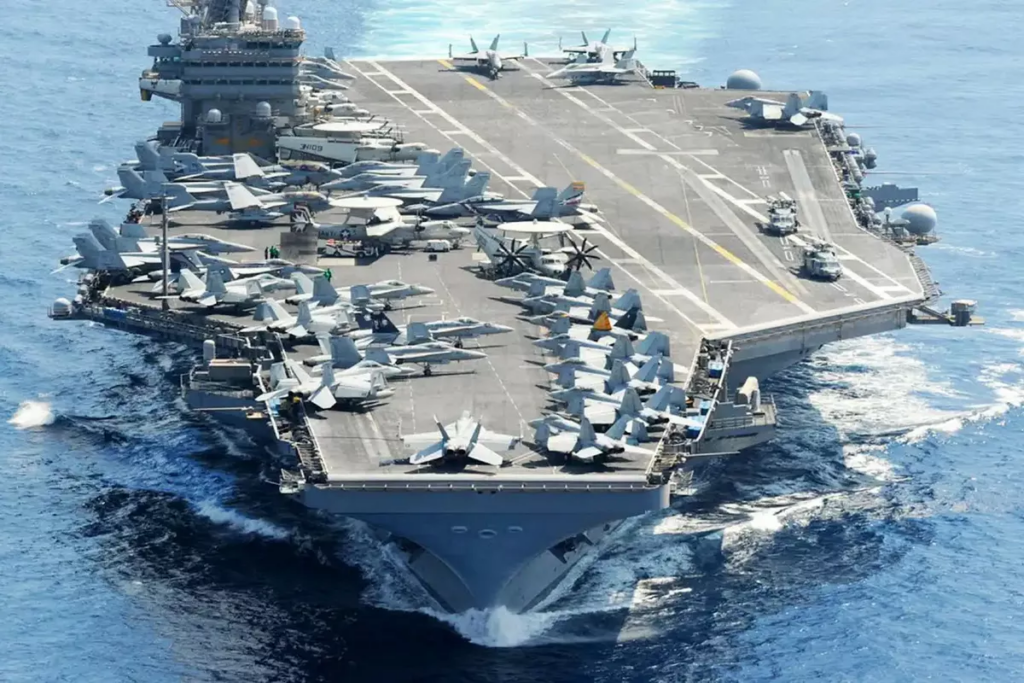
The USS Abraham Lincoln has suddenly become the center of a new information battle in the escalating US-Iran conflict. Iranian state media claimed the aircraft carrier was struck by missiles and forced to retreat, while the United States military quickly dismissed the claim as false.
The competing narratives emerged as Washington continues a major military buildup in West Asia and carries out air operations against Iran under Operation Epic Fury, launched alongside Israel’s campaign against Iranian targets.
So what actually happened? Here’s a clear breakdown of the claim, the denial, and why the USS Abraham Lincoln matters in this war.
What Is the USS Abraham Lincoln, and Why Is It Important?
The USS Abraham Lincoln (CVN-72) is one of the United States Navy’s Nimitz-class aircraft carriers—floating military bases capable of projecting air power anywhere in the world.
Aircraft carriers like the Lincoln are central to US military strategy because they allow the Pentagon to deploy combat aircraft without relying on land bases.
Key capabilities include:
- Launching fighter jets and strike aircraft for combat missions
- Conducting surveillance and reconnaissance operations
- Supporting naval and humanitarian missions
- Providing a mobile command center for military operations
A typical carrier strike group includes destroyers, cruisers, submarines, and supply ships that protect the carrier and extend its combat reach.
With more than 5,000 personnel onboard and dozens of aircraft, the USS Abraham Lincoln is effectively a self-contained air force at sea.
Why the USS Abraham Lincoln Is in the Middle East
The carrier was deployed to West Asia as part of one of the largest US military buildups in the region since the Iraq War.
The deployment supports Operation Epic Fury, a joint US-Israeli military campaign launched on February 28.
The stated goals of the operation include:
- Disrupting Iran’s nuclear program
- Destroying missile infrastructure
- Weakening Iran-backed militias across the region
Israel began the campaign under the name Operation Roaring Lion, and the United States joined soon after with its own air operations.
The USS Abraham Lincoln is believed to be launching strike aircraft carrying GBU-31 Joint Direct Attack Munitions (JDAMs), a type of precision-guided bomb used against hardened targets.
Iran’s Claim: The Carrier Was Hit
Iranian state media outlets reported that the Islamic Revolutionary Guard Corps (IRGC) Navy carried out a “precision strike” on the USS Abraham Lincoln.
According to those reports:
- The attack involved missiles and drones
- The strike occurred about 340 kilometers from Iran’s maritime borders
- The carrier was allegedly forced to retreat from the area
The claim was widely circulated by Iranian outlets such as Press TV, which framed the operation as a successful retaliation against US forces.
However, Iran did not provide independent evidence, satellite imagery, or verified damage reports to support the claim.
Military analysts note that striking a US aircraft carrier is extremely difficult due to layered defensive systems.
The US Response: “Carrier Continues Operations”
US military rejected Iran’s claim almost immediately.
The US Central Command (CENTCOM) released a statement saying the Abraham Lincoln Carrier Strike Group remains operational and continues supporting Operation Epic Fury.
CENTCOM also shared images of the carrier operating at sea, suggesting there was no disruption to its mission.
According to US officials:
- The carrier has not been damaged
- The strike group remains active in the region
- Air operations against Iranian targets are continuing
The rapid response suggests Washington wanted to quickly counter what it views as a propaganda claim during wartime.
What Defenses Protect the USS Abraham Lincoln?
Aircraft carriers are among the most heavily defended military assets in the world.
A carrier strike group uses multiple layers of defense designed to intercept missiles, aircraft, and drones long before they reach the ship.
Missile Defense Systems
Key defensive systems include:
- Aegis Combat System on escort ships
- Standard Missile interceptors (SM-2, SM-6)
- Close-In Weapon System (CIWS) rapid-fire cannons
- Electronic warfare systems that jam incoming threats
These systems create a defensive shield around the carrier.
Air Defense From Fighter Jets
Carrier-based fighter jets also patrol the surrounding airspace and intercept threats before they approach the fleet.
These aircraft act as a first line of defense.
Escort Ships and Submarines
Destroyers and cruisers surrounding the carrier add additional firepower and radar coverage.
Submarines in the strike group provide underwater protection against enemy vessels.
Because of this layered defense, damaging a US aircraft carrier would require a coordinated and sophisticated attack.
Another Incident: US Refueling Aircraft Crash in Iraq
Around the same time, the carrier claim surfaced, a US KC-135 refueling aircraft crashed in western Iraq.
US Central Command confirmed the incident and said rescue operations were underway.
The military stated:
- The crash was not caused by hostile or friendly fire
- Another aircraft involved in the operation landed safely
However, an Iran-backed militia group claimed responsibility for downing the aircraft.
As with the carrier claim, the competing narratives highlight how difficult it can be to verify battlefield information in real time.
Why Aircraft Carrier Claims Matter in War
Claims about damaging an aircraft carrier carry enormous symbolic weight.
Aircraft carriers are seen as the ultimate symbol of American military power. Any credible damage to one would be a major strategic and psychological victory for an adversary.
That’s why such claims often appear during conflicts—even when evidence is thin.
Military analysts say these narratives can serve several purposes:
- Boosting domestic morale
- Demonstrating strength to allies
- Influencing global media coverage
- Pressuring the opponent diplomatically
This is why governments typically move quickly to confirm or deny such claims.
The Bigger Picture: Rising Tensions in the Iran War
The dispute over the USS Abraham Lincoln comes as tensions between the United States and Iran continue to escalate.
The US has deployed two aircraft carriers to the region:
- USS Abraham Lincoln
- USS Gerald R. Ford
This level of deployment has not been seen in the region since the Iraq War.
Analysts say the presence of two carrier strike groups signals that Washington is preparing for sustained military operations.
TL;DR
- Iran claims its military struck the USS Abraham Lincoln aircraft carrier.
- The United States denies the claim and says the carrier remains operational.
- The carrier is supporting Operation Epic Fury, a US-Israeli campaign against Iran.
- Aircraft carriers are heavily defended, making them extremely difficult targets.
- The claim appears to be part of the broader information battle surrounding the war.