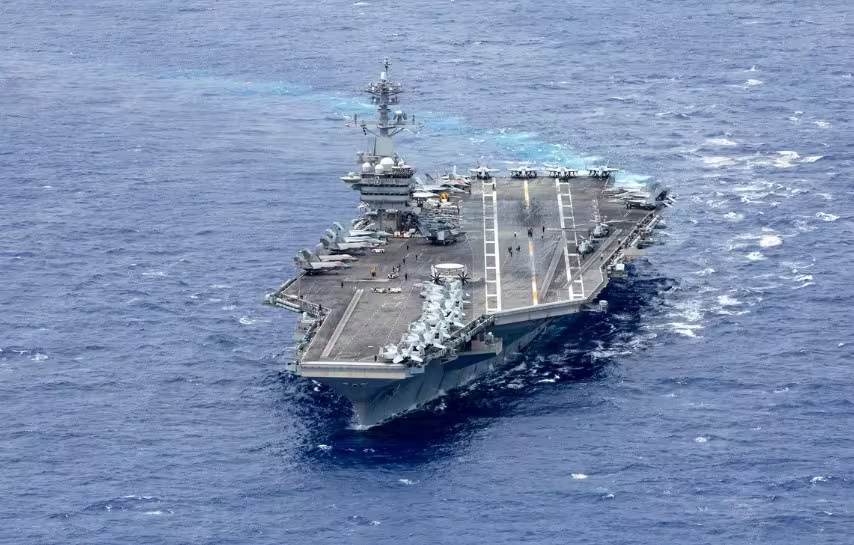
The United States has deployed the aircraft carrier USS Abraham Lincoln and a group of supporting warships to Middle Eastern waters, signaling a sharp escalation amid rising tensions with Iran. The move comes as Tehran faces international scrutiny over its violent crackdown on anti-government protests—and as Washington ramps up both military and rhetorical pressure.
According to U.S. officials cited by Reuters, the carrier strike group has entered the region under the authority of U.S. Central Command (CENTCOM), a development that underscores how quickly unrest inside Iran is spilling into a broader geopolitical standoff.
Why Has the USS Abraham Lincoln Been Deployed to the Middle East?
The deployment follows weeks of unrest in Iran and increasingly direct warnings from Washington.
Trump’s “Armada” Warning
Last week, U.S. President Donald Trump said the United States had “an armada” moving toward Iran, while adding he hoped it would not need to be used. The comment was widely interpreted as both a deterrent and a signal of readiness, aimed at Tehran’s leadership as protests continued across Iranian cities.
U.S. officials have framed the deployment as defensive, but the scale of the force suggests Washington wants to leave little ambiguity about its military posture.
What Is the USS Abraham Lincoln?
The USS Abraham Lincoln (CVN-72) is one of the most powerful naval assets in the U.S. arsenal.
A Floating Airbase
- Class: Nimitz-class aircraft carrier
- Commissioned: 1989
- Named after: Abraham Lincoln, the 16th U.S. president
- Homeport: San Diego, California
Built by Northrop Grumman Shipbuilding, the vessel is effectively a floating airbase capable of projecting U.S. power thousands of miles from home shores.
What Makes USS Abraham Lincoln Militarily Significant?
Aircraft carriers are not just ships—they are strategic statements.
H3: Size, Speed, and Capability
- Length: 1,092 feet (332.8 meters)
- Flight deck: 4.5 acres
- Maximum speed: Over 30 knots
- Crew capacity: Up to 5,680 personnel
The carrier is powered by two Westinghouse A4W nuclear reactors, allowing it to operate for decades without refueling and remain deployed for extended periods.
Weapons and Defensive Systems on Board
The USS Abraham Lincoln is heavily armed, even before counting its aircraft.
Missile and Countermeasure Systems
Onboard defenses include:
- 2 × RIM-116 Rolling Airframe Missile (RAM) launchers
- 2 × Mk 29 Sea Sparrow surface-to-air missile launchers
- 3 × Phalanx CIWS (Close-In Weapon Systems)
For undersea threats, the carrier is equipped with:
- SLQ-25A Nixie torpedo countermeasures
- SLQ-32A(V)4 electronic warfare and countermeasures suite
These systems are designed to defend against missiles, aircraft, and submarines—critical in a region where Iran has invested heavily in asymmetric naval tactics.
What Aircraft Does USS Abraham Lincoln Carry?
The real power of an aircraft carrier lies in its air wing.
H3: Nine Squadrons, Dozens of Aircraft
The USS Abraham Lincoln can carry up to 90 aircraft, including:
- E-2 Hawkeye early-warning aircraft
- EA-6B Prowler electronic warfare aircraft
- F/A-18 Super Hornet fighter-bombers
- F/A-18 Hornet fighter-bombers
- C-2 Greyhound logistics aircraft
- SH-60 Seahawk helicopters
This mix allows the carrier strike group to conduct surveillance, air superiority missions, ground strikes, and logistical support—all from international waters.
Is This a Defensive Move or Preparation for Conflict?
U.S. officials insist the deployment is precautionary, but history adds context.
A Familiar Pattern
The United States has repeatedly surged forces into the Middle East during periods of heightened tension with Iran. However, similar deployments preceded:
- The 2003 Iraq War
- Previous standoffs over Iran’s nuclear program
- U.S. airstrikes against Iranian-linked targets
Notably, the Pentagon is also relocating air-defense systems and fighter jets to the region, suggesting preparations for a wide range of contingencies.
How Has Iran Responded to the Deployment?
Tehran has struck a defiant tone.
“Regret-Inducing Response”
Iranian Foreign Ministry spokesperson Esmaeil Baghaei warned on Monday that any aggression would be met with a “comprehensive and regret-inducing response.”
Referring indirectly to the USS Abraham Lincoln, he said:
“The arrival of such a battleship is not going to affect Iran’s determination and seriousness to defend the Iranian nation.”
The statement reflects Iran’s long-standing strategy: project confidence outward, even as internal unrest intensifies.
How Do Iran’s Protests Fit Into the Standoff?
The military buildup cannot be separated from events inside Iran.
From Economic Anger to Political Uprising
The protests began in late December, initially driven by economic grievances such as inflation, unemployment, and fuel prices. They later evolved into a broader movement challenging the legitimacy of Iran’s ruling establishment.
A U.S.-based human rights organization said nearly 6,000 people may have died in the government’s crackdown—warning that the real number could be significantly higher.
Why the USS Abraham Lincoln Deployment Matters Globally
This is not just a bilateral issue between Washington and Tehran.
Risks Beyond the Region
A miscalculation could:
- Disrupt global energy markets
- Pull U.S. allies into a wider conflict
- Escalate proxy confrontations across the Middle East
Aircraft carriers like the USS Abraham Lincoln are meant to deter conflict—but they also raise the stakes if deterrence fails.
TL;DR
- The U.S. has deployed the USS Abraham Lincoln and warships to the Middle East amid rising tensions with Iran.
- The move follows Iran’s violent suppression of protests and sharp rhetoric from President Trump.
- The carrier brings massive military capability, signaling deterrence—but also raising escalation risks.
- Iran has warned of severe retaliation, while protests inside the country continue to mount.