
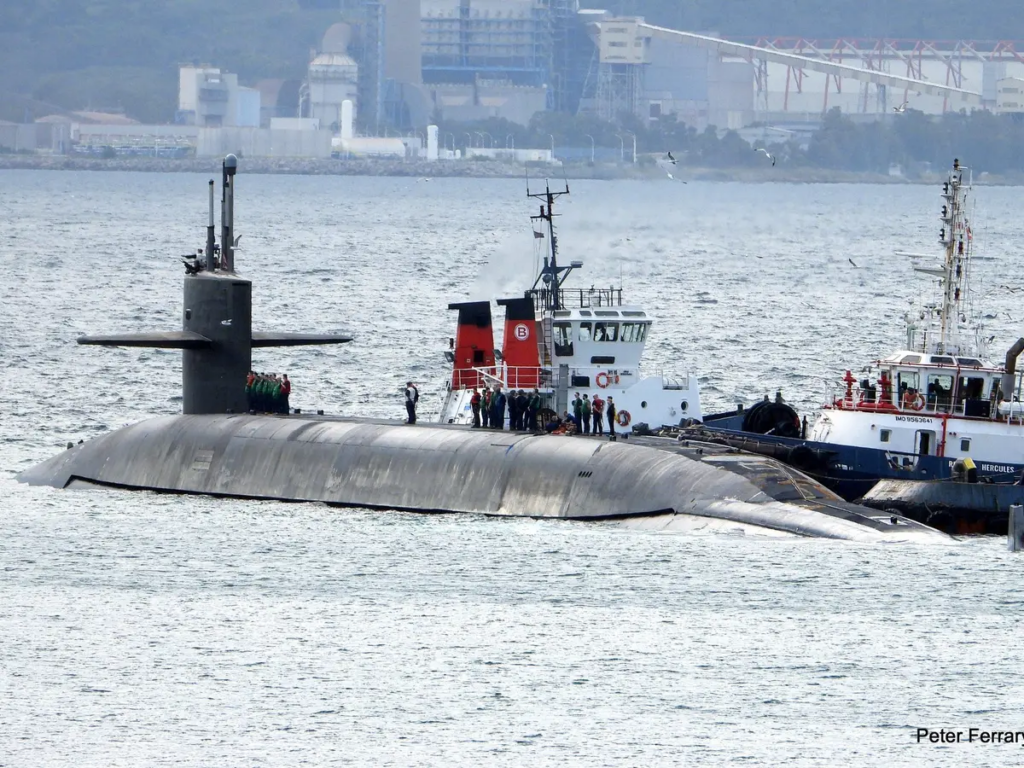
The reported appearance of the nuclear-powered submarine USS Alaska near Gibraltar has triggered intense online speculation amid escalating tensions between the United States and Iran.
The development came shortly after Donald Trump sharply criticized Tehran’s response to a US-backed ceasefire proposal, calling it “totally unacceptable” in a post on Truth Social.
Although there is no official indication that the submarine’s movement is directly tied to military escalation, the timing has placed defense observers, geopolitical analysts, and social media commentators into overdrive.
In moments of international tension, even the silhouette of a submarine near a strategic chokepoint can ignite an internet wildfire of theories before officials say a word.
What was reported about USS Alaska near Gibraltar?
According to reports from the Gibraltar Broadcasting Corporation, USS Alaska arrived near Gibraltar on May 10 under heightened security conditions.
Photographs reportedly showed:
- A 200-meter exclusion zone near the South Mole
- Increased maritime security presence
- Activity involving Royal Marines
- RAF transport aircraft movements
The broadcaster said security measures would remain in place “until further notice.”
Why Gibraltar matters strategically
Gibraltar sits at one of the world’s most critical maritime choke points:
- The gateway between the Atlantic Ocean and the Mediterranean Sea
- A key NATO-linked naval corridor
- A historically important military logistics hub
Any movement involving advanced naval assets there naturally attracts scrutiny, especially during geopolitical crises involving the Middle East.
However, military analysts caution that submarine port calls and logistics movements do not automatically signal imminent military action.
What is USS Alaska?
USS Alaska is part of the US Navy’s powerful Ohio-class submarine fleet, one of the most strategically important components of America’s nuclear deterrence system.
What makes Ohio-class submarines significant?
According to publicly available defense information, the fleet includes:
- 14 ballistic missile submarines
- 4 guided missile submarines
These vessels are designed for:
- Nuclear deterrence
- Long-duration stealth operations
- Strategic missile deployment
- Intelligence and special operations support
Key characteristics of Ohio-class submarines
- Approximately 171 meters long
- Submerged displacement of nearly 18,750 tonnes
- Nuclear-powered propulsion
- Extremely long operational endurance
- Capable of carrying advanced missile systems
Because of their stealth capabilities, these submarines are often described as among the most survivable elements of US military power.
They are less warships in the cinematic sense and more silent underwater geopolitical pressure systems drifting beneath the world’s fault lines.
Why Trump’s Iran comments intensified attention
The submarine reports gained traction because they coincided with Trump publicly rejecting Iran’s response to a proposed ceasefire framework tied to broader West Asia tensions.
Posting on Truth Social, Trump wrote:
“I don’t like it – TOTALLY UNACCEPTABLE!”
The remarks followed reports that Tehran had responded to a US proposal through Pakistani mediators.
According to Iran’s state-run Islamic Republic News Agency, Iran transmitted its response regarding efforts to end the conflict through diplomatic channels.
The sharp rhetoric immediately fueled speculation that Washington could increase military pressure in the region.
Is USS Alaska heading toward the Mediterranean?
That remains unconfirmed.
Social media accounts rapidly circulated claims that the submarine was moving into the Mediterranean Sea as part of potential military positioning related to Iran.
At present:
- No official US statement confirms such a mission
- No evidence publicly links USS Alaska to imminent operations
- The Pentagon has not announced deployment details
This distinction matters because military speculation online often outruns verified information.
Naval movements involving submarines are particularly vulnerable to rumor because:
- Missions are highly classified
- Tracking information is limited
- Public visibility is rare
- Geopolitical timing fuels assumptions
A useful explainer graphic here could map:
- Gibraltar’s strategic location
- Mediterranean naval routes
- Key US military positions in Europe and West Asia
- Major maritime choke points including Hormuz and Suez
Why submarines matter during geopolitical crises
Submarines occupy a unique role in global power projection.
Unlike aircraft carriers, which operate as visible demonstrations of force, submarines often function through ambiguity.
Why submarine deployments attract attention
They can:
- Operate undetected for extended periods
- Carry strategic weapons
- Support intelligence gathering
- Signal deterrence without direct confrontation
During periods of tension, even acknowledging a submarine’s presence can send a geopolitical message.
Sometimes the strategic effect comes not from what a submarine does, but from what adversaries fear it might be capable of doing unseen.
Iran tensions remain fragile despite diplomatic channels
The broader backdrop to the USS Alaska reports is the increasingly unstable situation involving:
- US-Iran negotiations
- Gulf security concerns
- Strait of Hormuz tensions
- Regional military operations
Recent weeks have already seen:
- Reports of naval deployments
- Concerns over oil infrastructure
- Rising military rhetoric
- Diplomatic mediation efforts involving regional actors
Trump’s rejection of Iran’s response suggests negotiations remain fragile despite ongoing backchannel diplomacy.
Why social media speculation spreads so quickly during military crises
The USS Alaska story also highlights how modern geopolitical reporting now unfolds in parallel with online speculation ecosystems.
Open-source intelligence communities, ship trackers, satellite imagery accounts, and defense influencers often analyze military movements in real time.
That can produce:
- Valuable public insight
- Rapid information sharing
- Premature conclusions
- Viral misinformation
Submarines are especially fertile territory for speculation because their missions are intentionally secretive.
A blurry dockside image plus a tense geopolitical headline can become a digital Rorschach test for the entire internet.
What happens next?
For now, there is no official confirmation linking USS Alaska’s reported movement to any immediate military escalation involving Iran.
But analysts will closely watch:
- US naval deployments
- Iranian responses
- Diplomatic mediation efforts
- Strait of Hormuz developments
- Pentagon statements
- NATO-linked maritime activity
In high-tension geopolitical environments, symbolism matters almost as much as action.
And few symbols carry more strategic weight than a nuclear-powered submarine appearing quietly at the entrance to the Mediterranean.
TL;DR
The reported arrival of the nuclear-powered submarine USS Alaska near Gibraltar has sparked online speculation amid rising US-Iran tensions. The development followed Donald Trump calling Iran’s response to a ceasefire proposal “totally unacceptable.” While there is no official confirmation linking the submarine to military escalation, the timing and Gibraltar’s strategic location have intensified geopolitical attention.