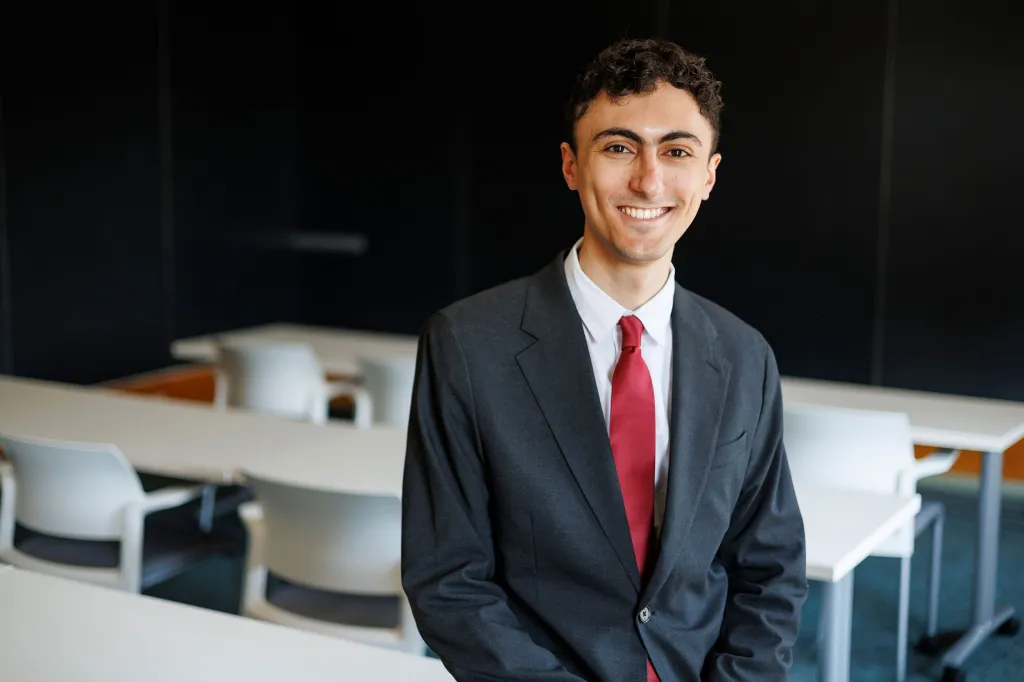
As thousands of graduates crossed the stage at Harvard University’s 2026 commencement ceremony, one student’s speech managed to break out of the usual graduation-day news cycle and become a national conversation. Noah Eckstein’s address, titled The Punchline, has attracted widespread attention online for its message about empathy, political division, and the growing difficulty of understanding people with different beliefs.
At a time when American politics remains deeply polarized, Eckstein’s speech offered something increasingly rare: a call not for agreement, but for understanding.
The speech has since been shared widely across social media platforms, with viewers praising its personal storytelling, emotional depth, and timely relevance. One line in particular has emerged as the defining takeaway: “Listen like you might be wrong.”
Why Noah Eckstein’s Harvard speech went viral
Commencement speeches often celebrate achievement and offer advice for the future. Eckstein took a different approach.
Rather than focusing solely on career ambitions or personal success, he addressed what many Americans experience daily: conversations that quickly turn into arguments, political disagreements that damage relationships, and a culture increasingly built around choosing sides.
The speech resonated because it touched on a challenge that extends well beyond politics.
Whether discussing elections, social issues, religion, education, or even family disagreements, many people feel that public discourse has become more combative and less curious. Eckstein’s message directly confronted that reality.
The viral response suggests audiences were hungry for a perspective that acknowledged division while offering a constructive path forward.
How Noah Eckstein used his family history to make a larger point
One of the most memorable aspects of the speech was its opening.
Eckstein introduced himself through a story about his family’s diverse religious and cultural background, describing ancestors connected to Christianity, Islam, and Judaism.
Using the setup of a classic joke, he began with the line: “A Christian, a Muslim, and a Jew walk into a bar.”
The audience initially expected humor. Instead, the line became the foundation for a reflection on identity, coexistence, and family history.
By sharing how generations of interfaith relationships shaped his own life, Eckstein transformed an intensely personal story into a broader commentary on what it means to live alongside people whose experiences differ from our own.
A lesson rooted in lived experience
The effectiveness of the speech came from its authenticity.
Rather than speaking in abstract terms about unity, Eckstein pointed to real examples within his own family. He described relatives who carried vastly different worldviews and historical experiences, yet maintained relationships despite profound disagreements.
That distinction matters.
Many discussions about polarization focus on political institutions, media ecosystems, or election outcomes. Eckstein instead focused on human relationships and everyday interactions.
What did Noah Eckstein say about political polarization?
A central theme of the speech was the way modern debates often reduce complex issues into simple categories.
According to Eckstein, society increasingly frames discussions as contests between:
- Right versus left
- Good versus bad
- Us versus them
- Winners versus losers
He argued that this mindset encourages people to view others as obstacles to overcome rather than individuals with experiences worth understanding.
The criticism was not directed at one political ideology or party. Instead, it targeted the broader culture of confrontation that has become common across political and social discussions.
“The counter to division isn’t necessarily agreement”
Perhaps the most important argument in the speech was the idea that unity does not require consensus.
Eckstein told graduates:
“The counter to division isn’t necessarily agreement. It’s understanding.”
That message challenges a common assumption in modern political discourse: that people must first reach agreement before meaningful progress can occur.
Instead, he suggested that understanding another person’s perspective is valuable even when disagreement remains.
For many viewers, this idea represented the speech’s strongest contribution to the ongoing conversation about political polarization.
Why “Listen like you might be wrong” resonated online
Every viral speech tends to produce one standout quote.
For Eckstein, that moment came when he urged listeners to approach conversations with humility.
“Listen like you might be wrong” quickly became the most widely shared excerpt from the address.
The phrase stands out because it challenges a behavior that has become increasingly common online.
Social media platforms often reward certainty, confidence, and quick reactions. Admitting uncertainty can feel risky. Yet Eckstein argued that genuine understanding begins when people accept the possibility that their own perspective may be incomplete.
Social media users praised the message
Online reactions were overwhelmingly positive.
Viewers described the speech as:
- Thoughtful
- Hopeful
- Timely
- Emotionally moving
- Refreshingly constructive
Many comments highlighted the quote about listening as one of the most useful pieces of advice they had encountered in recent years.
Others praised the way Eckstein balanced personal storytelling with a broader social message.
The response reflects a growing public appetite for conversations that move beyond political talking points and focus on human connection.
What the speech says about America’s broader cultural moment
The popularity of Eckstein’s address may reveal as much about the audience as it does about the speaker.
The United States continues to navigate intense political disagreements, debates over identity, and growing distrust across ideological lines. Polling from organizations such as the Pew Research Center and Gallup has repeatedly shown increasing partisan division over the past two decades.
Against that backdrop, a speech advocating curiosity, empathy, and humility was bound to attract attention.
Importantly, Eckstein did not present empathy as weakness or compromise. He framed it as a necessary skill for understanding a complex world.
His argument was straightforward: people cannot effectively address problems they refuse to understand.
Why commencement speeches still matter
Graduation speeches rarely shape national conversations.
Yet occasionally a message arrives at precisely the right cultural moment.
Eckstein’s speech appears to have done exactly that.
Rather than offering a list of life hacks or career advice, it challenged graduates to think differently about disagreement itself. The speech suggested that meaningful engagement begins not with winning arguments but with understanding why others hold the views they do.
In a political environment often dominated by outrage and certainty, that message has found a surprisingly large audience.
The takeaway
Noah Eckstein’s viral Harvard commencement speech is ultimately less about politics than about communication.
Its central lesson is simple but increasingly difficult to practice: understanding another person’s perspective does not require abandoning your own.
By drawing on his family’s history and reflecting on today’s polarized culture, Eckstein delivered a message that many viewers found both timely and hopeful.
Whether discussing politics, religion, social issues, or family disagreements, his challenge to graduates remains relevant far beyond Harvard’s campus:
Listen carefully. Stay curious. And listen like you might be wrong.
TL;DR
Harvard graduate Noah Eckstein’s commencement speech has gone viral for its message about empathy and political division. Drawing from his multicultural family history, he argued that understanding, not agreement, is the antidote to polarization. His line, “Listen like you might be wrong,” has become the speech’s defining takeaway and resonated widely with online audiences seeking a more constructive approach to disagreement.