
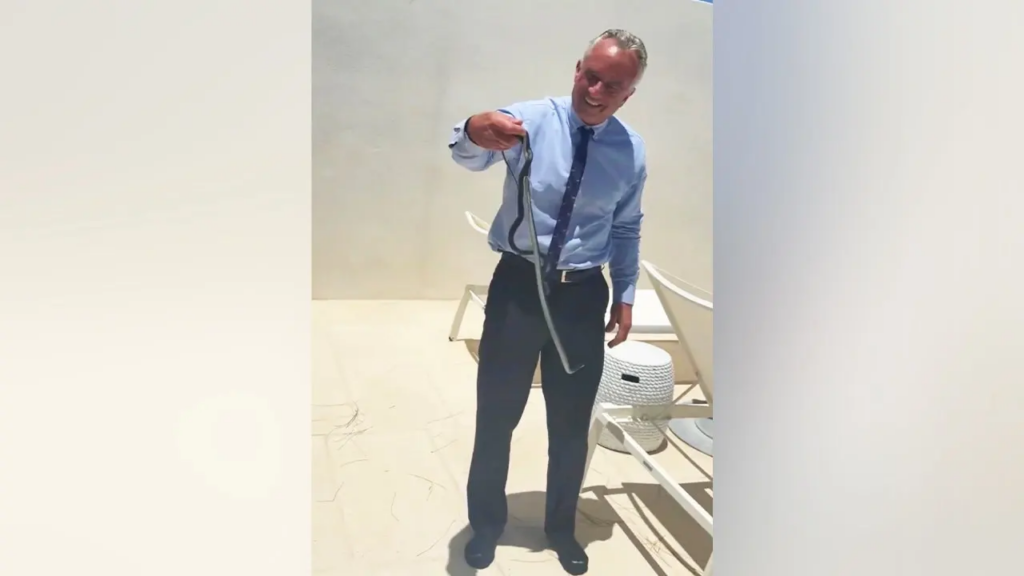
US Health Secretary Robert F. Kennedy Jr. is facing fresh backlash after posting a video showing himself picking up live snakes with his bare hands outside the Florida home of TV personality Mehmet Oz.
The clip, which quickly spread across social media, triggered a mix of fascination, mockery, and concern, while also reviving public scrutiny over Kennedy’s long history of bizarre animal-related stories.
In the video, Kennedy casually crouches barefoot beside two writhing black racer snakes before lifting them by hand as onlookers nervously react in the background.
One voice repeatedly pleads, “Bobby, please.”
Another simply asks:
“Why?”
Internet historians may someday identify this single word as the unofficial soundtrack of 2026.
What happened in the viral snake video?
The footage was posted by Kennedy himself on social media.
According to the caption, he was helping remove snakes from Dr Oz’s Florida beach property while his wife, actress Cheryl Hines, watched nearby.
Kennedy wrote:
“Cheryl cheerleads the removal of a pair of Black racers from Dr Oz’s patio.”
The video shows:
- Two black racer snakes are moving across a patio
- Kennedy approaching barefoot
- Him grabbing the snakes by hand
- Nervous reactions from people nearby
- Kennedy smiled throughout the encounter
At one point, the snakes appear to bite or strike at his hands, though he does not visibly react and continues holding them near the camera.
The clip immediately became viral meme material because it combined:
- A senior US official
- Reptiles
- Bare-handed animal handling
- Nervous bystanders
- Florida
- Social media bravado
That is essentially the internet’s version of a five-ingredient disaster smoothie.
What kind of snakes were involved?
The reptiles appeared to be black racer snakes, a common non-venomous species found across Florida and the southeastern United States.
Black racers are generally considered harmless to humans if left alone.
According to the US National Park Service:
- They are non-venomous
- Often flee from humans
- Can bite defensively if handled
- Become more active during warmer months
Wildlife officials still strongly discourage people from attempting to handle them.
The Florida Fish and Wildlife Conservation Commission recently warned residents to avoid picking up snakes, even if they are non-venomous.
The agency noted:
“Resist the urge to pick it up, even our nonvenomous snakes can give a solid bite.”
That warning became significantly more relevant after millions of people watched a cabinet official ignore it on camera.
Why the video triggered backlash
Critics online argued the stunt was reckless, performative, and potentially irresponsible given Kennedy’s public role.
Several users pointed out that:
- Wildlife experts discourage unnecessary handling
- Public figures can unintentionally normalize risky behavior
- The video could encourage imitation
Others focused less on safety and more on symbolism.
One widely shared comment called Kennedy:
“A snake oil salesman removing snakes.”
Another user jokingly compared the imagery to ancient mythology, referencing Hermes’ caduceus, the staff wrapped with serpents associated with medicine.
The internet rarely misses an opportunity to combine classical mythology with reptile chaos.
RFK Jr’s long and unusual history with animals
The snake video also reignited discussion about Kennedy’s past animal-related controversies, which have repeatedly drawn headlines over the years.
The whale incident
Kennedy previously faced backlash after recounting a story involving:
- A dead whale
- A chainsaw
- Transporting whale remains on top of a vehicle
Environmental groups criticized the anecdote heavily after it resurfaced publicly.
The raccoon controversy
Earlier this year, Kennedy was questioned during a congressional hearing regarding reports that he once cut off the genitals of a dead raccoon for research purposes.
The allegations sparked intense online reactions and renewed scrutiny of his history of unusual wildlife encounters.
As a result, the snake video did not emerge in isolation. It landed inside an already established public narrative surrounding Kennedy’s eccentric relationship with animals.
Why the internet reacts so strongly to RFK Jr moments
Part of Kennedy’s viral power comes from unpredictability.
In an era where politicians are often highly scripted, Kennedy’s public persona frequently feels startlingly unscripted, for better or worse.
That unpredictability makes seemingly small moments explode online because users are never entirely sure whether
- They are watching a government official
- A reality television clip
- A survival show audition
- Or an accidental parody of American politics
The snake video fit perfectly into that ecosystem.
The politics of virality
The episode also reflects a broader shift in political communication.
Modern politicians increasingly use:
- Viral clips
- Informal videos
- Shock moments
- Internet culture
- Personal branding stunts
to maintain public attention.
In some cases, controversy itself becomes a visibility strategy.
The challenge is that virality rarely distinguishes between:
- Entertainment
- credibility
- expertise
- spectacle
Social media rewards emotional reaction first and nuance much later, if at all.
A barefoot cabinet official wrestling snakes on a patio was almost guaranteed to dominate timelines regardless of context.
Wildlife experts say people should not imitate the stunt
Despite the humor surrounding the clip, wildlife experts consistently advise against handling snakes unnecessarily.
Even non-venomous snakes:
- Bite defensively
- Carry bacteria
- Experience stress when handled
- Can be misidentified by inexperienced people
Venomous and non-venomous species can also look similar to untrained observers.
Wildlife agencies generally recommend:
- Maintaining distance
- Contacting animal control when necessary
- Avoiding direct interaction
The safest snake encounter is usually the boring one.
The bigger picture: politics increasingly operates like internet entertainment
The RFK Jr snake episode may seem trivial, but it reflects a broader transformation in political culture.
Public figures today often exist simultaneously as:
- Policymakers
- Meme subjects
- Influencers
- Reality-show personalities
- Algorithmic content generators
Political attention increasingly flows through entertainment mechanics.
That means moments once considered strange side anecdotes can suddenly become defining public images.
And in the modern media ecosystem, few things travel faster than a barefoot politician smiling while holding angry snakes beside a Florida patio.