
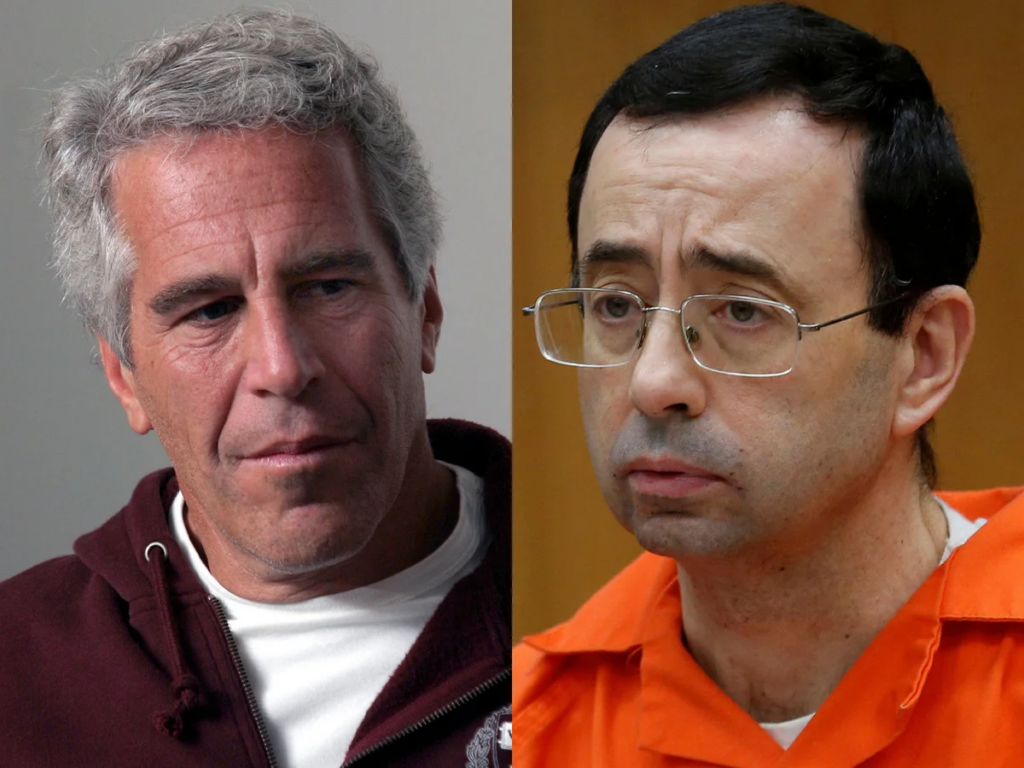
A newly resurfaced document tied to convicted sex offender Jeffrey Epstein has ignited renewed scrutiny, not just for its disturbing content, but for growing questions over whether it is real at all.
The handwritten letter, allegedly sent by Epstein to disgraced former USA Gymnastics doctor Larry Nassar shortly before Epstein died in federal custody in 2019, appears in a fresh batch of congressionally mandated document releases related to the Epstein investigation. While the letter’s contents are graphic and deeply unsettling, federal authorities now say the document is not authentic.
The episode underscores a recurring problem with large-scale document dumps tied to high-profile cases: shocking claims can circulate widely before their credibility is fully understood.
What Is the Alleged Jeffrey Epstein Letter to Larry Nassar?
The letter, addressed to “L.N.” and signed “J. Epstein,” was postmarked in August 2019, the same month Epstein died by suicide while awaiting trial on federal sex trafficking charges at the Metropolitan Correctional Centre (MCC) in Manhattan.
According to records first reported by the Associated Press in 2023, the letter never reached Nassar. Instead, it was found weeks later in the MCC mailroom, returned to sender after Epstein’s death.
In an internal email, a prison investigator noted uncertainty over how the letter should be handled, writing that it appeared to have been mailed but returned, raising questions about whether it should be opened or turned over to authorities.
What the Letter Allegedly Said and Why It Shocked Readers
The contents of the letter are disturbing even by the grim standards of the Epstein case.
According to the document:
- Epstein claimed he and Nassar “shared one thing,” referring to what he described as their “love & caring for young ladies.”
- He used explicitly sexual language, including the word “nubile,” to describe young women.
- The letter included a crude comparison involving “our president,” widely interpreted as then-President Donald Trump, who was in office at the time.
- It ended with the line: “Life is unfair.”
Given that both Epstein and Nassar were convicted of sex crimes involving minors, the language immediately drew outrage and widespread attention after resurfacing in the latest document release.
DOJ and FBI Say the Epstein-Nassar Letter Is Fake
Federal authorities have since moved forcefully to cast doubt on the document’s authenticity.
Why Investigators Rejected the Letter
According to the FBI and Department of Justice, the letter was reviewed at the time it was flagged in jail, and several inconsistencies led investigators to conclude it was not genuine:
- Handwriting mismatch: The writing does not match verified samples of Epstein’s handwriting.
- Postmark anomaly: The envelope was postmarked in Northern Virginia three days after Epstein’s death, even though he was incarcerated in New York.
- Incorrect return address: The envelope listed the wrong jail.
- Missing inmate number: Federal rules require all outgoing inmate mail to include an inmate identification number, which was absent.
Taken together, officials said, the discrepancies were too significant to ignore.
DOJ Clarification on Document Releases
The Department of Justice addressed the controversy in a post on X, stating it was “investigating the validity of this alleged letter from Jeffrey Epstein to Larry Nassar” and would provide updates as appropriate.
Importantly, the DOJ emphasized that the inclusion of a document in a release does not mean the claims within it are factual. The department said it is legally required to release certain materials, even when they contain false, unverified, or sensationalist allegations.
Why the Letter Reappeared Now
The disputed document surfaced again as part of a broader release of more than 8,000 DOJ records related to the Epstein investigation.
These files were made public under the Epstein Files Transparency Act, a law passed by Congress with near-unanimous support after sustained criticism over secrecy, delays, and redactions in the handling of Epstein-related records.
The release includes:
- Internal DOJ and FBI correspondence
- Investigative leads and tips
- Redacted interviews and memos
- References to public figures
Many documents remain heavily redacted, and officials have warned that some contain unsubstantiated or false claims.
Trump References in the DOJ Files: What’s Confirmed and What Isn’t
The resurfaced letter gained additional traction because of its reference to “our president,” which many interpreted as a nod to Donald Trump.
Separately, the DOJ release includes an internal email stating that Trump was listed as a passenger on at least eight flights aboard Epstein’s private jet between 1993 and 1996.
The email explicitly notes that:
- Being listed on flight records does not imply criminal conduct
- No allegation of wrongdoing is established by the records alone
The DOJ has also stated that some documents include “untrue and sensationalist claims” about Trump that were submitted to the FBI shortly before the 2020 election.
Trump has acknowledged knowing Epstein socially but has said their relationship ended around 2004, well before Epstein’s first arrest. No criminal charges or credible evidence have linked Trump to Epstein’s sex trafficking crimes.
Why This Matters Beyond One Letter
The Epstein–Nassar letter controversy highlights a critical issue in high-profile transparency efforts: raw disclosure without context can mislead.
Key takeaways:
- Document releases can include false, forged, or unverified material
- Shocking content often spreads faster than official clarifications
- Inclusion in government files does not equal validation
- Context and sourcing are essential — especially in politically charged cases
As the DOJ continues releasing Epstein-related records, officials say scrutiny and skepticism are necessary — even, and especially, when the material is disturbing.
TL;DR
- A graphic letter allegedly from Jeffrey Epstein to Larry Nassar resurfaced in newly released DOJ files
- The FBI and DOJ say the letter is not authentic, citing handwriting, postmark, and address errors
- The document’s inclusion does not mean its claims are true
- Trump references in the broader file release remain unproven and contested
- The episode underscores the risks of misinterpreting raw document dumps