
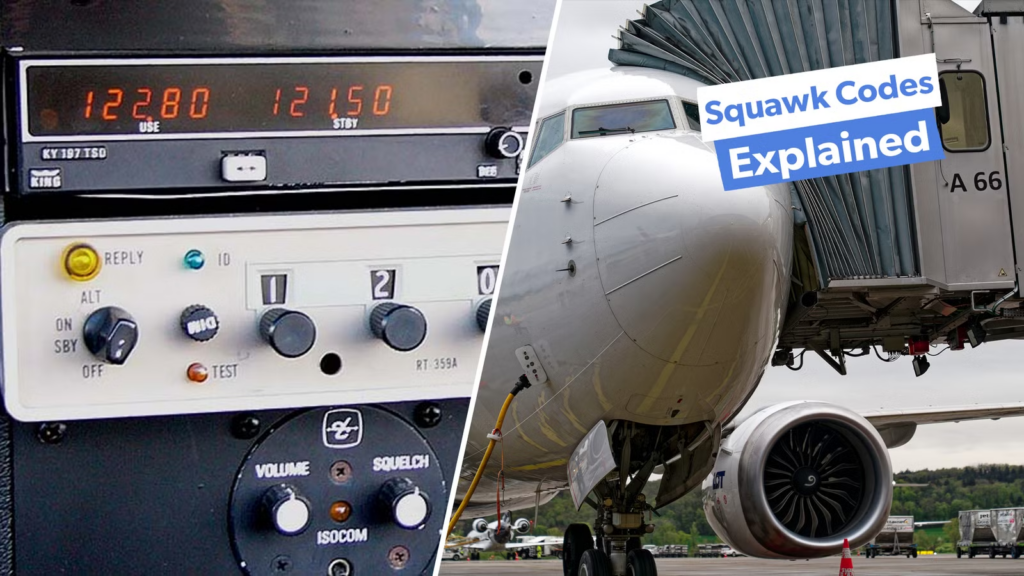
A U.S. Air Force cargo aircraft flying between Abu Dhabi and Doha briefly lit up flight-tracking screens after transmitting Squawk 7700—the universal code for a general in-flight emergency. The aircraft, identified by callsign MOOSE31, was a Boeing C-17 Globemaster III, one of the U.S. military’s primary heavy airlifters.
The transponder signal does not confirm what went wrong. It does confirm one thing: the crew needed immediate priority handling from air traffic control. Here’s what Squawk 7700 actually means—and what it doesn’t.
What Is Squawk 7700?
Squawk 7700 is a four-digit transponder code pilots enter into their aircraft’s transponder to signal a general emergency.
When transmitted, it:
- Automatically flags the aircraft on radar screens
- Alerts air traffic controllers to provide priority routing
- Triggers readiness from emergency services if needed
- Clears the surrounding airspace when necessary
Think of it as the digital equivalent of a Mayday call. It doesn’t specify the problem. It simply says: this aircraft requires immediate attention.
Why Would a Pilot Squawk 7700?
The reasons vary. Importantly, squawking 7700 does not mean a crash is imminent.
Common causes include:
Mechanical Issues
- Engine malfunction
- Hydraulic system problems
- Electrical failures
- Smoke or fire warnings
Cabin or Environmental Emergencies
- Rapid depressurization
- Oxygen system faults
Medical Emergencies
- A crew member or passenger requiring urgent medical attention
Precautionary Declarations
Sometimes crews declare 7700 out of caution, even if the issue later turns out to be minor.
Controllers treat every 7700 as urgent until proven otherwise.
How Is Squawk 7700 Different From 7500 and 7600?
Aviation uses three primary emergency codes:
- 7500 — Unlawful interference (hijacking)
- 7600 — Radio communication failure
- 7700 — General emergency
These codes are standardized globally under the International Civil Aviation Organization (ICAO) rules.
The distinction matters. A 7500 signal triggers a very different security response than a 7700.
What Do We Know About MOOSE31?
The aircraft involved was a United States Air Force transport operating in the Middle East.
The Boeing C-17 Globemaster III is a long-range, heavy-lift cargo aircraft capable of transporting:
- Troops
- Military vehicles
- Humanitarian aid
- Medical evacuation equipment
C-17s routinely operate across the Gulf region as part of logistics and operational missions.
Military flight details—including cargo, route purpose, or onboard systems—are rarely disclosed publicly. As of now, no official statement has detailed the cause of the emergency.
Flight-tracking platforms can show transponder codes but cannot reveal cockpit conditions.
What Happens After 7700 Is Declared?
Once 7700 is transmitted:
- Air traffic control acknowledges the emergency.
- The aircraft receives priority over all other traffic.
- Nearby aircraft may be rerouted.
- Emergency services at the nearest suitable airport are placed on standby.
Pilots then decide whether to:
- Continue to destination
- Divert to the nearest airport
- Hold while troubleshooting
In many cases, aircraft land safely without further incident.
Why Military Emergencies Draw Extra Attention
When a military aircraft declares an emergency, speculation often spreads quickly online. But military operations operate under different disclosure rules than commercial aviation.
Unlike civilian airlines, the U.S. Air Force does not routinely provide immediate public explanations for in-flight incidents—especially in sensitive regions.
It’s also worth noting that military aircraft are engineered with multiple redundancies. Emergency declarations are often precautionary rather than catastrophic.
Does Squawk 7700 Mean the Aircraft Was in Immediate Danger?
Not necessarily.
Pilots are trained to err on the side of caution. Declaring an emergency early gives crews:
- Maximum airspace flexibility
- Direct routing
- Immediate access to ground support
In aviation culture, declaring 7700 is considered prudent decision-making—not a sign of failure.
Why This Matters Beyond One Flight
Aviation emergency codes are rarely understood outside pilot circles. Yet they’re fundamental to global air safety.
Standardized codes allow:
- Rapid cross-border coordination
- Uniform response procedures
- Immediate clarity without lengthy radio exchanges
In high-traffic airspace like the Gulf region, that clarity can prevent cascading complications.
What We Still Don’t Know
At this time:
- The specific cause of the emergency remains undisclosed.
- There is no official confirmation of mechanical or medical issues.
- The Air Force has not publicly detailed the event.
Until confirmed information is released, any specific cause would be speculative.
Responsible reporting requires distinguishing between what radar data shows and what it does not.
TL;DR
- Squawk 7700 signals a general in-flight emergency.
- A U.S. Air Force C-17 (callsign MOOSE31) transmitted the code between Abu Dhabi and Doha.
- The signal guarantees priority handling—but does not imply an imminent crash.
- No official cause has been released.
In aviation, early emergency declarations are often a sign of disciplined safety protocol—not disaster.