
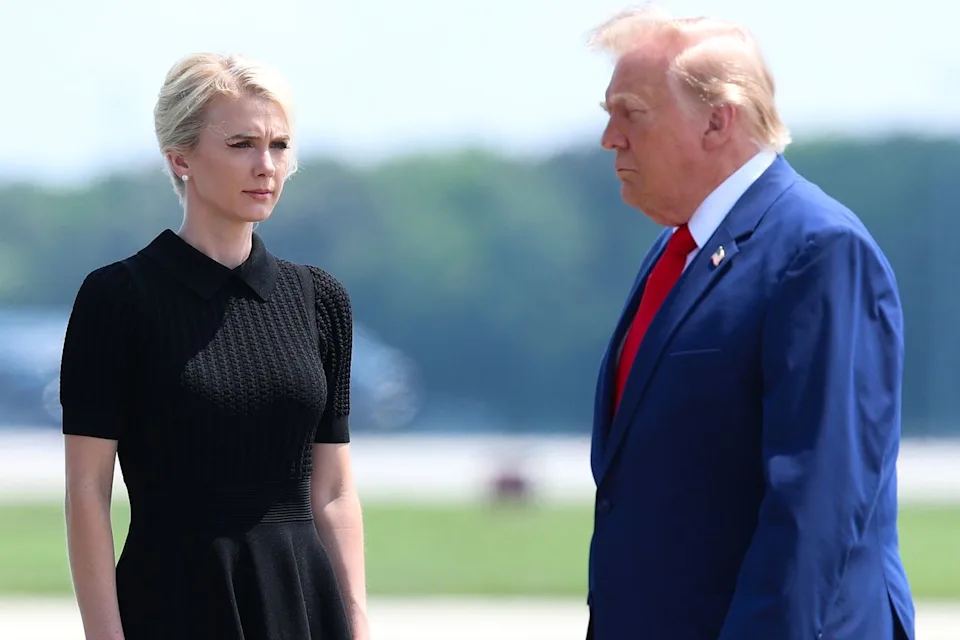
Natalie Harp, a close aide to US President Donald Trump, is back in the political spotlight after Democratic Sen. Jon Ossoff mentioned her during a campaign rally in Atlanta.
Harp has been a visible supporter of Trump for years, first gaining national attention after publicly crediting him with helping her navigate treatment for stage II bone cancer. Since then, she has moved from political advocate to a member of Trump’s inner circle, appearing alongside the president at major political events and traveling with him.
Her renewed visibility comes amid controversy over a reported aircraft switch involving Trump during a July trip to Turkey. Reports that Harp was among the aides who accompanied the president during the maneuver have prompted fresh questions about her role and access within the White House.
Who is Natalie Harp?
Harp, 35, is a California native who became politically prominent after speaking publicly about her experience with cancer and her support for Trump’s healthcare agenda.
Her personal story became closely associated with Trump’s Right to Try legislation, which he signed into law in 2018.
The law allows eligible patients with life-threatening or immediately life-threatening diseases to seek access to certain investigational treatments that have not yet received full approval from the US Food and Drug Administration.
At a 2019 Washington conference, Harp praised Trump for signing the legislation and argued that conventional political and medical institutions had failed patients like her.
She said Trump had helped give patients an opportunity to fight for their lives and described his approach in highly personal terms.
Her story subsequently became part of Trump’s political messaging around healthcare, particularly his argument that patients should have greater access to experimental treatments.
What did Natalie Harp say about Trump and her cancer?
Harp became a prominent speaker at Republican events after publicly discussing her diagnosis.
During an appearance on Fox News’ Fox & Friends, she credited Trump’s policies with helping her continue living with cancer.
“I’m not dying from cancer anymore. Thanks to President Trump, I’m living with cancer.”
The statement became one of the most recognizable examples of Harp’s public advocacy for the president.
At the 2020 Republican National Convention, she again spoke directly to Trump about her experience, telling him:
“I wouldn’t be alive today if it wasn’t for you.”
She also compared Trump to George Bailey, the central character played by Jimmy Stewart in the classic film It’s a Wonderful Life.
Her speeches transformed what could have been a personal medical story into a powerful political narrative about Trump’s relationship with supporters who believed his policies had directly affected their lives.
How did Natalie Harp become part of Trump’s inner circle?
Harp’s role expanded beyond that of a political supporter.
She became known as a Trump aide and has maintained unusually close proximity to the president at public events and during travel.
Her visibility has also been linked to her ability to communicate Trump’s message in highly personal terms. Unlike many political surrogates, Harp’s advocacy is rooted in her own experience with serious illness and her belief that Trump provided patients with greater autonomy.
Her presence around Trump has therefore attracted attention not only because of her political views but because of the level of access she appears to have within his orbit.
That access became particularly relevant after reports emerged about Trump’s travel during a July visit to Turkey.
Why did Jon Ossoff mention Natalie Harp?
Democratic Sen. Jon Ossoff mentioned Harp while criticizing Trump during a campaign rally in Atlanta.
Ossoff was discussing Trump’s handling of the military and his conduct as president when he referred to the reported aircraft switch involving Trump and several aides.
According to The Independent, Harp was among a small group of Trump aides who reportedly traveled with the president during the maneuver.
The report alleged that Trump and selected members of his team switched aircraft using an airport catering truck amid concerns about a possible Iranian assassination threat.
Other senior officials, including Secretary of State Marco Rubio and Treasury Secretary Scott Bessent, were reportedly left on the other aircraft, which continued carrying journalists and other members of the presidential entourage.
Ossoff invoked the episode while attacking Trump’s leadership.
“While the sailors on the Lincoln fight his war…”
He went on to accuse Trump of prioritizing personal activities while US military personnel remained involved in the conflict.
Harp’s reported presence on the aircraft therefore became part of a broader political argument about Trump’s security arrangements and decision-making.
What was the reported aircraft swap?
The reported operation has attracted attention because of the unusual method allegedly used to move Trump between aircraft.
According to the reports cited by WION, Trump and a small group of aides were moved between planes using an airport catering vehicle.
The alleged objective was to prevent potential attackers from determining which aircraft carried the president.
Such deception is not entirely unprecedented in presidential travel. US presidents have historically used alternate aircraft, concealed schedules and other security measures when traveling through high-risk environments.
However, the reported operation attracted particular attention because of its alleged connection to concerns about Iranian retaliation and because senior members of Trump’s administration were reportedly left aboard the other aircraft.
What is the Right to Try Act?
The Right to Try Act, signed by Trump in 2018, was designed to give certain terminally ill patients another route to access experimental therapies.
Under the federal law, eligible patients can seek access to investigational treatments that have completed a specified stage of the clinical-trial process but have not yet received full FDA approval.
The legislation was controversial.
Supporters argued that patients facing terminal illnesses should have greater freedom to try potentially life-saving therapies when conventional options have failed.
Critics raised concerns about patient safety, informed consent and whether the law meaningfully expanded access beyond mechanisms that already existed through the FDA.
That distinction is important when considering Harp’s story. Her public advocacy reflects her personal experience, but the existence of the law does not establish that a particular treatment saved her life or that Trump’s legislation caused her medical outcome.
Why has Harp remained politically significant?
Harp occupies an unusual position in Trump’s political world.
She is both a personal advocate and a political symbol.
Her story allows Trump supporters to frame healthcare policy through an individual narrative: a patient confronting a serious illness who believes government restrictions stood between her and potential treatment.
That message has been particularly effective at Republican events, where Harp has appeared alongside Trump and other senior figures.
Her proximity to the president also means that relatively obscure details about her movements can become politically significant.
The Turkey aircraft report is a case in point.
Before the incident, Harp was primarily known to a national audience because of her cancer story and political advocacy. After reports identified her among the aides traveling with Trump during the alleged aircraft maneuver, attention shifted toward her access to the president and her role inside his political operation.
What should readers know about Harp’s cancer claims?
Harp’s statements about her cancer are personal accounts and should be distinguished from medical evidence about the effectiveness of particular treatments or government policies.
Her comments about surviving cancer are part of her public story and political advocacy.
They should not be interpreted as evidence that the Right to Try Act itself cured her cancer.
The law provides a legal pathway for certain patients to seek access to investigational therapies. It does not guarantee that an experimental treatment will work, and access to an investigational therapy does not establish its effectiveness.
That distinction is especially important when personal medical experiences become part of political campaigns.
Why is Natalie Harp back in the news?
Harp’s renewed prominence is ultimately a result of two very different parts of her public profile colliding.
For years, she was known primarily as a Trump supporter who had publicly credited the president with helping her fight cancer.
Now, her reported proximity to Trump during a sensitive international trip has placed her in a different political conversation — one focused on presidential security, military decision-making and the president’s inner circle.
Ossoff’s remarks brought that connection back into the political debate.
For Harp, the attention represents another chapter in a remarkable political trajectory: from a cancer patient advocating for the Right to Try, to a prominent Republican speaker, and eventually to an aide with close access to the president.
The controversy surrounding her latest appearance is therefore less about Harp alone than about what her position reveals about the increasingly personalized nature of Trump’s inner circle.