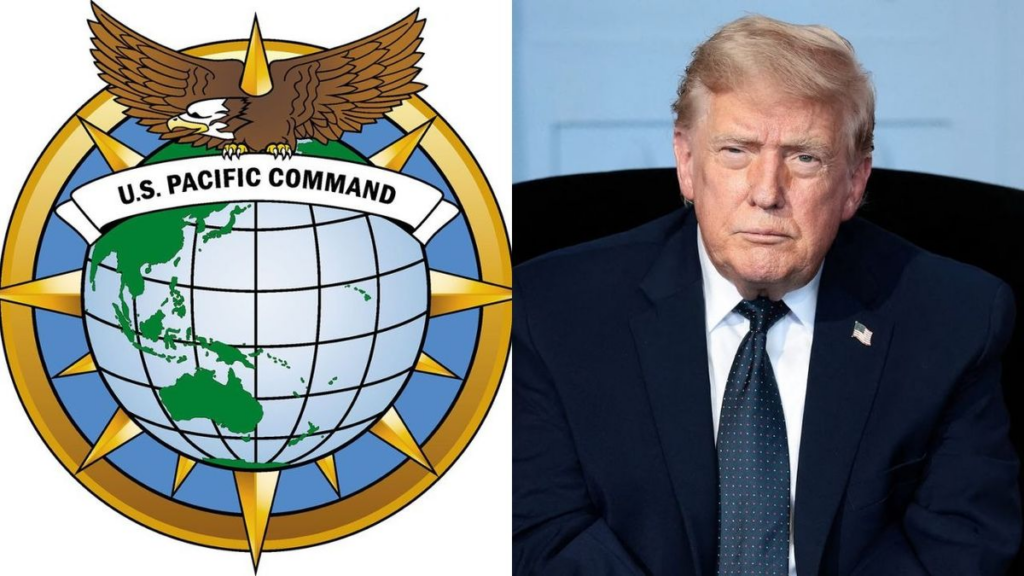
The U.S. military’s reported decision to restore the name U.S. Pacific Command (USPACOM), replacing U.S. Indo-Pacific Command (USINDOPACOM), has sparked debate among diplomats and security analysts about Washington’s strategic priorities in Asia.
Although Pentagon officials have reportedly described the move as a return to the command’s historic identity rather than a policy shift, the timing has attracted attention. The reported change came as G7 leaders reiterated support for a “free and open Indo-Pacific” and peace across the Taiwan Strait, raising questions about whether the symbolism reflects a broader recalibration of U.S. strategy.
While a name alone does not change military operations, strategic language often signals diplomatic priorities. Here’s what the reported renaming could mean and why experts are watching closely.
TL;DR
- The U.S. military has reportedly restored the name Pacific Command, replacing Indo-Pacific Command.
- The Pentagon has characterized the move as a restoration of the command’s historic identity rather than a change in mission.
- The command’s area of responsibility reportedly remains unchanged.
- Analysts are debating whether the move signals a shift in emphasis toward East Asia or is largely symbolic.
- The development has implications for perceptions surrounding India, the Quad, and U.S. competition with China.
What is the Pacific Command?
The command oversees U.S. military operations across one of the world’s largest strategic regions.
Its responsibilities include:
- East Asia.
- Southeast Asia.
- The Pacific Ocean.
- Australia.
- Much of the Indian Ocean.
- Security coordination with allies and partners.
The command works with treaty allies including:
- Japan.
- South Korea.
- Australia.
- The Philippines.
- Thailand.
It also coordinates closely with partners such as India through military exercises, maritime cooperation, and regional security initiatives.
Despite the reported name change, officials have indicated that the geographic area of responsibility and operational mission remain the same.
Why was it renamed Indo-Pacific in 2018?
The command adopted the name Indo-Pacific Command during President Donald Trump’s first administration.
The change reflected a broader strategic concept recognizing that the Indian and Pacific Oceans had become increasingly interconnected economically, militarily, and geopolitically.
Several factors drove the shift:
- China’s expanding naval presence.
- Growing strategic importance of the Indian Ocean.
- India’s emergence as a major security partner.
- Increasing focus on maritime trade routes.
- The revival of the Quad partnership.
The new terminology also aligned U.S. strategy with that of allies including Japan, Australia, and India, all of which increasingly embraced the “Indo-Pacific” framework.
Does dropping “Indo” signal a policy shift?
Not necessarily.
Military commands occasionally restore historic names without altering their responsibilities.
According to Pentagon officials, the reported decision honors the command’s origins dating back to 1947.
However, names carry diplomatic weight.
The adoption of “Indo-Pacific” in 2018 was widely viewed as a strategic message emphasizing India’s growing role alongside America’s Pacific allies.
Removing that terminology, even symbolically, is therefore likely to invite questions about whether Washington is subtly adjusting its regional narrative.
At present, there is no indication that U.S. defense commitments, force posture, or alliance obligations have changed.
What could it mean for India?
India has become an increasingly important U.S. security partner over the past decade.
The Indo-Pacific concept elevated India’s strategic importance by explicitly linking the Indian Ocean with East Asian security.
If the terminology shifts back toward “Pacific,” some analysts believe New Delhi could interpret it as reducing the symbolic prominence of India’s role.
That said, symbolism should not be confused with policy.
Defense cooperation between the United States and India continues through initiatives including:
- The Quad.
- Joint military exercises.
- Defense technology partnerships.
- Maritime security cooperation.
- Intelligence sharing.
Unless those policies change, the practical relationship remains intact.
What about the Quad?
The Quadrilateral Security Dialogue, or Quad, brings together:
- The United States.
- India.
- Japan.
- Australia.
The grouping has consistently framed its objectives around maintaining a “free and open Indo-Pacific.”
Because the Quad’s identity is closely tied to that concept, any shift in U.S. terminology naturally prompts questions about future messaging.
However, there is currently no evidence that the reported renaming alters Washington’s commitment to the Quad or its objectives.
Does this affect U.S. policy toward China?
The reported name change comes amid continued strategic competition between Washington and Beijing.
The United States continues to:
- Support freedom of navigation.
- Strengthen alliances in East Asia.
- Deepen defense cooperation with regional partners.
- Express concern over stability in the Taiwan Strait.
- Expand military coordination with allies.
These policies have remained consistent regardless of the command’s name.
If anything, analysts suggest the renaming may reflect an emphasis on institutional history rather than a shift in military priorities.
Still, Beijing and regional observers are likely to examine such symbolic decisions for clues about future U.S. strategy.
Why does the timing matter?
The reported change coincided with the G7 summit, where leaders again reaffirmed support for:
- Peace and stability across the Taiwan Strait.
- Freedom of navigation.
- International law.
- A free and open Indo-Pacific.
Because diplomatic messaging often relies on symbolism, the timing has fueled speculation that exceeds the practical impact of the renaming itself.
Whether intentional or coincidental, the overlap has made the announcement a subject of debate among strategic analysts.
The bigger picture
Military names do more than identify organizations. They communicate priorities, partnerships, and strategic narratives.
The 2018 adoption of “Indo-Pacific” reflected a recognition that the Indian and Pacific Oceans had become part of a single geopolitical theater shaped by China’s rise and India’s growing influence.
If the reported restoration of “Pacific Command” proves to be primarily symbolic, the practical effects on U.S. strategy may be limited. But symbols matter in international relations, particularly when allies and competitors are looking for subtle signals about future priorities.
Ultimately, analysts will judge the significance of the name change not by the wording itself but by whether it is followed by shifts in U.S. military deployments, diplomatic engagement, alliance commitments, or defense policy across the Indo-Pacific region.