
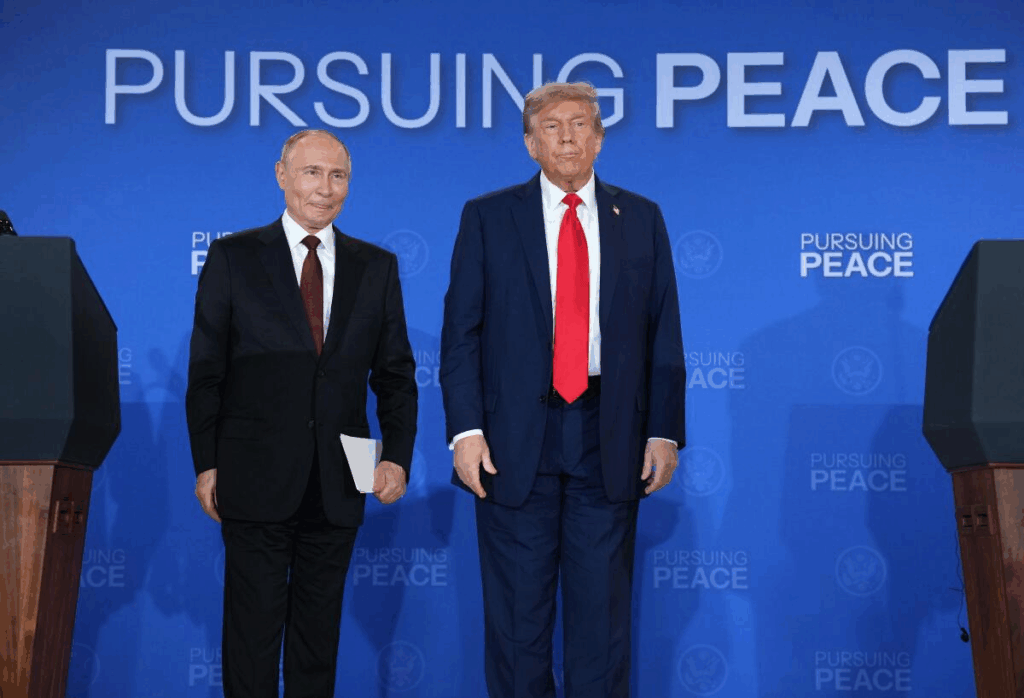
Despite high expectations from their August 15, 2025, meeting in Anchorage, Alaska, Presidents Trump and Putin concluded the Alaska Summit without a ceasefire or a formal peace agreement. Instead, they offered vague optimism around a possible “understanding” and hinted at future dialogue, but left Ukraine and NATO allies waiting for concrete answers.
Quick Summary
- The August 15 summit lasted nearly three hours, with heavy symbolism but no concrete outcomes.
- Both leaders gave short remarks at a no-questions press conference.
- Trump admitted “no deal,” while Putin spoke of an ambiguous “understanding.”
- A possible follow-up summit in Moscow was floated.
- Ukraine was excluded from talks, fueling criticism from allies.
What Happened at the Alaska Summit?
Symbolism and Setting
The summit took place at Joint Base Elmendorf‑Richardson in Alaska—the first Russian presidential visit to U.S. soil in a decade. The setting was carefully staged: red carpet, military flyovers featuring B‑2 bombers and F‑35s, and even a ride together in the U.S. presidential limousine known as “The Beast.” The optics were designed to project strength and cooperation, even as the substance lagged.
The Talks
Trump, joined by Secretary of State Marco Rubio and envoy Steve Witkoff, met with Putin and his delegation for nearly three hours. Despite the length, the talks did not produce a ceasefire deal for Ukraine. Instead, both sides framed the meeting as a “productive discussion” without tangible breakthroughs.
Why the Outcome Matters
The Alaska summit represented a rare chance to reset U.S.–Russia dialogue. Yet Trump’s blunt admission of “no deal” revealed the gap between optics and outcomes.
- Putin’s narrative: He emphasized that peace requires addressing “all of Russia’s legitimate concerns,” particularly regarding security guarantees and disarmament in Ukraine.
- Trump’s stance: He highlighted “great progress” but declined specifics, adding, “There’s no deal until there’s a deal.”
The absence of Ukrainian President Volodymyr Zelenskyy at the table underscores the diplomatic imbalance. Without Kyiv’s participation, the meeting risks being perceived as optics-driven rather than peace-focused.
What Trump and Putin Actually Said
Putin’s Highlights
- Described the talks as “constructive” and rooted in mutual respect.
- Referenced shared U.S.–Russia history, including Alaska’s Russian past, as symbolic of cooperation.
- Stressed that resolving the Ukraine war means addressing its “primary causes,” namely, Russia’s security demands.
Trump’s Highlights
- Stated plainly: “There’s no deal until there’s a deal,” signaling the lack of an agreement.
- Claimed there was a “very good chance” of reaching peace eventually.
- Promised to brief NATO allies and Zelenskyy in upcoming calls.
- Floated the possibility of a second summit in Moscow, responding to Putin’s “Next time in Moscow” with, “I could see it possibly happening.”
- Urged Zelenskyy to “make a deal,” raising concerns about U.S. pressure on Ukraine.
Global Reactions to the Alaska Summit
Ukraine’s Position
Kyiv reacted cautiously, with officials noting that no deal affecting Ukraine should be made without Ukraine’s direct participation. Zelenskyy reiterated that his country will not accept concessions undermining its sovereignty.
NATO and Europe
NATO allies expressed unease at being sidelined. European diplomats stressed the importance of maintaining a united front against Russia, warning that bilateral U.S.–Russia summits should not replace collective decision-making.
Russia’s Spin
Russian state media portrayed the summit as a symbolic victory for Putin, highlighting the ceremonial pomp and Trump’s openness to a Moscow follow-up. The lack of a deal was downplayed in favor of framing the meeting as progress.
U.S. Political Reaction
In Washington, reactions split along partisan lines. Supporters praised Trump for reopening dialogue, while critics argued he gave Putin global legitimacy without securing concessions. The “no questions” press format drew sharp criticism for lacking transparency.
Historical Context: How This Compares
This summit echoes past high-profile U.S.–Russia meetings that emphasized theater over substance:
- Helsinki 2018 (Trump–Putin): Widely criticized for Trump’s conciliatory tone and lack of clear outcomes.
- Reykjavík 1986 (Reagan–Gorbachev): Initially ended without agreement, but later paved the way for nuclear arms treaties.
- Geneva 2021 (Biden–Putin): Focused on cybersecurity and strategic stability, producing limited but concrete steps.
In comparison, Alaska 2025 leaned heavily on optics, jets, ceremonies, and symbolic gestures, without the structural groundwork that past summits sometimes provided.
Key Components of the Summit
Here’s a breakdown:
| Element | Description |
|---|---|
| Symbolism & Optics | Red carpet, military jets, limo ride—heavy on theatrics |
| Meeting Dynamics | Nearly 3-hour closed-door talks |
| Public Messaging | Putin: “understanding,” Trump: “no deal yet” |
| Media Strategy | No questions taken post-conference |
| Follow-up Hint | Possible second summit, potentially in Moscow |
| Exclusion of Ukraine | Zelenskyy not invited; future hinges on Ukraine’s stance |
How This Shapes What Comes Next
Action-Oriented Keys: What to Watch
- Follow-up diplomacy: Will Trump make good on calls to NATO leaders and Zelenskyy, and will allies accept the framing of the summit?
- Russia’s intent: Is Putin genuinely open to a peace process, or leveraging optics to buy time?
- Ukraine’s leverage: Kyiv’s role remains pivotal. Without Ukrainian consent, any “understanding” risks collapse.
- Second summit risk: A Moscow follow-up could hand Putin symbolic legitimacy without securing progress on peace.
Final Thoughts
The Alaska summit was dramatic but inconclusive. Trump and Putin delivered spectacle, not substance, leaving Ukraine’s war and global stability unresolved. With allies skeptical and Kyiv determined to protect its sovereignty, the path from “understanding” to actual peace remains uncertain.
Whether future talks, in Moscow or elsewhere, yield real progress will depend on whether Ukraine is finally given a seat at the table and whether both leaders are willing to move beyond optics toward enforceable commitments.