Reports that President Donald Trump secretly departed Turkey aboard a smaller military aircraft while an Air Force One carrying journalists and White House staff continued on as a decoy captured global attention. The operation sounded like a Hollywood spy thriller—but the strategy behind it is far from unprecedented.
For decades, U.S. presidents have relied on secret flights, misleading schedules, alternate aircraft, decoy motorcades, and surprise visits when travelling through regions deemed high-risk. While each operation has reflected the security concerns of its time, they all share a common goal: making it difficult for potential attackers to determine the president’s exact location.
Trump’s reported aircraft switch may be one of the most elaborate examples in recent years, but it follows a long tradition of presidential deception designed to protect the commander in chief.
Why do U.S. presidents use decoys and secret travel?
Presidential travel is among the most complex security operations in the world. Every public appearance, airport arrival, or motorcade route presents potential vulnerabilities.
Security planners aim to eliminate predictability by employing tactics such as:
- Keeping travel plans secret until after arrival.
- Using alternate aircraft or vehicles.
- Changing routes at the last minute.
- Limiting the number of people aware of the president’s movements.
- Employing decoys to confuse observers and potential attackers.
The objective isn’t secrecy for its own sake. Rather, it’s to reduce the risk that hostile actors can identify where and when the president is most vulnerable.
Bill Clinton’s Pakistan visit remains one of the clearest examples
One of the closest historical parallels to Trump’s reported Turkey operation occurred during President Bill Clinton’s visit to Pakistan in March 2000.
A decoy aircraft fooled observers
Clinton arrived in Islamabad amid heightened security concerns following a military coup led by General Pervez Musharraf and ongoing threats from extremist groups.
According to accounts of the operation:
- A Gulfstream C-20 bearing presidential markings landed first.
- A Secret Service agent resembling Clinton reportedly exited the aircraft.
- The plane then departed, creating the impression the president had already arrived.
Meanwhile, the real Clinton landed shortly afterwards aboard an unmarked C-20 painted in neutral colours. He exited behind a limousine before being transferred through another layer of deception involving multiple identical vehicles.
The elaborate plan was intended to obscure the president’s true movements during his brief visit to Islamabad.
Why security was so tight
Although officials did not publicly identify a specific assassination plot, Pakistan was considered an exceptionally dangerous security environment.
During his six-hour visit, Clinton met General Musharraf and then-President Muhammad Rafiq Tarar before delivering a televised address urging Pakistan to restore civilian democracy, curb terrorism, and exercise restraint in its nuclear rivalry with India.
Clinton also survived another major security scare
The Pakistan mission wasn’t the only time Clinton’s itinerary changed because of security concerns.
The Manila bomb threat
During the 1996 Asia-Pacific Economic Cooperation (APEC) summit in Manila, U.S. intelligence reportedly warned the Secret Service about a possible bomb targeting Clinton’s motorcade.
His security team immediately altered the planned route.
Filipino authorities later discovered:
- An explosive device positioned near the original route.
- An SUV containing AK-47 rifles.
The incident underscored one of the biggest challenges in presidential protection: even if the aircraft is secure, airports, roads, bridges, and public venues remain potential targets.
George W. Bush secretly flew into Iraq during wartime
President George W. Bush adopted a different strategy in November 2003 when he made a surprise Thanksgiving visit to U.S. troops stationed in Iraq.
A mission hidden from almost everyone
Bush publicly appeared to be spending Thanksgiving at his ranch in Crawford, Texas.
Instead, he quietly departed for Andrews Air Force Base before boarding Air Force One for Baghdad.
The operation remained so secret that reports at the time indicated even some members of Bush’s family were unaware of the trip.
Extra precautions during the flight
Because Iraq remained an active war zone, additional safety measures were taken.
As Air Force One approached Baghdad International Airport:
- Cabin lights were switched off.
- Window shades remained closed.
- The aircraft performed a steep corkscrew landing to reduce exposure to possible missile attacks.
Only after Bush had safely departed Iraq did the White House publicly reveal the visit.
Unlike Clinton’s Pakistan operation, Bush did not rely on a visible decoy aircraft. Instead, secrecy centered on concealing the destination and timing.
Barack Obama also relied on surprise visits
President Barack Obama repeatedly traveled to Afghanistan under strict secrecy.
Secret overnight flights
In March 2010, Obama flew overnight to Bagram Airfield without publicly announcing the trip.
The White House deliberately withheld information until the president had safely arrived.
Obama met Afghan leaders and U.S. service members before returning to Washington.
He later made another similarly unannounced visit using many of the same security principles.
Rather than employing elaborate decoys, Obama’s trips focused on preventing advance knowledge of his movements.
How Trump’s reported Turkey operation differed
Trump’s reported departure from Turkey appears to combine several long-established presidential security tactics into one operation.
According to U.S. officials:
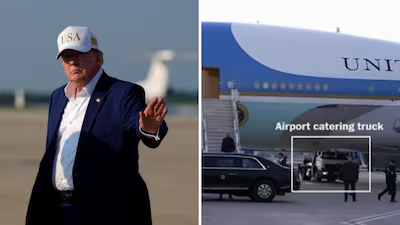
- Trump initially boarded Air Force One in full public view.
- Observers believed he would depart aboard the presidential aircraft.
- He was then reportedly transferred using an airport catering truck.
- He boarded a smaller C-32A military aircraft.
- The original Air Force One continued flying as a decoy carrying journalists and some White House staff.
Trump later confirmed that the aircraft switch was carried out at the direction of the Secret Service because of what officials described as a credible security threat linked to Iran.
If accurate, the operation represents a hybrid approach—using both physical deception and secrecy simultaneously.
How presidential security has evolved
While technology has transformed presidential travel, the underlying security challenges remain remarkably consistent.
Modern threats include:
- Terrorist organizations
- State-sponsored intelligence services
- Shoulder-fired missiles
- Drone surveillance
- Cyber-enabled tracking
- Social media monitoring
- Satellite imagery
As surveillance technology becomes more sophisticated, presidential security teams have had to become increasingly creative in concealing movements.
What once involved changing motorcade routes can now require complex operations involving multiple aircraft, restricted communications, and tightly controlled information sharing.
Why these operations matter
Presidential protection is designed around a simple principle: unpredictability saves lives.
Whether through:
- Decoy aircraft,
- Secret overnight flights,
- Alternate motorcade routes,
- Concealed schedules, or
- Surprise arrivals,
each tactic seeks to deny adversaries the information needed to plan an attack.
The public often sees only the official itinerary. Behind the scenes, however, presidential travel typically involves layers of contingency planning that remain classified long after the trip concludes.
The bottom line
Trump’s reported aircraft switch in Turkey may appear unprecedented, but history suggests otherwise. From Bill Clinton’s decoy landing in Pakistan to George W. Bush’s covert wartime visit to Iraq and Barack Obama’s surprise flights into Afghanistan, U.S. presidents have long relied on secrecy and deception to reduce security risks.
What makes the reported Turkey operation stand out is the apparent combination of multiple protective measures—publicly boarding one aircraft while secretly departing on another. Although the methods continue to evolve alongside modern threats, the mission remains unchanged: ensuring that no potential attacker can confidently predict where the president will be at the moment he is most vulnerable.