
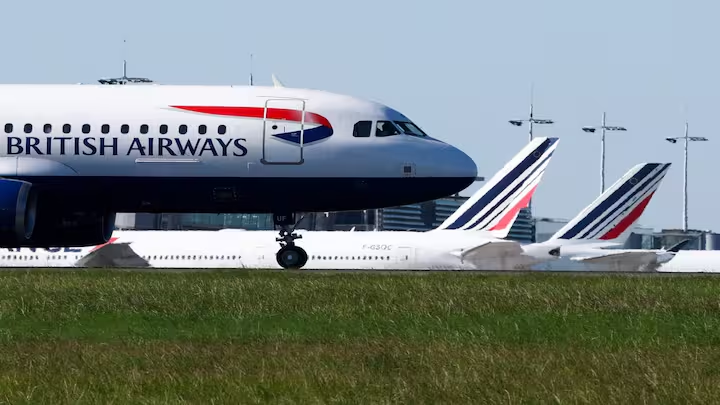
A British Airways flight from London to Chicago declared a mid-air emergency on October 5 after rapidly descending nearly 28,000 feet while flying over Ireland.
Flight BA295, operating a Boeing 777-200ER, had climbed to about 37,000 feet after departing London Heathrow. Flight-tracking data later showed the aircraft descending to approximately 9,000 feet, a drop of around 28,000 feet.
The crew transmitted the internationally recognised 7700 emergency transponder code during the incident, signalling a general emergency to air traffic controllers.
The reason for the sudden descent has not yet been publicly confirmed by British Airways. Flight-tracking data indicated that the aircraft abandoned its planned transatlantic journey and turned back toward London.
There were no immediate reports of deaths or serious injuries linked to the incident.
What happened to British Airways Flight BA295?
BA295 was operating a scheduled service from London Heathrow to Chicago O’Hare International Airport.
The Boeing 777-200ER, reportedly registered G-VIIA, departed Heathrow’s Terminal 5 at around 11:50 a.m. local time. The scheduled journey was expected to take roughly eight hours and 40 minutes.
About an hour into the flight, the aircraft had reached a cruising altitude of approximately 37,000 feet when its flight path changed dramatically.
Tracking data showed the aircraft descended to around 9,000 feet over Ireland. That represents a loss of approximately 28,000 feet.
The aircraft later turned back toward the United Kingdom instead of continuing across the Atlantic.
What does the 7700 emergency code mean?
The number 7700 is one of the standard emergency transponder codes used in commercial aviation.
When an aircraft squawks 7700, it tells air traffic controllers that it is experiencing a general emergency and may require priority handling or assistance.
It is important to understand what the code does not mean.
7700 does not identify the specific problem. It can be used for a wide range of emergencies, including serious technical failures, medical situations, smoke or fire concerns and other incidents requiring immediate attention.
That means the transmission alone does not establish that BA295 suffered a mechanical failure or cabin depressurisation.
Why would a plane descend 28,000 feet?
A rapid descent from cruising altitude is often associated with an emergency requiring the aircraft to operate at a much lower altitude.
One well-known reason is a loss of cabin pressurisation. Passenger aircraft normally cruise at altitudes where the outside air is far too thin for people to breathe normally without supplemental oxygen.
If pressurisation is lost, pilots may descend rapidly to an altitude where the surrounding air is safer to breathe.
But that is only one possible explanation.
A sudden descent could also be associated with another technical problem, an onboard medical emergency, an operational issue, or a precautionary decision made by the flight crew.
As of October 5, there was no confirmed public statement identifying the cause of the BA295 descent.
Was the aircraft in danger of crashing?
A dramatic altitude change does not automatically mean that an aircraft was close to crashing.
Commercial airliners are designed to conduct emergency descents when necessary, and pilots are trained to manage situations requiring a rapid change in altitude.
The key issue is whether the aircraft remains controllable and whether the crew can reach a suitable airport.
In the case of BA295, the aircraft continued flying after the descent and then headed back toward the United Kingdom.
That suggests the crew retained control of the aircraft, although the reason for the emergency and the precise severity of the underlying problem remained unclear.
Why did BA295 turn back to London?
Once the aircraft had descended and the emergency was declared, continuing westward across the Atlantic would have meant moving farther away from major diversion airports.
Turning back toward Heathrow provided the crew with a familiar airport and extensive emergency support infrastructure.
Flight-tracking data showed the aircraft heading back toward London after abandoning its scheduled trip to Chicago.
At the time of the latest reports, the aircraft was also observed making movements over and around the English Channel before its eventual landing arrangements were determined.
That pattern is consistent with an aircraft preparing for a return to its departure region, although only the airline or investigators can confirm the operational decisions behind the flight path.
Was this a pressurization emergency?
There is no confirmed answer yet.
Some aviation observers noted that a controlled descent to around 9,000 feet can be consistent with a pressurization-related emergency.
However, flight-tracking data cannot determine what happened inside the aircraft.
Only the crew, airline maintenance records, aircraft systems data and investigators can establish whether there was a cabin-pressure problem or another cause.
Until British Airways provides an explanation, claims about depressurization should therefore be described as a possibility rather than a fact.
What type of aircraft was involved?
BA295 was operated by a Boeing 777-200ER.
The aircraft involved was identified in flight-tracking data as G-VIIA, a British Airways Boeing 777-236ER.
The 777 is a long-haul twin-engine wide-body aircraft widely used for intercontinental services.
The aircraft type itself does not indicate that the emergency was related to a design problem. There is currently no evidence linking the BA295 incident to a broader Boeing 777 safety issue.
How unusual is a 28,000-foot descent?
A 28,000-foot altitude change sounds enormous because it is.
Commercial aircraft normally cruise at high altitudes to improve efficiency and avoid much of the weather and traffic found closer to the ground.
An emergency descent from the upper 30,000-foot range to around 10,000 feet is nevertheless an established aviation procedure when circumstances require it.
The important detail is the speed and reason for the descent, rather than the size of the number alone.
In an emergency, pilots can descend thousands of feet in a short period while following established procedures and coordinating with air traffic control.
Why would pilots choose 9,000 feet?
The precise altitude chosen during an emergency depends on several factors, including the nature of the problem, terrain, weather, air traffic and aircraft performance.
For a pressurization emergency, descending to a lower altitude can reduce the need for supplemental oxygen because the outside atmosphere contains more usable oxygen.
A descent also allows pilots to operate the aircraft under different emergency conditions while giving them additional options for diversion.
The fact that BA295 reached about 9,000 feet therefore does not by itself reveal why the pilots chose that altitude.
Did passengers report anything unusual?
As of the latest reports available on October 5, detailed passenger accounts were limited.
The most reliable information initially came from flight-tracking data showing the emergency code and sudden descent.
There were no immediate reports of a cockpit intrusion, security incident or attack comparable to the recent Flydubai FZ1073 emergency.
That distinction is particularly important because the BA295 incident occurred only days after the dramatic Flydubai cockpit attack involving an Omani co-pilot and Indian captain Smit Machchhar.
The two events are separate, and there is currently no evidence connecting them.
Is the BA295 incident linked to the recent Flydubai scare?
No evidence currently suggests a connection.
Flydubai Flight FZ1073 involved an alleged attack inside the cockpit while traveling from Dubai to Tel Aviv. That aircraft diverted to Saudi Arabia after a violent confrontation between the pilots.
BA295, by contrast, involved a British Airways Boeing 777 flying from London to Chicago. The aircraft declared a general emergency and descended while over Ireland, but the cause had not been publicly established.
The similarity lies mainly in the timing and the dramatic altitude changes, not in any known common cause.
Treating the two incidents as connected without evidence would be misleading.
What happens when an aircraft declares an emergency?
Once an aircraft transmits 7700, air traffic controllers can give it priority over other traffic.
Controllers may clear other aircraft out of the way, coordinate a suitable route and prepare emergency services at the aircraft’s destination or diversion airport.
The airline’s operations team may also begin coordinating with the crew and airport authorities.
What happens next depends entirely on the nature of the emergency.
If the aircraft is stable and the problem is manageable, pilots may continue to a nearby airport. In other cases, they may return to their departure airport or divert to the closest suitable runway.
What will investigators examine?
If an investigation is opened or expanded, investigators will have several sources of evidence available.
They can examine the aircraft’s flight-data recorder, cockpit voice recorder, maintenance records, and technical warnings generated during the flight.
They will also examine air traffic control communications, weather information and the aircraft’s trajectory.
Those records can establish whether the rapid descent followed a system warning, a crew decision, an external event or another problem.
The aircraft’s pressurization systems and other relevant equipment would also be inspected if technical failure is suspected.
Could the aircraft have continued to Chicago?
Technically, an aircraft can sometimes continue a flight after resolving an in-flight problem.
But commercial pilots generally have to consider more than whether the aircraft is physically capable of continuing.
Once a serious emergency has occurred, factors such as available diversion airports, fuel, passenger condition, weather and the possibility of the problem recurring all influence the decision.
Returning to London would therefore be a reasonable precaution if the crew believed the aircraft or passengers would be better served by landing closer to maintenance and emergency facilities.
What do we know about injuries?
There were no immediate reports of fatalities or serious injuries among passengers or crew in the initial coverage of the incident.
That information could change as British Airways and authorities release more details, but there was no confirmed report of a major casualty event at the time of publication.
The most important confirmed details were the emergency declaration, the rapid descent, the aircraft’s subsequent return toward the United Kingdom and the fact that the cause remained unknown.
Why is this incident attracting so much attention?
The timing is a major reason.
BA295’s emergency occurred just days after the Flydubai FZ1073 cockpit attack, another aviation incident involving a dramatic loss of altitude and an emergency diversion.
That recent event has made passengers and the public particularly sensitive to reports of aircraft suddenly descending or transmitting emergency signals.
But aviation emergencies are not all alike.
A 7700 code means “general emergency,” not “hijacking.” Similarly, a rapid descent can have many causes, and there is currently no evidence that BA295 experienced a security incident.
The available evidence points to an emergency that required the crew to change course and return toward the United Kingdom, while the specific cause remains under investigation.
What happens next for Flight BA295?
The next significant development will be an explanation from British Airways or the relevant aviation authorities.
Investigators will need to establish why the aircraft made such a rapid descent and whether any technical or operational fault triggered the emergency.
The aircraft will also likely undergo inspection before being returned to regular service, depending on the findings of the airline’s engineering and safety teams.
For passengers booked on the service, the disruption could also mean rebooking and delays as the airline arranges alternative travel to Chicago.
For the aviation industry, however, the focus will be on something much more technical: reconstructing the sequence of events that led a Boeing 777 to descend from 37,000 feet to around 9,000 feet and then turn back toward London.
Bottom line
British Airways Flight BA295 declared a general emergency over Ireland on October 5 after descending approximately 28,000 feet from around 37,000 feet to 9,000 feet.
The aircraft was operating from London Heathrow to Chicago O’Hare and later turned back toward London.
The 7700 transponder code confirmed that the crew was dealing with a general emergency, but it did not reveal the cause.
There is currently no confirmed evidence of a security attack, hijacking or connection to the recent Flydubai incident.
The most important unanswered question is what triggered the rapid descent. Until British Airways or investigators provide that information, reports about a possible pressurization failure or other technical problem should remain clearly identified as possibilities rather than established facts.