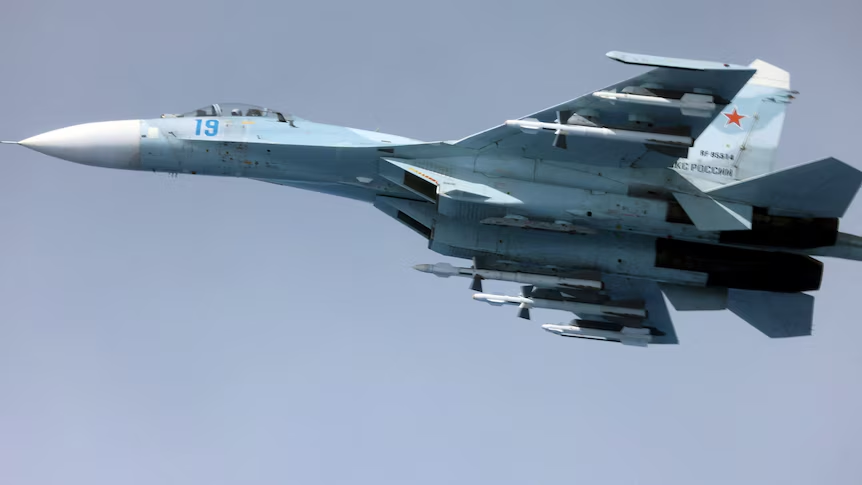
The United Kingdom says Russian fighter jets carried out a “dangerous” interception of a British surveillance aircraft over the Black Sea, with one aircraft reportedly flying within just six meters of the RAF plane during a NATO-linked mission.
The encounter, described by British officials as reckless and unsafe, is the latest in a long series of tense aerial confrontations between Russian forces and NATO aircraft operating near Eastern Europe and the Black Sea region.
According to the UK Ministry of Defence, the incident triggered onboard emergency warning systems aboard the British aircraft but did not prevent the mission from being completed safely.
The episode underscores how the skies around the Black Sea have increasingly become a geopolitical pressure cooker, where surveillance missions, military signaling, and razor-thin flybys are now routine features of the post-Ukraine-war security landscape.
What happened over the Black Sea?
RAF says Russian jets flew within six meters
The incident involved a Boeing RC-135 Rivet Joint operated by the Royal Air Force during what Britain described as a routine intelligence-gathering mission in international airspace.
According to the UK Ministry of Defence, Russian military jets intercepted the aircraft while it was supporting NATO operations over the Black Sea.
British officials said the Russian aircraft approached so closely that emergency systems aboard the Rivet Joint were activated.
The UK described the maneuver as:
- Dangerous
- Reckless
- Unprofessional
- Unsafe for international air operations
Despite the close encounter, the RAF said the crew completed the mission and returned safely.
What is the RAF Rivet Joint aircraft?
The aircraft is essentially a flying intelligence hub
The RC-135 Rivet Joint is one of NATO’s most sophisticated airborne surveillance platforms.
Its primary role is electronic intelligence gathering, often referred to as SIGINT, or signals intelligence.
The aircraft can monitor:
- Radar emissions
- Military communications
- Air defense systems
- Electronic warfare signals
- Battlefield activity
These aircraft do not typically carry offensive weapons. Their value lies in collecting enormous amounts of military intelligence in real time.
Britain says missions like this help NATO maintain “situational awareness” along its eastern flank.
Why Russia closely watches these flights
From Moscow’s perspective, NATO surveillance aircraft operating near Russian territory are highly sensitive.
While the flights occur in international airspace and are legal under international aviation rules, Russia often views them as intelligence probes monitoring military activity near its borders.
That is why Russian intercepts have become increasingly common around:
- The Black Sea
- The Baltic region
- The Arctic
- Eastern Europe
These encounters are part deterrence, part signaling exercise, and part aerial chess match.
Why the Black Sea has become a military flashpoint
The region sits at the center of NATO-Russia tensions
The Black Sea has become one of the most militarized regions in Europe since Russia’s invasion of Ukraine.
Countries bordering or connected to the region include:
- Ukraine
- Russia
- Turkey
- Romania
- Bulgaria
NATO aircraft frequently patrol the area to:
- Monitor Russian military movements
- Support alliance operations
- Gather intelligence
- Reassure Eastern European allies
Russia, meanwhile, has dramatically expanded military operations in and around the region since the Ukraine war escalated.
The result is an increasingly crowded and tense airspace where military aircraft from rival powers operate in close proximity almost daily.
Why six meters matters
Modern military aircraft move at enormous speeds
To civilians, six meters may not sound impossibly close.
For fast-moving military jets, it is extraordinarily tight.
Aircraft traveling hundreds of kilometers per hour leave very little room for error. Turbulence, sudden maneuvers, or pilot miscalculations can quickly create catastrophic risks.
That is why NATO countries frequently protest close Russian intercepts as unsafe.
Russia, however, often argues its pilots are responding appropriately to foreign military aircraft operating near sensitive areas.
Are these interceptions becoming more common?
NATO and Russia regularly accuse each other of dangerous maneuvers
Close aerial encounters have become a recurring feature of modern NATO-Russia relations.
Recent years have seen:
- Russian fighters shadowing NATO aircraft
- NATO jets scrambling to intercept Russian bombers
- Drone incidents over the Black Sea
- Near-collision accusations
- Electronic warfare activity
These operations serve both military and political purposes.
They allow countries to:
- Demonstrate readiness
- Signal territorial awareness
- Test reactions
- Gather intelligence
- Project strength without direct conflict
The danger is that repeated close encounters increase the possibility of accidents or escalation.
How Russia’s military strategy has evolved
Surveillance and drone warfare have intensified
The incident comes amid broader concerns over Russia’s increasingly aggressive aerial strategy linked to the war in Ukraine.
British officials recently highlighted:
- Expanded drone attacks
- Larger coordinated aerial assaults
- Increased military activity near NATO borders
- More assertive Russian patrol patterns
Moscow has relied heavily on drones, missiles, and electronic warfare during the conflict, while NATO has expanded intelligence-sharing and reconnaissance operations supporting Ukraine indirectly.
That environment has made surveillance flights like the RAF mission strategically important and politically sensitive.
Why NATO surveillance missions continue despite risks
Intelligence gathering is considered essential
Despite the dangers, NATO countries are unlikely to reduce reconnaissance flights near the Black Sea.
These missions provide critical information on:
- Troop movements
- Missile systems
- Naval deployments
- Air defense activity
- Drone operations
In modern warfare, intelligence often matters as much as firepower.
Aircraft like the Rivet Joint function as flying sensor networks, quietly absorbing electronic data across enormous distances.
The irony is that these missions are designed partly to prevent surprise escalation, yet their presence can also create moments of tension that raise escalation risks themselves.
The larger geopolitical message behind the interception
Both sides are signaling resolve
Britain’s public release of the incident and accompanying video footage was likely intentional.
By publicizing the interception, the UK sends several messages:
- NATO will continue operating in international airspace
- Russian actions are being monitored
- Britain remains committed to alliance operations
- Moscow’s behavior will be publicly challenged
Russia, meanwhile, often uses aggressive intercepts to demonstrate that it can contest NATO activity near areas it considers strategically vital.
These aerial confrontations are not random encounters. They are geopolitical theater performed at high altitude and high speed.
TL;DR
- The UK says Russian fighter jets dangerously intercepted an RAF Rivet Joint aircraft over the Black Sea.
- One Russian jet reportedly came within six meters of the British surveillance plane.
- The RAF aircraft was conducting a NATO-linked intelligence mission in international airspace.
- Britain called the maneuver reckless and unsafe.
- The incident reflects rising military tensions between NATO and Russia around the Black Sea region.