
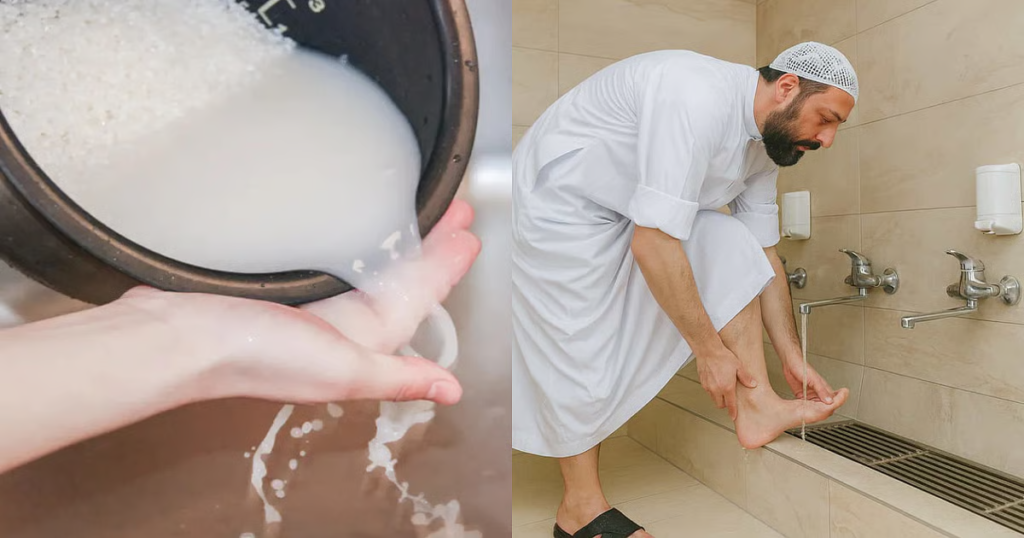
England’s worsening water crisis has prompted an unusual conservation campaign: households are being encouraged to rethink everyday cultural and religious practices, from washing rice to performing wudu before prayer.
The £270,000 project, funded through Ofwat’s Innovation Fund, includes campaigns developed with faith and culturally diverse communities. One encourages Southeast Asian households to wash rice fewer times, while another encourages Muslims to perform wudu using roughly one liter of water rather than leaving a tap running.
The campaign comes as 71.3% of England was officially classified as being in drought as of August 10, with the government describing the situation as a rapidly developing “flash drought” caused by very low rainfall and high temperatures.
The unusual focus on specific cultural and religious practices has generated political criticism, but the project predates the current drought. It was developed as part of a longer-term effort to understand how water-saving measures can be made more relevant to different communities.
Why is England asking people to change everyday water habits?
England’s water system is under growing pressure from both demand and climate change.
Ofwat says England alone could need an additional five billion liters of water every day by 2055 if current trends continue. Its national Water Efficiency Campaign, launched in May 2026, is designed to encourage households and businesses to use water more efficiently.
The immediate pressure is more severe.
Government figures published August 10 showed that 71.3% of England was officially in drought. The National Drought Group warned that pressure was being felt across public water supplies, agriculture and the natural environment.
The campaign’s logic is that conservation does not necessarily require major lifestyle changes. Small reductions repeated across thousands of households can add up, particularly when they target activities involving running water.
What is the £270,000 water-efficiency project?
The project is called “Water efficiency in faith and diverse communities.”
Ofwat awarded £270,000 through its Water Breakthrough Challenge to South Staffordshire Water, the lead entrant. The project brought together water companies, researchers, community organizations and faith groups to develop culturally specific approaches to conservation.
It was not created specifically in response to the 2026 drought.
The University of Cambridge’s Interfaith Programme says the wider project ran for 21 months from July 2023, with the aim of developing evidence-based methods for engaging faith and culturally diverse communities in water conservation.
Two campaigns emerged from the project: one centered on wudu in the Muslim community and another on rice-washing practices among Southeast Asian communities.
That distinction is important because some descriptions of the initiative as a brand-new £270,000 “drought campaign” simplify a project that had already been under development for years.
Why is the campaign telling people to wash rice twice?
One part of the campaign addresses the amount of water used to wash rice.
British Malaysian chef Ping Coombes appears in campaign material explaining that some people wash rice five to seven times until the water runs clear. The campaign encourages washing it twice instead.
The message is not that rice must never be washed. Instead, it encourages households to reduce the amount of rinsing and find uses for the water that remains.
Campaign material suggests using leftover rice water for plants. Other promotional content has discussed traditional beauty uses, although those claims should not be confused with scientifically established medical or cosmetic benefits.
The broader idea is behavioral rather than culinary: identify a routine activity involving running water and find a way to perform it with less.
How much water could washing rice differently save?
The campaign says reducing repeated rinsing can save up to five liters per cooking session.
That figure should be understood as an estimate rather than a universal saving. The amount of water used depends on the number of rinses, the size of the container and how much water is used each time.
Even relatively small savings can become significant when multiplied across households and repeated throughout the year.
The project deliberately focuses on these routines because they are predictable. Unlike an emergency drought restriction, a household can continue the same activity while simply changing how much water it uses.
What does the campaign say about wudu?
The second campaign, called “Reviving the Sunnah,” focuses on wudu, the ritual washing Muslims perform before prayer.
The campaign encourages people to use a one-liter jug rather than leaving a tap running.
Its website says a running tap can use about six liters of water each minute, while the project references Islamic traditions describing the Prophet Muhammad’s use of approximately one mudd of water for wudu, generally understood as around one liter.
The campaign was developed in partnership with Cambridge Central Mosque and Cambridge Water.
Imam Sejad Mekic demonstrates the method in campaign material, showing how a measured amount of water can be used for the ritual instead of relying on a continuously running faucet.
How much water does wudu use?
The campaign materials estimate that people using a running tap can consume six to 12 liters of water during a typical wudu session.
The exact figure will vary considerably depending on how long the tap runs, the flow rate and the individual’s practice.
The underlying mathematics is straightforward. A faucet flowing at approximately six liters per minute can use a large amount of water during repeated washing, while a container allows the user to control the total volume.
The project is therefore less about changing the religious ritual than changing the way water is delivered.
Is using less water during wudu consistent with Islamic teaching?
The campaign itself frames the recommendation through the concept of the Sunnah, or practices associated with the Prophet Muhammad.
Its stated objective is to encourage Muslims to “make wudu the Prophetic way” by limiting water use to approximately one mudd, or around one liter.
That approach is significant because the project was designed around trusted community and religious partners rather than simply issuing generic instructions from a regulator.
The Cambridge Interfaith Programme says the wider research project specifically examined how religious values and traditions influence attitudes toward water and how that understanding could improve conservation campaigns.
Why did Ofwat use faith and cultural communities?
The project reflects a broader behavioral-science principle: people are more likely to change habits when conservation messages are delivered through trusted institutions and connected to practices they already understand.
Ofwat’s own evaluation said the project prioritized trusted messengers, culturally sensitive language and collaboration with local organizations. The wudu campaign’s evaluation estimated potential savings of 1,400 to 5,900 liters per day across participating households.
Cambridge Central Mosque was one of the project’s partners.
The University of Cambridge also participated in research examining how different communities understand and use water. The resulting work was intended to give water companies a better framework for engaging communities rather than treating every household as if it had identical habits.
Why has the £270,000 campaign been criticized?
The spending has attracted criticism because the campaign involves public-regulatory funding at a time when households are facing water restrictions and wider cost pressures.
Critics have questioned whether focusing on rice washing and wudu is an appropriate use of £270,000 when England’s water system faces much larger infrastructure problems.
Those criticisms have also been amplified by concerns over leakage.
But there is an important distinction between criticizing the campaign and establishing that the campaign is responsible for a significant share of England’s water shortage.
The project is a behavior-change initiative. It is not a substitute for fixing leaking pipes, improving reservoirs or increasing long-term water supply.
How serious is England’s drought?
The water shortage is substantial.
On August 10, the UK government said 71.3% of England was in drought. The Environment Agency said the combination of exceptionally low rainfall and higher temperatures had rapidly depleted water resources.
Government drought reports have also recorded declining river flows and groundwater levels, while multiple water companies have introduced temporary use bans.
Earlier in July, the government reported that seven water companies had already introduced or announced temporary use bans affecting 23 million customers.
The drought is therefore not simply about asking households to use slightly less water. It reflects a larger imbalance between water availability, weather conditions and demand.
Are household habits the main cause of England’s water shortage?
No.
Household consumption is one part of the overall water-demand picture, but England’s water challenges are also tied to infrastructure, population growth, climate change, leakage, industrial and agricultural demand and long-term supply planning.
Ofwat estimates that England could need five billion additional liters of water per day by 2055.
That scale shows why behavior-change campaigns should be viewed as one tool rather than a complete solution.
Using less water at home can reduce pressure on supplies, but it cannot by itself solve Britain’s long-term water infrastructure problem.
Why does the campaign focus on South Asian and Muslim communities?
The project was designed around the idea that water-use habits differ between communities.
The Cambridge research component examined cultural and religious relationships with water, while the campaign development used community organizations and trusted figures to communicate specific conservation messages.
The intention was therefore not simply to single out a particular ethnic or religious group.
It was to identify practices where targeted advice could produce measurable reductions in water use while making the message culturally relevant.
That strategy is similar to other public campaigns that tailor health, recycling or energy-efficiency messaging to particular audiences.
What does the project say about the future of water conservation?
The £270,000 project has produced something potentially more useful than the two individual campaigns: a model for designing future conservation initiatives.
Ofwat says the project produced a sector-wide toolkit, a behavioral-change framework and reusable campaign materials for engaging diverse communities.
Waterwise, a UK water-efficiency organization involved in the project, says the resulting toolkit is intended to help water practitioners design more inclusive and effective conservation campaigns.
That could matter well beyond the current drought.
As climate change increases pressure on water supplies, regulators and utilities will have to find ways to reduce demand without relying solely on restrictions.
The bigger picture
The debate over the campaign is really a debate about how England should respond to water scarcity.
One approach is to focus almost entirely on large infrastructure projects: reservoirs, pipelines, leakage reduction and new sources of supply.
Another is to also reduce demand by changing millions of small household behaviors.
The Ofwat project belongs to the second category.
Washing rice twice instead of seven times will not solve England’s drought. Neither will performing wudu with a jug instead of a running tap.
But the project is testing whether culturally specific, community-led changes can contribute to a larger conservation effort. Its own evaluation suggests that there were measurable savings among participating households.
The real test is whether those small changes can be adopted widely enough to matter, while policymakers simultaneously address the much bigger structural problems facing England’s water system.
Key takeaways
- Ofwat awarded £270,000 to a project examining water efficiency in faith and culturally diverse communities.
- One campaign encourages Southeast Asian communities to wash rice fewer times and reuse the water where possible.
- Another, developed with Cambridge Central Mosque, encourages Muslims to perform wudu with approximately one liter of water rather than a continuously running tap.
- The project was developed years before the current drought and was not created solely as an emergency response to the 2026 water crisis.
- Ofwat’s evaluation estimated potential wudu-related savings of 1,400 to 5,900 liters per day across participating households.
- As of August 10, 71.3% of England was officially in drought.
- Long-term water demand is expected to rise, with Ofwat projecting an additional five billion liters per day could be needed in England by 2055.