
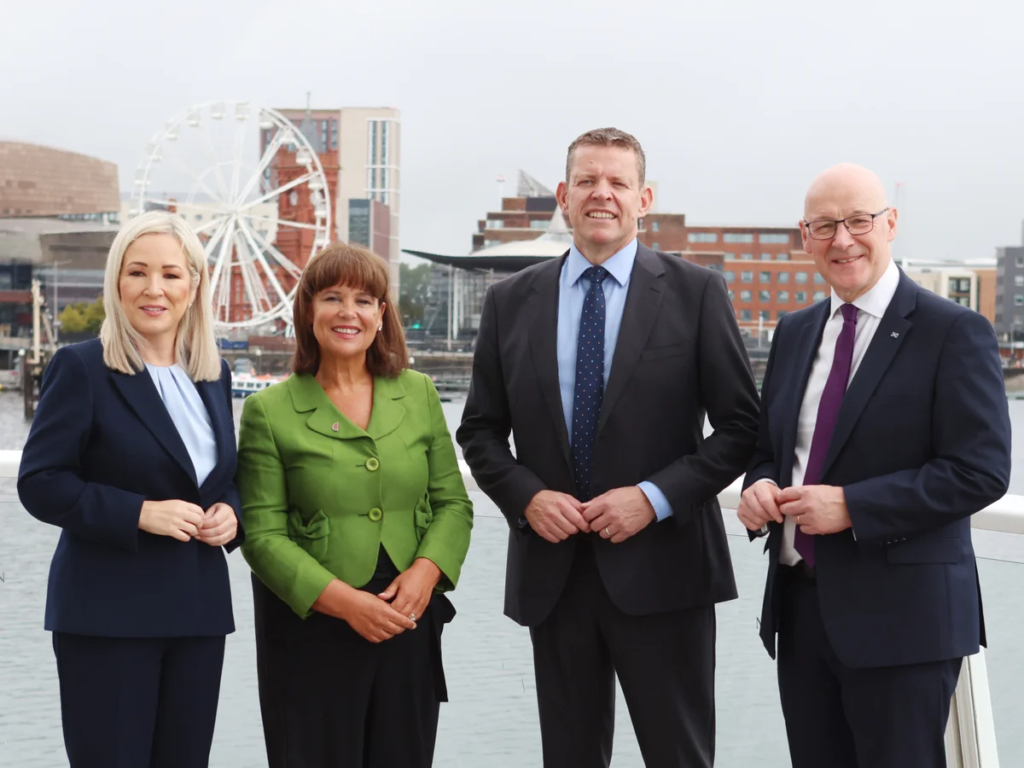
A major new fault line has opened in British politics after the leaders of Scotland, Wales and Northern Ireland joined forces in Cardiff to demand a clearer path toward constitutional change.
SNP leader John Swinney, Plaid Cymru leader Rhun ap Iorwerth and Sinn Féin vice-president Michelle O’Neill signed a joint memorandum calling on the UK government to “prepare for, plan and facilitate constitutional change”. Sinn Féin president Mary Lou McDonald also took part in the meeting.
The declaration said the political landscape across the UK and Ireland was changing and warned that “Westminster’s time is coming to an end”.
The meeting was politically significant because nationalist parties now lead the devolved governments in Scotland, Wales and Northern Ireland, creating an unusual alignment among parties that support greater self-government or independence.
What did the leaders agree in Cardiff?
The memorandum centers on the principle of self-determination.
The signatories argued that no Westminster government should be able to prevent people in Scotland, Wales or Northern Ireland from deciding their constitutional future. They called for the British government to prepare for potential constitutional change rather than attempt to block it.
The document is political rather than legally binding. It does not itself authorize an independence referendum or alter the constitutional status of any part of the UK.
Instead, it is designed to create a common political front among the nationalist movements.
Why is this summit important now?
The Cardiff meeting follows a major shift in Welsh politics.
Plaid Cymru’s rise to power means nationalist parties now control the devolved administrations in Scotland, Wales and Northern Ireland. That gives the independence movement a degree of institutional influence it has not previously enjoyed across all three nations at the same time.
The gathering was also notable because the participants discussed cooperation extending beyond constitutional questions, including areas such as the economy, energy and international relations. Reports ahead of the summit said the leaders were meeting as party leaders rather than formally representing their governments.
What does Scotland want?
Scotland is the territory with the clearest existing history of an independence referendum.
Scottish voters rejected independence in 2014, but the SNP has continued to argue that another vote should be possible, particularly after Brexit and subsequent political developments.
Swinney has recently pressed Prime Minister Andy Burnham to turn what he sees as a democratic principle into a formal legal mechanism for a referendum. Burnham, however, has rejected the SNP’s demand for an agreed route to another vote, while insisting that the government’s position has not fundamentally changed.
That dispute has become one of the main constitutional battles between Edinburgh and London.
What is Wales asking for?
Wales has taken a more cautious approach to outright independence.
Plaid Cymru now leads the Welsh government, but ap Iorwerth has ruled out holding an independence referendum during his first term. His immediate focus has instead included securing greater powers for Wales.
That makes the Welsh position somewhat different from Scotland’s. Plaid Cymru supports Welsh independence as a long-term goal, but the immediate political strategy is centered on expanding devolved powers and strengthening Wales’s autonomy.
The Cardiff summit nevertheless gives Welsh nationalists a larger platform to argue that decisions affecting Wales should be made closer to home.
Why is Northern Ireland different?
Northern Ireland follows a separate constitutional framework because of the 1998 Good Friday Agreement.
Unlike Scotland, Northern Ireland has an established mechanism for a border poll on Irish unity. Under the agreement, a vote can be called when it appears likely that a majority would favor Northern Ireland leaving the UK and joining a united Ireland.
Sinn Féin has made Irish reunification a central objective. McDonald has said she expects a unity poll by 2030, although the timing ultimately depends on the constitutional process and political judgment in Northern Ireland.
The Cardiff pact therefore brings together three independence movements, but they are not pursuing identical legal routes.
What does ‘Westminster’ mean?
“Westminster” is a shorthand term for the UK’s central Parliament and government in London.
Scotland, Wales and Northern Ireland have devolved institutions with powers over areas including health and education, but Westminster retains authority over reserved matters such as defense and foreign affairs and remains central to the UK’s constitutional structure.
For nationalist parties, “Westminster” also represents a system they argue leaves too much political power concentrated in London.
That is why the phrase “Westminster’s time is coming to an end” is about more than one government. It reflects a broader argument that the UK’s current constitutional arrangement is becoming unsustainable.
Where does Andy Burnham stand?
The Labour government has sought to emphasize partnership with the devolved administrations while resisting calls for immediate constitutional referendums.
Burnham has also faced criticism over a series of recent comments on Scotland’s constitutional future. He appeared to suggest that a referendum could become relevant if there were substantial public support, before clarifying that he was not opening the door to a second Scottish independence vote under the current circumstances.
The episode has allowed the SNP to argue that Westminster’s position is becoming harder to maintain, while unionist politicians have accused the government of sending mixed signals.
How does Donald Trump fit into the debate?
The British constitutional debate has also received an unexpected intervention from Washington.
During his visit to Ireland, US President Donald Trump said he would “love” to see a united Ireland. The comments prompted criticism from pro-Union politicians and a reminder from the British government that Northern Ireland’s constitutional future is governed through its established legal and democratic framework.
Trump’s comments do not change the process for a border poll, but they have added an international dimension to a debate that is already politically sensitive.
Does the Cardiff agreement mean the UK is about to break up?
No.
The memorandum is a political declaration, not legislation. It cannot independently trigger an independence referendum in Scotland, Wales or Northern Ireland, and each territory has a different constitutional process.
Scotland would need a legally authorized referendum. Wales has no imminent referendum planned under the current Welsh government’s stated timetable. Northern Ireland’s route toward a border poll is governed by the Good Friday Agreement.
The significance of Cardiff is therefore less about an immediate breakup of the UK and more about the emergence of a coordinated political challenge to the existing Union.
What happens next?
The next phase is likely to center on political pressure rather than an immediate constitutional settlement.
Swinney will continue pushing Westminster on Scotland’s right to hold another independence referendum. Plaid Cymru is likely to pursue further devolution in Wales, while Sinn Féin will continue building support for Irish reunification.
For the UK government, the challenge is to manage three different constitutional pressures without allowing any one dispute to dominate its wider agenda.
The Cardiff summit does not signal the end of the United Kingdom. But it does show how dramatically the constitutional conversation has shifted.
For the first time, the nationalist leadership across Scotland, Wales and Northern Ireland is visibly coordinating its message from a position of governmental power.
And that makes the question of Westminster’s future considerably harder for London to ignore.